<p><!-- BEGIN THEIA POST SLIDER --></p>
<p> <br />
</p>
<div>
<p>Pope Leo XIV will visit Spain from June 6-12, making stops in Madrid, Barcelona, the Canary Islands, and Tenerife. This is the ninth time a pope has visited the country. John Paul II visited Spain five times and Benedict XVI traveled there on three occasions.</p>
<p>During this trip, Pope Leo will take part in 20 official events, with some of the most anticipated moments being a large vigil with young people, an open-air Mass celebrating Corpus Christi, and a procession through the streets of Madrid.</p>
<p>Here are 10 things to know about the Church in Spain, with a special focus on areas the Holy Father will be visiting.</p>
<h2>1. Spain is the country that sends out the most missionaries.</h2>
<p>Spain currently leads the world in sending Catholic missionaries to other countries and is also one of the top financial supporters of the Pontifical Mission Societies. According to the <a href="https://www.omnesmag.com/en/news/spain-country-with-the-most-missionaries/">2024 report</a> of the mission group, Spain has nearly 10,000 missionaries, about 5,000 of whom are active; more than half are women and most serve in the Americas.</p>
<h2>2. Pope John Paul II called Spain <i>Tierra de María </i>(“Mary’s Land”).</h2>
<p>St. John Paul II when he was pope repeatedly referred to Spain as “Mary’s land,” especially during his 1982 and 2003 visits, pointing to the country’s dense network of Marian shrines and devotions. Spain is literally dotted with Marian sanctuaries — from major basilicas to tiny hilltop hermitages — so that almost every region has its own beloved Marian title, feast, and pilgrimage.</p>
<h2>3. Itʼs a place of Christian witnesses and martyrs.</h2>
<p>The Spanish Civil War left one of the largest “<a href="https://www.catholicculture.org/culture/library/view.cfm?recnum=7999">footprints of martyrdom</a>,” according to Spanish historian Monsignor Vicente Carcel Orti, in modern Church history, and it has profoundly shaped Spain’s map of saints and blesseds. During the war and the wider period of persecution, around 6,832 bishops, priests, religious, and nuns were killed for their faith, along with thousands of lay Catholics who risked their lives to protect clergy and religious.</p>
<p>Out of this mass persecution, the Church has gradually recognized a very large number of martyrs: In 2007, the October beatification of 498 martyrs under Benedict XVI was the single-largest beatification ceremony ever held. By the late 2000s, nearly 1,000 martyrs of the Spanish Civil War had been beatified or canonized.</p>
<h2>4. Madridʼs cathedral was consecrated by a pope.</h2>
<p>One of Madridʼs most important Catholic landmarks is the Cathedral of Our Lady of Almudena, which was consecrated by Pope John Paul II in 1993. Such papal consecrations are relatively rare outside Rome, giving the cathedral special significance in Spanish Catholic life. The building remains a focal point for major religious celebrations in the Spanish capital.</p>
<p>Construction of Almudena Cathedral began in 1883 and was not completed until 1993. The century-long project reflects both the enduring importance of Catholicism in Spain and the architectural evolution of the modern era. Today, the cathedral stands across from the Royal Palace of Madrid, symbolizing the historic relationship between church and crown.</p>
<h2>5. Madrid’s Marian patroness was “hidden in the walls.”</h2>
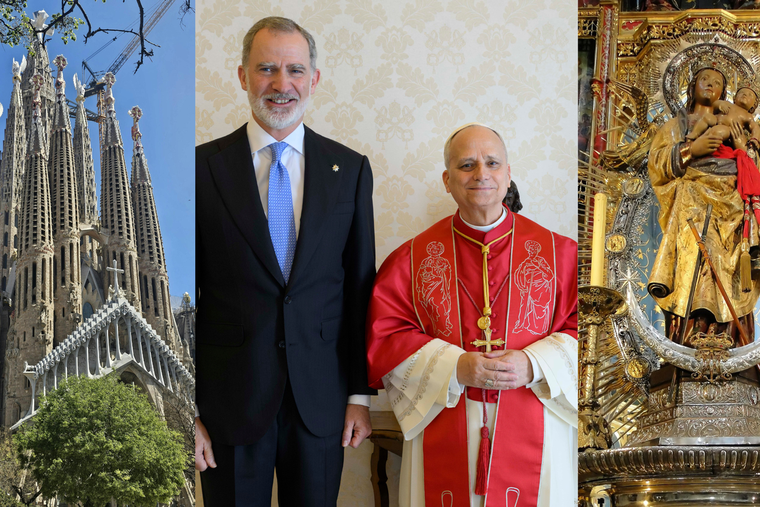
<p>Madridʼs patron saint is the Virgin of Almudena, whose image is linked to a centuries-old tradition dating back to Spainʼs medieval period. According to tradition, as Moorish forces invaded the region in A.D. 712, the citizens of Madrid secretly hid their beloved statue of the Virgin Mary inside the thick stone walls of the cityʼs fortress, leaving two lit candles beside it. In 1085, after King Alfonso VI reconquered Madrid, the Christians searched for the statue. While processing around the city walls, a section of the wall miraculously crumbled, revealing the statue perfectly preserved with the candles still burning after centuries.</p>
<p>That same venerable image will be processed through the Santiago Bernabéu Stadium during the Holy Father’s meeting with the diocesan community of Madrid on June 8.</p>
<h2>6. Spainʼs royal family has strong ties to the Church.</h2>
<p>Spainʼs royal family maintains strong ties to the Catholic Church, and one of the most visible examples came in 2004 when then-Prince Felipe married Letizia Ortiz in Madridʼs Almudena Cathedral. The ceremony highlighted the continued role of Catholic traditions in important national events.</p>
<h2>7. Barcelonaʼs most famous church is a catechesis in stone.</h2>
<p>The Basilica of the Sagrada Família is more than just an architectural masterpiece — it was built to be a tool of evangelization. Its founders envisioned a church that would communicate the Christian faith through art, symbolism, and architecture, making it one of the worldʼs most distinctive expressions of the Catholic faith.</p>
<p>Visitors to the Sagrada Família encounter a visual retelling of Christianityʼs central story. The basilicaʼs major façades depict the Nativity, the Passion, and the glory of Christ — which is dedicated to the glory, ascension, and eternal life of God.</p>
<p>The Sagrada Família has become the tallest church building in the world at 566 feet. Despite its immense scale, the basilica was designed to direct attention toward God rather than human achievement.</p>
<p>The famous basilica was originally designed by Francisco de Paula del Villar in 1882. However, Catalan architect Antoni Gaudí took over the project in 1883 and completely transformed the design into a blend of Gothic and Art Nouveau styles, overseeing its construction until his death in 1926. After his passing, several other architects have continued his work with the goal of fulfilling his original vision.</p>
<p>Gaudí deliberately planned the Sagrada Família so that it would remain slightly shorter than Barcelonaʼs nearby Montjuïc hill, because he believed no human work should surpass Godʼs creation.</p>
<h2>8. The architect of Sagrada Família may one day be a saint.</h2>
<p>Antoni Gaudí was known for his intense personal faith and devotion to the building of the Sagrada Família. The Vatican announced April 14, 2025, that Pope Francis had formally recognized Gaudí’s “heroic virtue,” a key step in the canonization process. Two miracles attributed to Gaudí’s intercession are now required for his canonization.</p>
<h2>9. Tenerifeʼs great Marian shrine is the Canary Islands&#8217; most important pilgrimage site.</h2>
<p>The Basilica of Our Lady of Candelaria in Tenerife is the most important Catholic pilgrimage site in the Canary Islands. For generations, it has served as the spiritual heart of the archipelago and remains a major destination for pilgrims and visitors, drawing roughly 2 million visitors a year.</p>
<p>The basilica is dedicated to the patron saint of the Canary Islands — the Virgin of Candelaria. Tradition holds that the image of the Virgin of Candelaria was venerated by the Indigenous Guanche people before Spain completed its conquest of Tenerife. The Virgin of Candelaria is often associated with the tradition of Black Madonnas — dark-skinned images of Mary that are venerated in various parts of the world.</p>
<h2>10. The Canary Islands were an early Catholic outpost.</h2>
<p>The Canary Islands are divided into two Catholic dioceses: one centered in Las Palmas and the other in San Cristóbal de La Laguna on Tenerife. These were established in the early 15th century, decades before the evangelization of much of the Americas. This made the islands an important frontier of Catholic expansion during a pivotal period in world history.</p>
<p>Because of their strategic location in the Atlantic, the Canary Islands became a key stopping point for explorers, missionaries, and settlers traveling between Europe and the Americas. As a result, the islands played a notable role in the spread of Catholicism across the New World.</p>
</p></div>
<p><br />
<br /><a href="https://www.ncregister.com/cna/10-things-to-know-about-church-in-spain">Source link </a></p>
<p><!-- END THEIA POST SLIDER --></p>

10 Things to Know About the Catholic Church in Spain Ahead of Pope Leo XIV’s Visit| National Catholic Register