<p><!-- BEGIN THEIA POST SLIDER --></p>
<p> <br />
</p>
<div>
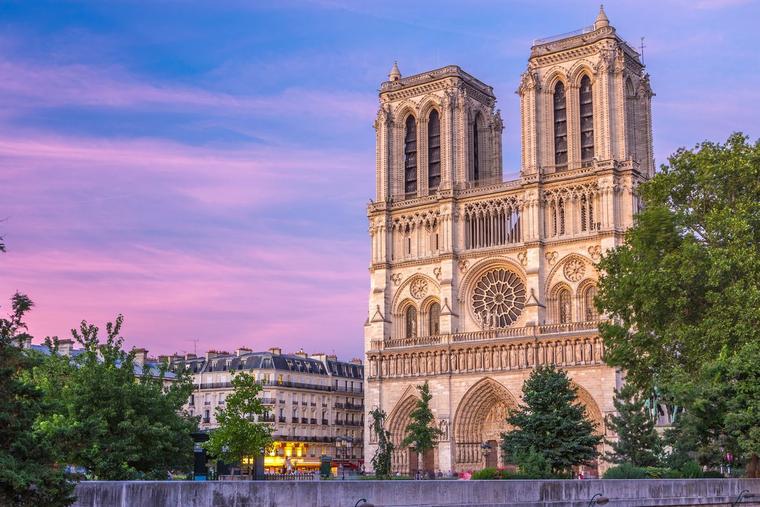
<p>This medieval Gothic jewel — which, until its closure, was France’s most visited site, with some 13 million visitors a year, far ahead of the Eiffel Tower — is inextricably linked to the grand and epic history of France and to the soul of its people.</p>
</p></div>
<div>
<p>Notre-Dame de Paris is about to open its doors to visitors again on Dec. 8, the Solemnity of the Immaculate Conception. It’s been five years since the terrible fire that ravaged its roof, roof frame and spire, causing shock throughout the world, far beyond the Catholic faithful. </p>
<p>This medieval Gothic jewel — which, until its closure, was France’s most visited site, with some 13 million visitors a year, far ahead of the Eiffel Tower — is inextricably linked to the grand and epic history of France and to the soul of its people. </p>
<p>Nearly everything has been said and written about Notre-Dame, but many visitors, Catholics included, miss out on its special essence. Its curiosities and the highlights of the eight centuries of history it has witnessed include the depositing of the Holy Crown of Thorns by King St. Louis in 1239, the French Revolution and the Second World War, plus the 2019 fire. Here are facts that are often little-known, but which make it distinct. </p>
<p><b>1. Notre-Dame is built on four churches, with a choir in the shape of Christ’s sagging head</b>. The largest building in Europe in the 12th century (with a surface area of 64,000 square feet), erected on the Ile de la Cité on the initiative of Bishop Maurice de Sully of Paris in 1163, the cathedral is said to have been built on the ruins of four previous churches, the first dating from the fourth century in early Christian style. It was followed in turn by Merovingian, Carolingian and Romanesque buildings, a few parts of which were preserved when the present Gothic cathedral was built. Like most of France’s cathedrals, Notre-Dame was constructed on a Latin cross plan, but its choir is slightly offset from the central nave to the left, forming the slumped head of Christ Crucified.</p>
<p><b>2. The architecture is meant to reflect the “Golden Ratio.” </b>The perfect harmony and refinement of Notre-Dame’s Gothic architecture cannot escape the most casual observer. But few realize that the aesthetic perfection of the monument is the result of a sophisticated mathematical rule, that of the Golden Ratio, or “sacred geometry,” often applied by medieval cathedral builders, as well as those of ancient times, with masterpieces such as the Parthenon. For a building to achieve this, the ratio between the height of the facade and its width must be as close as possible to the number Phi (around 1.618). With a ratio of around 1.725, the facade of Notre-Dame is considered to form a “golden rectangle.” </p>
<p><b>3. Does the cathedral possess a gate shaped by the devil? It’s one of the most persistent legends surrounding Notre-Dame.</b> In fact, how can one explain the astonishing perfection of the ironwork on the main portal of this Gothic monument? As a <a href="https://passerelles.essentiels.bnf.fr/fr/chronologie/construction/5528aa47-6ab5-48d1-92fb-46ca5144731b-cathedrale-notre-dame-paris/article/18a9dbc6-8550-4f06-8df8-3c39206e3a9a-un-ferronnier-diabolique">publication</a> from the Bibliothèque nationale de France points out, the welds on the fittings are “so numerous and so well executed that it is impossible to determine their number,” and for a time, it was even suggested that the iron was cast rather than wrought. This led to the popular rumor that the locksmith known as Biscornet had traded his soul to the devil in order to achieve this technical exploit within the allotted time. According to this legend, the devil’s intervention in the plans for the church dedicated to the Virgin Mary, although confined to its portal, had the effect of blocking its opening when it was inaugurated around 1345. Legend also has it that the gate had to be sprinkled with a heavy dose of holy water to overcome the lock’s resistance. As for Biscornet, he is said to have mysteriously disappeared after the inauguration. It wasn’t until the 19th century that a craftsman, Pierre Boulanger, succeeded in reproducing the technique used by the medieval ironworker, after 12 years of hard work on some 500kg (more than 1,100 pounds) of iron.</p>
<p><b>4. The cathedral was the site of the legislature in French history. </b>In 1302, the vaults of the cathedral, whose construction was not quite complete, played host to a most secular of events: King Philip the Fair, then in conflict with Pope Boniface VIII over questions of tax and resource management between Rome and France, convened the representatives of the three orders of the Kingdom of France — the nobility, the clergy and the Third Estate — to form the very first Estates-General, a sort of parliament. Philip the Fair then asked them to recognize his supremacy over the Pope in temporal matters, thus prefiguring France’s move toward secularism. </p>
<p><b>5. Notre-Dame is the point of origin for all roads in France.</b> While a famous medieval proverb asserts, “All roads lead to Rome,” because Emperor Augustus made it point zero of the Roman Empire’s roads, it is indeed to Notre-Dame that all roads in France have converged for almost three centuries. In fact, it was King Louis XV who, by issuing letters of patent in 1769, made it the epicenter of all the country’s roads. However, it wasn’t until 1924 that this point, from which mileage distances between towns are calculated, was materialized by decision of the town’s administration. The slab, in the shape of a compass rose, can still be seen on the cathedral forecourt. </p>
<p><b>6. Notre-Dame was transformed into a “Temple of Reason” during the French Revolution.</b> During the Reign of Terror, a particularly dark page in French history when the Revolution reached its height, the murderous violence of its proponents was unleashed throughout the country and did not spare members of the clergy. Most places of worship were destroyed, ransacked or confiscated by the Paris Commune. Notre-Dame was transformed into a <a href="https://en.wikipedia.org/wiki/Temple_of_Reason">Temple of Reason</a>, for the cult of the Supreme Being. Plundered, vandalized and forgotten, the cathedral later became a warehouse for wine barrels, before finally being returned to worship in 1802. Napoleon’s coronation in 1804 marked the first stage in its rehabilitation, as the emperor commissioned restoration work for the event. But it was Victor Hugo and his landmark novel <i>Notre-Dame de Paris</i> in 1831 that definitively brought the church back from the brink of oblivion, consecrated its international glory and gave rise to the vast restoration project led by Eugène Viollet-le-Duc from 1843.</p>
<p><b>7. The cathedral was the site of the conversion of celebrated poet Paul Claudel. </b>It is one of the most famous conversions in modern French history. The legendary poet and writer Paul Claudel (1868-1955), agnostic for the first part of his life and known for his taciturn temperament, had a sudden and powerful encounter with God while listening to Christmas vespers on Dec. 25, 1886. He was just 18 years old. “I was standing in the crowd, near the second pillar at the entrance to the choir on the right-hand side of the sacristy. And then came the event that dominates my whole life,” he <a href="https://societe.paul-claudel.net/homme/foi/">remembered</a> in <i>Oeuvres en prose. </i>“In an instant my heart was touched and I believed. I believed, with such a force of adhesion, with such an uprising of my whole being, with such a powerful conviction, with such a certainty leaving no room for any kind of doubt, that, since then, all the books, all the reasoning, all the hazards of a troubled life, have not been able to shake my faith, nor, to tell the truth, touch it.” </p>
<p><b>8. The cathedral stood as the symbol of the liberation of Paris at the end of World War II. </b>It is an event that remains indelibly etched in France’s memory. The day after the German occupation troops surrendered on Aug. 25, 1944, Gen. Charles de Gaulle entered the liberated capital, marching along the Champs-Elysées surrounded by jubilant crowds, and headed straight for the forecourt of the famous cathedral, whose bells were ringing out, announcing the liberation. Despite a failed attempt on his life on arrival, the general was able to join the cathedral choir in singing the <i>Magnificat</i>, as he himself recounted in his <i>Mémoires de Guerre</i>: “The<i> Magnificat </i>rose. Was ever a more ardent one sung?” A <i>Te Deum </i>was also celebrated in the cathedral on May 9, 1945, in the presence of representatives of the Allied forces, to celebrate their final victory over Nazi Germany.</p>
</p></div>
<p><br />
<br /><a href="https://www.ncregister.com/news/8-little-known-facts-about-notre-dame-cathedral">Source link </a></p>
<p><!-- END THEIA POST SLIDER --></p>

8 Little-Known Facts About Notre Dame Cathedral| National Catholic Register