


In the hands of this Maronite scholar, the humble bean became not only a beverage but a witness to divine Providence.
The goats simply refused to sleep. Their shepherd, annoyed by the animals that had been jumping and dancing all night, went to complain to the monks at a nearby monastery in the kingdom of Ayaman, Arabia Felix — which corresponds to present-day Yemen.
The prior, “driven by curiosity,” went to the hillside where the herd had been grazing, found a small bush laden with berries there, and, “after boiling them in water, immediately realized that this drink helped keep one awake at night.”
The monks then “ordered that it be used daily during night vigils, so that they might be more alert for the night services and prayers.”
This is the story that countless café chalkboards recount today in one form or another, usually featuring a goat herder named Kaldi. This name is a later addition, absent from the oldest written version of the tale, which first appeared in Rome in 1671, penned by a Maronite Catholic priest of Lebanese origin.
Father Antonio Fausto Naironi taught Syriac at Rome’s Sapienza and was nephew to the great Orientalist Abraham Ecchellensis. His De saluberrima potione cahue, seu cafe nuncupata discursus — a discourse on “the most salubrious drink called cahue or coffee” — was the first book printed in the West devoted entirely to the beverage. In publishing it, as he himself stated, “for the public good” and “the preservation of health,” Father Naironi indicated on the title page that it was a medical treatise addressed to the Roman authorities, presenting to European readers the knowledge of a learned son of the East on a subject about which they knew nothing. He thus placed his work under the patronage of Cardinal Giovanni Nicola de’ Conti, a central figure at the time.
Father Naironi wrote as a scholar, a witness to his time, and a bridge between cultures, teaching his readers the most appropriate ways to enjoy coffee. He recorded the Arabic name for the bean, bunn, distinguished between a lighter roast and a darker, oilier one that he considered “superior,” and warned against burning the beans, which should be heated over the fire only until they turned a brownish-purple color. The preparation of the beverage itself must have sounded exotic to readers of the time: The powder was to be poured into boiling water in a pewter vessel, allowed to simmer briefly, and then drunk hot after letting the sediment settle.
He emphasized the moderation of the Easterners, who “were not in the habit of taking it on an empty stomach, for they say that doing so stimulates the yellow bile” — one of the four bodily humors associated, from antiquity and throughout the Middle Ages, with anger and irritability — and would eat a little fruit or bread before their morning cup. The drink’s benefit, he added in accordance with the physicians of his time, lay not in how much one took but in how good it was, for in medicine “it is not the quantity but the quality” that matters.
Behind these practical details lay a theological conviction that God uses nature to enlighten human reason. Father Naironi discusses coffee from the perspective of Providence, based on the belief that God reveals to humans the “unknown virtues of things,” sometimes instructing “rational beings” through “irrational beings.” He recalls that the deer revealed the herb known as “dittany” for removing arrows from a wound; the swallow taught the use of celandine. Coffee belongs to the same order of grace, as hyperactive goats revealed the virtues of the coffee bean. This was “a testimony of fortuitous experience,” disseminated “by the marvelous providence of God” across the kingdoms of the East until it reached, in his own words, “the shores of Europe.”
The monks in his account also reveal a typical approach of Christianity and its universalism throughout history — one that consists of “baptizing” traditions and foods that do not originate directly from its own ranks.
Father Naironi identifies the first regular devotees of the beverage as monks named Sciadli and Aidrus, figures widely associated in Eastern tradition with Sufi sheikhs linked to early coffee use. By framing the discovery within a Christian monastic setting of nocturnal prayer, Father Naironi made a beverage with roots in the Islamic world understandable and respectable to a Christian Europe that viewed it with suspicion as “the wine of the Turks.”
Legend has it that Pope Clement VIII himself had previously “baptized” coffee, refusing to condemn this Ottoman beverage after tasting it and finding it too delicious to leave it to the nonbelievers.
But it was Father Naironi himself who truly legitimized this beverage, and his work has gone down in history. Within a single generation, coffee had established itself in the sociocultural landscape of Venice and Rome. Italy has embraced this beverage so fully that the whole world now orders its espresso and cappuccino in Italian.
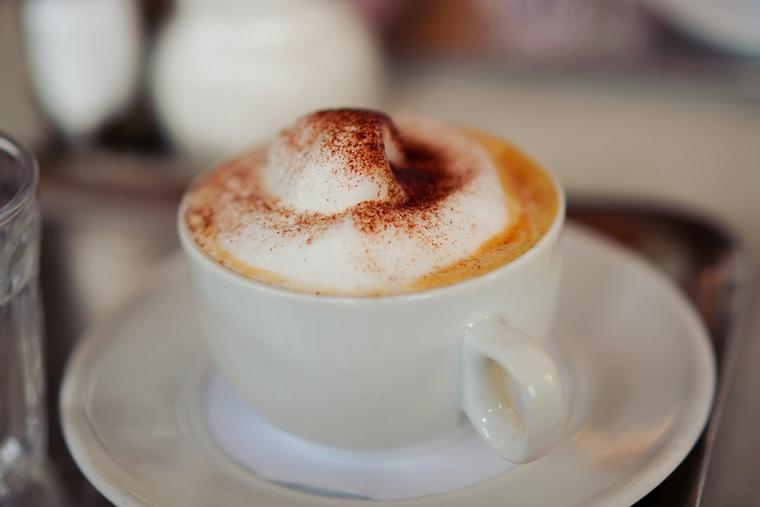
The cappuccino itself carries a Catholic memory, named for the brown habit of the Capuchin friars and bound by tradition to Marco d’Aviano, the preacher whose rallying of Christian forces is credited with lifting the Ottoman siege of Vienna in 1683, and to whom legend also gives the crescent pastry born of that deliverance, the croissant.
And so coffee found its way onto the Christian table, alongside fine wines and monastic liqueurs. As Father Naironi reflected, it is one of those discoveries through which “the wonderful God, burning with the highest love for us,” reveals his care. In the hands of this Maronite scholar, the humble bean became not only a beverage but a witness to divine Providence.