


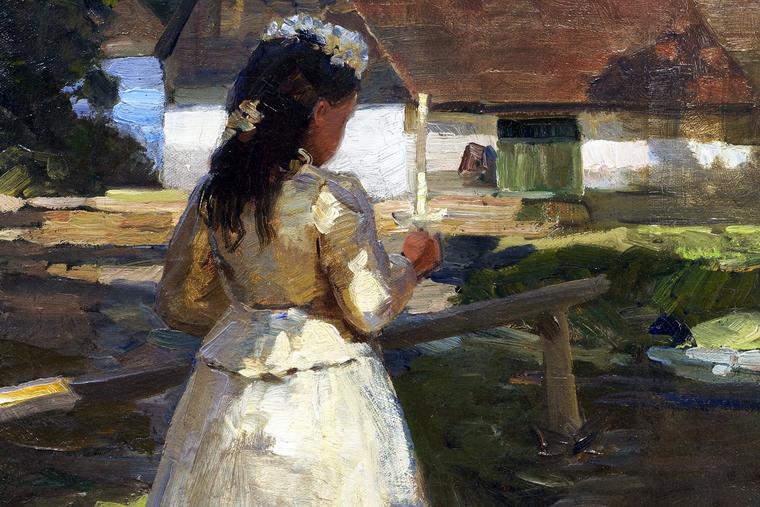
I hope the purpose of your life becomes this: to love and serve the God who created you and died for you — by being his love in the world.
With the blessing of your mother, we’re embarking on a Catholic home study program as you start first grade. I pray that in a few years it will culminate with your confirmation in the Catholic Church. I’m writing this letter to you now, hoping to give it to you then.
You are my darling, beautiful, beloved granddaughter, and I love you “more than tongue can tell,” as my grandmother used to say.
I hope for you what most grandmothers would want for their grandchildren: a life filled with joy and peace. But more than that, I wish for you a life filled with purpose and meaning. Like most grandmothers, I know that along with the joy and peace I hope you enjoy, there will be challenges. There will be times when you wonder why there’s suffering, and what’s the meaning of life — of your life. Because life is complicated. It’s hard to figure out sometimes. And sometimes it’s just plain hard. That’s where purpose and meaning come in.
One of my favorite writers, Peggy Noonan, talked about this in a book she wrote about Pope John Paul II. She thinks that questions about the meaning and purpose of life are, as she writes, “a kind of preparation for God, a necessary preamble he wants to write on your heart. The moment you ask them, your freedom has been set in motion. You become more sharply aware that there are choices. This, in a way, is the beginning of morality because there is no morality without freedom. Only in freedom can you turn toward what is good.” And what is good is God.
In a novel I recently read, one character told a young girl that everyone needs a code to live by. Now strictly speaking, that isn’t true. No one needs a code to live by, but most people have one, even if they don’t realize it. Most people have a kind of mental checklist of things they would or wouldn’t do, a catalog of rights and wrongs. Most of us start to compile such lists inadvertently from the time we’re very young. We’re admonished to share with other children and not to hit them. Teachers tell us not to lie or cheat. Parents encourage us to work and study hard.
As we get older, it often gets harder to know what’s right or wrong. We become more aware of what other people think and do. It’s easy to follow along and do things just because others are doing them. It’s especially tempting as you become a teenager to follow the crowd, to do what “everyone” is doing.
I hope that the code you choose to live by isn’t one that you make up as you go along or adopt from the world. What I most deeply wish for you is that you follow the code that comes from the one who made the world, and who therefore knows how best to live in it.
The world may say otherwise, but there is such a thing as right and wrong. And the best way to know which is which is to live by the code of Catholic Christianity. That’s the one that will cover you in every situation, guide you in every confusing moment, and offer you peace in every difficult circumstance. Going to Mass on Sundays and holy days of obligation, going to confession, following the Church’s teachings on sex and marriage, all those things will orient you toward God. The rules the Church lays out aren’t intended as a burden, but as a roadmap to true happiness.
You’ll also be guided by your conscience, a gift God has given each of us. It’s almost like a voice or feeling deep within us that knows the difference between right and wrong. Pay attention to it. If you feel that something you’re about to do is wrong, that’s your conscience guiding you not to do it. When you feel good because you’ve done the right thing, that’s your conscience, too.
Speaking of conscience, one thing you’ll have learned along the way to being received into the Church is about the sacrament of penance. You examine your conscience, trying to remember what you’ve done wrong, to prepare for going to confession. When I became a Catholic very late in life (having been raised a Protestant), it was one of my favorite things about the Church. How amazing it is that we can have our sins washed away by confessing them to a priest! It may feel uncomfortable and awkward in the moment, but it’s freeing, too.
But being a Christian isn’t only about trying to do the right thing and avoid doing the wrong thing. We’re supposed to go beyond just being morally good or ethical. We’re supposed to be holy. Jesus tells us to love our enemies and pray for those who persecute us. How is that possible? How could anyone do that? Acting on our own, we can’t. But with God, nothing is impossible. At baptism and confirmation, we receive the gifts of the Holy Spirit. When we receive Communion, we are consuming Christ in a mystical way we cannot understand. He enters into us through the Eucharist. God gives us his love, his strength, his patience, his kindness and his forbearance. That is how we love our loved ones, even when we’re angry and upset and hurt. That’s how we love our enemies. By giving them God’s love. One priest I know encourages his parishioners “to become what we consume” in the Eucharist.
One of the most beautiful prayers I’ve ever come across is from a novena to St. Julian of Norwich: “Pray for me that I may so love God, all those I encounter today, and myself, that nothing will prevent God’s love from flowing through me to the whole of creation.”
Help those who need help. Not only by feeding the poor and needy, as important as that is, but by giving comfort to those closest to you: your family and friends, people you interact with every day.
Simply put, I hope the purpose of your life becomes this: to love and serve the God who created you and died for you — by being his love in the world.