<p><!-- BEGIN THEIA POST SLIDER --></p>
<p> <br />
</p>
<div>
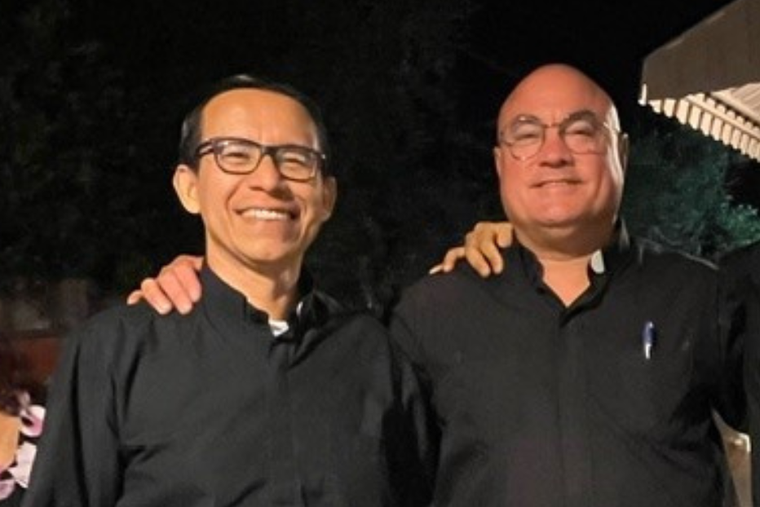
<p>REDWOOD CITY, Calif. — Only nine months ago, Father Edgardo Rodriguez, a Salvadoran priest beloved in his California parish, was on a clear path to securing permanent residency in the United States.</p>
<p>He expected to live out his vocation in the Archdiocese of San Francisco, where he had served since 2018 and applied for incardination with the support of Archbishop Salvatore Cordileone.</p>
<p>Instead, to the shock of Father Rodriguez, his parish community and the archdiocese, the priest was notified by U.S. immigration authorities last April that he would have to return to his home country for one year and apply for reentry, restarting the entire process for securing a lawful permanent residency card, commonly called the green card. </p>
<p>“We lost a great priest,” said Father Thomas Martin, the pastor of St. Pius Church and administrator of St. Anthony Church in Redwood City, California, where Father Rodriguez ministered to a large community of Hispanic Catholics and “cared for the poor and marginalized.” </p>
<p>Father Rodriguez is not alone. A U.S. visa rule change that was finalized in April has disrupted what was once a seamless and predictable process for priests like Father Rodriguez. Instead of obtaining a green card in a timely manner, thousands of religious workers, including Catholic priests seeking permanent residency in the United States, now face a sudden — and lengthy — backlog of visa applicants that prevents them from obtaining a green card before their initial visa expires. </p>
<p>Thus far, the visa rule change has received scant attention in Church circles or Catholic media, and many foreign-born priests who had expected to obtain a green card in the next couple of years are still unaware of the looming roadblock.</p>
<p>But the stakes are high for international priests who hope to minister in this country — and for the many U.S. dioceses that depend on them to fill as much as 50% of parish placements. </p>
<p>“The impact of this change is just beginning to be felt,” Archbishop Joseph Naumann of Kansas City, Kansas, told the Register, expressing both disappointment and puzzlement at the government’s reasons for making the change. </p>
<p>“We are getting no reassurance from federal agencies” that this can be fixed, said Archbishop Naumann, though “the federal branch that created the problem could resolve it.”</p>
<p>Father Joel Henson, the Archdiocese of Los Angeles’ vicar for clergy, told the Register that two international priests have already returned to their home country after it became clear that they could not obtain a green card before their initial visa expired. Deacons now administer those parishes and recruit local priests to provide the sacraments.</p>
<p>Father Henson reported that 50% of priests in the archdiocese, the largest in the nation, are foreign born. Many have already obtained permanent residency or U.S. citizenship. But 10% of the priests hold a temporary R-1 immigrant religious worker visa capped at five years, and Father Henson could not say how many priests in this group hoped to remain permanently in the U.S. and so could face similar difficulties.</p>
<p> </p>
<p><b>Rule Change</b></p>
<p>Until April, an international priest’s path to a green card was straightforward and generally granted once the newcomer was approved for incardination by the local bishop.</p>
<p>The process for most international priests still begins with an R-1 nonimmigrant religious worker visa. Once the applicant has successfully served in a parish or other assignment for a couple of years, the diocese sponsors the priest for permanent residency, generally through an EB-4 (employment-based) special immigrant category, which allots 10,000 visas per year. </p>
<p>Until this year, applicants in the special immigrant category, which also includes juvenile immigrants and former employees of federal agencies abroad, “never faced a backlog,” said Miguel Naranjo, director of the Religious Immigration Services section of the <a href="https://www.cliniclegal.org/about-us">Catholic Legal Immigration Network</a>, Inc. (CLINIC), which works with U.S. dioceses and religious communities to bring foreign-born church workers and seminarians into the U.S. </p>
<p>Then, earlier this year, “the State Department and Homeland Security announced in the federal register that there had been a misapplication or a misinterpretation of the law in the way the government had calculated the number [of applicants who could apply for a visa from this category].”</p>
<p>The ballooning immigration crisis at the southern border of the U.S. provided the context for the shift in federal immigration policy. </p>
<p>“A large number of juveniles have come across the border and applied to that special immigrant category,” explained Naranjo, and the government put limits on applicants from El Salvador, Guatemala and Honduras. </p>
<p>The government now argues that its past treatment of this class of applicants was a mistake that must be addressed by increasing the number applying from the three Central American countries to make up for the past restrictions. </p>
<p>Naranjo estimated that the resulting backlog for other applicants in this category will be lengthy.</p>
<p>“It will be five, seven or even 10 years before a religious worker or anyone else in the special immigrant category will be able to obtain permanent resident status,” he said.</p>
<p>He described the decision as “a lightning bolt that came out of nowhere.”</p>
<p> </p>
<h3><b>Seeking Solutions</b></h3>
<p>Naranjo’s organization has joined with the U.S. Conference of Catholic Bishops and other religious leaders of all faiths to advocate for a resolution.</p>
<p>If the new rule cannot be rescinded, the USCCB and other U.S. faith leaders have proposed that the one-year delay before religious workers can reapply for a new R-1 nonimmigrant religious worker visa be reduced to six months or even 90 days. A shorter period outside the country, they say, would limit the costs to the applicant and the disruption to pastoral placements in the U.S.</p>
<p>“That one-year period is really problematic for dioceses and other Catholic institutions that are employing these religious workers,” David Spicer, senior policy advisor for migration and refugee services at the USCCB, told the Register. “Having a priest away from his parish for a year isn’t sustainable.” </p>
<p>Spicer noted that the rule change could also affect Catholic schools and nursing homes staffed by foreign-born men and women religious, as well as pastoral programs that depend on well-formed lay immigrants who share the language and culture of newly arrived Catholics. </p>
<p>Experts advising religious leaders are also exploring other visa program options for international religious workers.</p>
<p>Randy McGrorty, the CEO for Catholic Legal Services in the Archdiocese of Miami, told the Register that his office typically handles applications for 12 church workers per year, and it is now exploring a visa program facilitated by institutions of higher education, though he was not prepared to provide details at this time.</p>
<p>Another possibility is the H-1B visa program, which is designed for applicants who wish to perform services in a specialty occupation, like computer science. But this program features significant costs and other burdensome conditions that make it less appealing for most religious employers.</p>
<p> </p>
<h3><b>Stakes Are High</b></h3>
<p>Religious leaders of all faiths have also asked members of Congress for help, but that polarized legislative body has been slow to address immigration issues, and there is little hope it will act quickly now.</p>
<p>Indeed, over many decades, the U.S. bishops have been at the forefront of the campaign for immigration reform, while urging the faithful to welcome asylum-seekers who arrive in this country.</p>
<p>Now, as U.S. states and cities struggle to feed and house an unprecedented surge of undocumented migrants, local dioceses have also become entangled in the nation’s broken immigration system in an unexpected way.</p>
<p>The government is “struggling to deal with the volume of people coming into the country,” said Archbishop Nauman, and “one of the consequences” of that escalating crisis is the visa rule change for religious workers.</p>
<p>Asked to assess the impact of this change in his archdiocese, Archbishop Naumann predicted that over the next five years, at least “six priests and 13 religious will have to leave the U.S. for a year before reapplying for another R-1 visa.” </p>
<p>Obtaining the new visa will allow them to return to the U.S. for another five years. But it will not get them any closer to securing permanent residency, unless and until the backlog in the special immigrant category is cleared up. </p>
<p>“This prevents us from having foreign-born priests long term,” he said. “In many ways, it takes five years before they hit their stride.”</p>
<p>The archbishop is also concerned about the impact of the backlog on priests and religious who already have green card applications pending. </p>
<p>Though their paperwork has been finalized, the backlog will likely prevent them from receiving their EB-4 immigrant visa for as long as a decade. And that delay will effectively bar them from leaving the country to visit family back home during this period, he noted. If they travel without a green card, they could jeopardize their application for permanent residency. </p>
<p><b> </b></p>
<h3><b>‘This Affects Everyone’</b></h3>
<p>Given the challenges ahead, Archbishop Naumann is worried about the broader impact of visa problems on the Church in the U.S., which has depended on immigrant priests, religious and lay ministers to advance its mission since its infancy.</p>
<p>At the same time, he also expressed gratitude for the foreign-born priests and religious women in the archdiocese and singled out a group of Indian women religious who staff a Catholic nursing facility.</p>
<p>“It is a grace,” he said, “to have excellent nurses who also bring a faith dimension to their work.” </p>
<p>Pallottine Father Frank Donio, executive director of the Conference of Major Superiors of Men, echoed the archbishop’s remarks as he emphasized the international origins and character of the Church in the United States.</p>
<p>“Many Catholic religious communities came here from Ireland, France, Poland, Italy, Germany and Spain to serve European immigrants, while we have always had priests from Latin America,” said Father Donio. “Now, there are priests from Asia and Africa. The reality of priests and brothers coming to this country to serve the needs of the people is part of the past and the present.”</p>
<p>With that history in mind, he stressed that the U.S. visa rule change will force international religious orders to rethink pastoral placements and other staffing responsibilities in this country.</p>
<p>“This affects everyone,” said Father Donio. “That is why we are working together with the USCCB, the Leadership Conference of Women Religious and other religious communities” to find a resolution. </p>
<p>For now, however, Church leaders, chancery officials and legal experts contacted by the Register could offer no immediate hope for a solution. But they suggested that religious orders might have more wiggle room to address staffing problems, while dioceses would have to get more creative and flexible.</p>
<p>And back in Redwood City, Father Thomas Martin is keeping a spot open for Father Rodriguez. </p>
<p>“He will return here,” said Father Martin, with confidence. “He has the permission of his archbishop [in El Salvador] to excardinate. We speak every two weeks.” </p>
</p></div>
<p><br />
<br /><a href="https://www.ncregister.com/news/a-lightning-bolt-visa-rule-change-upends-placements-for-foreign-born-priests">Source link </a></p>
<p><!-- END THEIA POST SLIDER --></p>

‘A Lightning Bolt’ — Visa Rule Change Upends Placements for Foreign-Born Priests| National Catholic Register