<p><!-- BEGIN THEIA POST SLIDER --></p>
<p> <br />
</p>
<div>
<p>BOOK PICK: Concise and easy to read, Father Aidan Nichols’ latest book gives an excellent overview of 16 giants of the early Church, with topics of thought ranging from Scripture to volcanoes.</p>
</p></div>
<div>
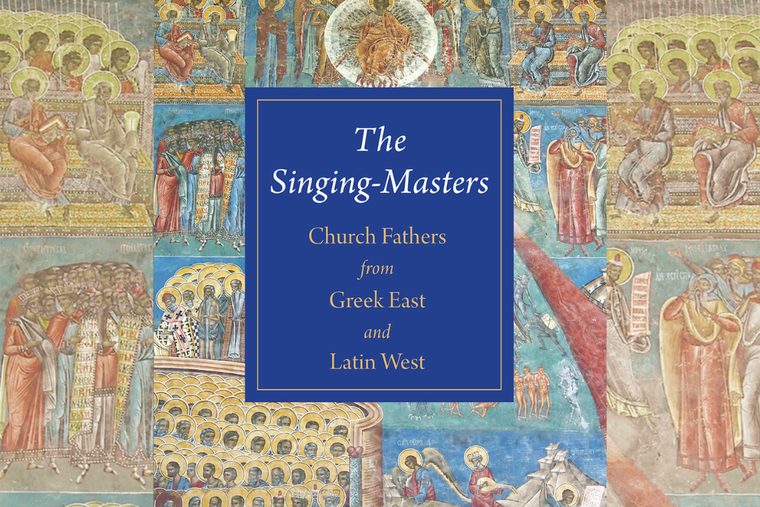
<p><b>The Singing Masters</b></p>
<p><b>Church Fathers From Greek East and Latin West</b></p>
<p>By Father <a href="https://ignatius.com/authors/fr-aidan-nichols-o-p/">Aidan Nichols, OP</a></p>
<p>Ignatius, 2023</p>
<p>$19.95, 343 pages</p>
<p><i>To order: </i><a href="https://ignatius.com/the-singing-masters-smp/"><i>ignatius.com</i></a></p>
<p>Dominican Father Aidan Nichols puts “scholarly” in the phrase “scholarly Dominican” as few others of his order today. The author of more than 45 books on Scripture, Church history and Catholic theology, he offers a handy introduction to patristics with his latest from Ignatius Press: <a href="https://ignatius.com/the-singing-masters-smp/"><i>The Singing Masters: Church Fathers From Greek East and Latin West.</i></a></p>
<p>Arranged in the form of 16 “vignettes” that treat eight Eastern and eight Western fathers, Father Nichols has “selected for treatment those patristic figures who have the best claim to the attention of modern theology students, or who were in other ways the most influential in Church tradition.”</p>
<p>The focus is patristic theology rather than spirituality. Monastic figures like Cassian or Benedict don’t feature, but rather “those figures who had contributed most effectively to the contemporary and subsequent doctrinal consciousness of the Church,” as Father Nichols noted in <a href="https://www.catholicworldreport.com/2023/01/18/listening-to-the-church-fathers-an-interview-with-fr-aidan-nichols-o-p/">an interview</a> on this book. These are the Fathers who would be most influential for dogmatic theology, which “explores the heartland of divine revelation: the saving outreach of the Father through his consubstantial Son, humanized as Jesus Christ, who by their common Spirit enters into our lives through the instrumentality of the Church.”</p>
<p>One of the main reasons the Fathers remain so important today is their proximity to the apostolic teaching and the age of inspired revelation. Handing on as well as developing what they received from the apostles, the Fathers represent the first generations of the Church’s post-apostolic teaching gift. Their teaching is often as relevant today as it was in their own time.</p>
<p>For example, St. Irenaeus, the “witness against the Gnostics,” whose battle with Gnosticism is reminiscent of the postmodern and New Age movements, claims that “the physical sciences have superseded the metaphysics of the common man.” Famous for formulating the concept of the “rule of faith” in his work <i>Against Heresies,</i> he shows that we move from the truths of the faith that are more clearly known to lesser-known truths. He teaches that faith is based on truth rather than contrary to it, and that one can determine right doctrine by discovering what has been believed always, everywhere, and by everyone in the Church (a formula made more famous by <a href="https://www.ncregister.com/blog/st-vincent-of-lerins-and-doctrinal-development">St. Vincent of Lérins</a>).</p>
<p>In the words of Irenaeus, tradition is a “deposit of great price” and it “rejuvenates the very vessel that contains it,” namely, the Church and the Christian soul. Irenaeus reminds us that a Church that holds fast to the tradition of the faith will be rejuvenated and kept eternally young by those same beliefs. </p>
<p>Each chapter opens with a brief biographical sketch, followed by an examination of the main works or themes in that particular Father’s writings or life work. Throughout the book, Father Nichols touches on St. Ambrose’s political involvement and his ascetic and liturgical spirituality, Cyril of Alexandria’s Trinitarian and Christological work, St. Athanasius’ defense of the Incarnation, St. Cyprian’s development of episcopal theory, and St. Augustine’s philosophical meditation.</p>
<p>Father Nichols has noted that Catholics today already receive much of the teachings of the Church Fathers indirectly because of how saturated Catholic tradition is with their thought. But to be formed more deeply in their thought presumes exposure to their actual writings, which is difficult unless some context is provided. Father Nichol’s book gives that initial context so that one may more fruitfully approach the actual texts of the Fathers. The author hopes that his readers “can go on and study the Fathers for themselves, hopefully more fully and fruitfully than I have.”</p>
<p>“Only by remaining in the truth of the Fathers can the Church continue to be rooted in the faith of the Apostles,” Father Nichols writes. </p>
<p>When we examine the lives of the Fathers we find ourselves faced with an interesting paradox, both an abundance of information and a lack of it. For some Fathers, we have considerable information on their personal lives and formative years; for others, there is only general information. Thus, for someone like St. Jerome, “thanks to his copious letters and other texts that derive from the various controversies in which he was involved, lengthy periods of Jerome’s life are extremely well documented.”</p>
<p>In the Fathers, we see very human men: holy and sinful, humble and proud. Sts. Jerome and Augustine are classic examples of this — in one a fiery temper, in the other a dissolute youth — both consumed with love for God and strong theological opinions. </p>
<p>Many of the Fathers were highly intelligent and conversant in the secular sciences of their day, viewing studies like logic, history and grammar as directly aiding their work of scriptural interpretation. Father Nichols quotes a comment made about St. Gregory the Great: “There is no reason why ‘spiritual men’ should not make use of the words of the carnal in order to further spiritual understanding.” And the Venerable Bede, the last Father Nichols writes of, wrote works on singing chant, grammar, timekeeping and cosmology, as well as a handbook on poetry. So we have a Father writing on interpreting Scripture as well as the “nature of seismic and volcanic activity.”</p>
<p>My only disappointment with the book was Father Nichol’s treatment of Origen. Admittedly a difficult and highly complex figure, with mountains of literature discussing his thought, problems in his thought and later influence, I did not find the chapter on this “pious speculator” quite as clear as I might have wished.</p>
<p><i>The Singing Masters </i>can’t help but include a fair amount of history in its exploration of the Fathers, which is especially valuable in an era that so easily forgets what happened last year, let alone in the history of former centuries. For example, Father Nichols notes how Pope St. Gregory the Great’s pontificate saw an increase in donations of property to the Holy See, which opened the way for “the notion of the Apostolic See as an investment corporation” and “the financial scandals that dogged the medieval and later modern papacy.” </p>
<p>Church history is intimately bound up with doctrine, and Father Nichols knows this well. Besides a doctrinal introduction, <i>The Singing Masters </i>will also begin to familiarize its readers with various councils, emperors and political events.</p>
<p>Concise and easy to read, <i>The Singing Masters </i>is an excellent introduction to the Fathers that provides a synthetic summary of their thought and historical context, facilitating reading of their original works. Whether in a college-level theology course or even in a high-school Church history curriculum, this book promises to be useful in general theological education. As much for the lay armchair theologian as for the home-schooling parent, <i>The Singing Masters</i> can introduce, bolster or brush up one’s knowledge of the early Church’s theological scene.</p>
</p></div>
<p><br />
<br /><a href="https://www.ncregister.com/features/the-singing-masters">Source link </a></p>
<p><!-- END THEIA POST SLIDER --></p>

A New Introduction to the Church Fathers| National Catholic Register