<p><!-- BEGIN THEIA POST SLIDER --></p>
<p> <br />
</p>
<div>
<p>SAINTS &; ART: From the Edict of Milan to the Council of Nicaea, St. Sylvester’s papacy marked a turning point for Christianity.</p>
</p></div>
<div>
<p>If you had to remember two things about <a href="https://www.newadvent.org/cathen/14370a.htm">St. Sylvester</a>, they are:</p>
<ul>
<li>He’s the last saint in the calendar year, his feast on Dec. 31.</li>
<li>He was the first full papal reign under the Edict of Toleration, ending the persecution of and legalizing Christianity in the Roman Empire.</li>
</ul>
<p>Sylvester was pope from 314-335, a 21-year reign (in contrast to the two-and-a-half-year reign of his predecessor, St. Miltiades. Miltiades was pope when Constantine issued the Edict of Milan, which gave Christianity a legal status in the Roman Empire, but Sylvester was the first pope fully to reign under its benefits. Remember that a decade earlier, the Empire was in the throes of the Diocletian Persecution, the last but rather severe persecution of the Church, generating martyrs.</p>
<p>The shift from political persecution put a focus on Church unity. The Church was beset by the Arian heresy. Arianism denied that Jesus was, in the later words of the Council of Chalcedon, truly God and truly human. For the Arians, Jesus was some kind of hybrid: more than man but not equal to God the Father. </p>
<p>In order to consolidate Christian unity, the Council of Nicaea — the first ecumenical Council — met at Nicaea in Turkey in A.D. 325. Catholics and Orthodox, both of whom acknowledge the authority of Nicaea, will mark the 1,700<sup>th</sup> anniversary of that council in June 2025. </p>
<p>Nicaea condemned the Arian heresy and began the composition of what we now call the “Nicaean-Constantinopolitan Creed” (after the Councils of Nicaea and Constantinople I, which met in 381), which is essentially what Catholics profess at Mass every Sunday.</p>
<p>Nicaea also tackled the question of when Easter should be observed. There were two positions. Some Christians wanted to observe Easter whenever the Jewish Passover fell which, because it is a moveable feast in a lunar calendar, could occur on any day of the week. Other Christians contended that Easter should be on the following Sunday. The latter position prevailed, stressing the significance of Sunday as “the Lord’s Day” and the center of the Christian week. Nicaea also set the formula by which Catholics to this day fix the moveable Solemnity of Easter: the Sunday after the first full moon of spring.</p>
<p>(There have been suggestions by Pope Francis that, in order to emphasize ecumenical unity with the East, Catholics and Orthodox — for both of whom Easter falls on the same day, April 20, in 2025 — should settle on a fixed common Easter, e.g., the second or third Sundays of April. (<a href="https://crisismagazine.com/opinion/hands-off-easter">This author has problems with that idea</a>.)</p>
<p>St. Sylvester also launched major ecclesiastical building projects in Rome, including the Basilicas of St. John Lateran (the pope’s official cathedral), the Basilica of the Holy Cross, and Old St. Peter’s Basilica, as well as churches over some martyrs’ graves. This should not be seen as some effort at Church embellishment. One should not forget that, before Constantine’s Edict of Milan, the Church always hung between passive tolerance and active persecution, which meant permanent infrastructure, e.g., things like churches, were clandestine at best. And when you’ve collected martyrs over three centuries, there are plenty of graves to commemorate. Finally, Constantine’s mother Helen had set out for the Holy Land in search of the True Cross of Christ and so the relics of so central a thing to Christianity had to be kept in an appropriate church.</p>
<p>Other than that, we don’t know very much about the life of Sylvester, except that he seemed at least to be a Roman citizen. That didn’t stop his life from being embellished with legend. </p>
<p>The most important legend is the so-called “Donation of Constantine,” which claimed that the Emperor recognized the primacy of the Bishop of Rome over all other bishops, including in the East, and over the Emperor himself. Most historians consider the “Donation” a later forgery. The question of papal primacy was, of course, the point of division between East and West that ultimately led to the Schism of 1054. The question of the spiritual power’s authority over the temporal would be a point of contention throughout the Middle Ages, from the Pope crowning Charlemagne in 800 as the newly reconstituted “Holy Roman Emperor” to claims of being able to depose sinful kings.</p>
<p>Other legends speak of St. Sylvester curing Constantine of serious illness (most sources say leprosy), out of gratitude for which Constantine finally agreed to be baptized by the Pope. Rather, as was customary at the time, Constantine was baptized on his deathbed: baptism was deferred to obtain full remission of sins before death.</p>
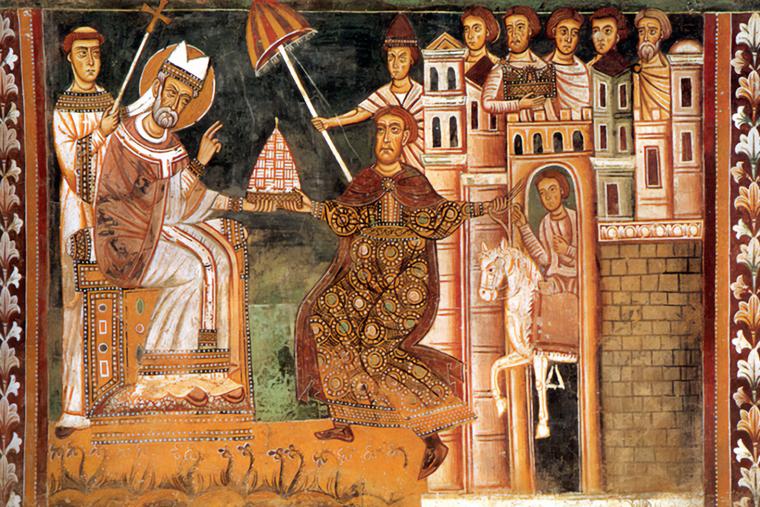
<p><b>Today’s saint is depicted in art</b> by one fresco from the St. Sylvester Chapel, part of the Santi Quattro Coronati Basilica in Rome. The fresco is one of a series, dating from the 13th century, based on the legends that had sprung up about the “Donation of Constantine” and the life of St. Sylvester. This particular fresco is central because it depicts the “Donation.”</p>
<p>Pope Sylvester sits higher: the Emperor kneels before him. They exchange symbols of sovereignty: at the moment, the Pope (who otherwise sits in a bishop’s miter) receives a tiara from Constantine, a symbol of papal authority that was used in papal coronations until 1978, when Pope John Paul I gave it up in favor of a rite of installation as Bishop of Rome.</p>
<p>Atop the city walls, Constantine’s courtiers hold a crown Sylvester has passed back. Another holds a red-and-gold <i>umbraculum</i>, a sign of papal authority over the Church, once used as a parasol in papal processions but also always present as a sign of its ecclesiastical status in every major and minor basilica. Constantine holds the bridle, about to lead forth a white horse that was also a symbol of papal authority.</p>
<p>Executed when the Pope was embroiled in controversy with Holy Roman Emperor Frederick II, the frescoes have been called “propaganda” aimed at advocating papal privileges. Regardless of the history, the artwork is impressive.</p>
<p>To read more, see <a href="https://www.newadvent.org/cathen/14370a.htm">here</a>, <a href="https://www.britannica.com/biography/Saint-Sylvester-I">here</a> and <a href="https://corvinus.nl/2017/01/23/rome-santi-quattro-coronati/#The%20Chapel%20of%20Saint%20Sylvester">here</a>.</p>
</p></div>
<p><br />
<br /><a href="https://www.ncregister.com/blog/saints-and-art-st-sylvester">Source link </a></p>
<p><!-- END THEIA POST SLIDER --></p>

A Pivotal Moment in Church History| National Catholic Register