


The United States and Cuba, at odds for more than six decades, are once again in a period of heightened confrontation. Washington’s recent tightening of sanctions on Havana’s communist government has compounded long-standing economic problems on the island. The effects include shortages, fuel scarcity and frequent blackouts, contributing to conditions that some observers have described as a humanitarian crisis.
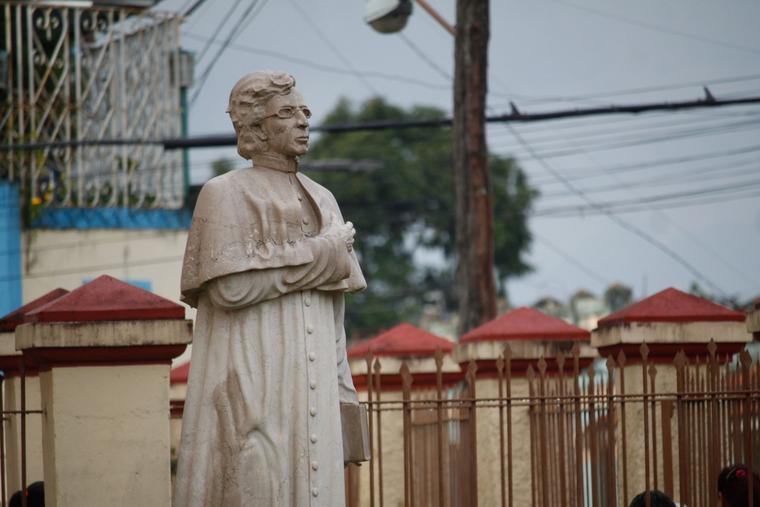
At first glance, Cuba’s economic crisis and deteriorating relations with the United States seem far removed from the world of a 19th-century priest and philosophy professor. Yet admirers of Venerable Félix Varela, a Cuban-born candidate for Catholic sainthood, say he embodied the virtues needed today for Cuba’s pursuit of freedom and reconciliation with the U.S.
Varela’s biography bridges the two countries. Born in Havana in 1788, he was orphaned as a child before moving to St. Augustine, Florida, then Spanish colonial territory, to live with his grandfather, a military officer. He later returned to Cuba to study for the priesthood and became a respected philosophy professor. He had a wide range of interests, including natural science to music, and his influence extended far beyond the classroom.
Varela was “the first man who taught us to think,” said 19th-century Cuban intellectual José de la Luz y Caballero, in words that have become Father Varela’s defining epithet.
Circa-1853 image of Father Félix Varela (1788-1853) | Attributed to Nagel & Weingartner via Library of Congress; Public domain
In 1821, Father Varela was elected to represent Cuba in the Spanish Parliament in Madrid, the Cortes Generales, where he advocated for the island’s independence and the abolition of slavery. These stances eventually made it impossible for him to remain under Spanish rule; and in 1823, he fled to the U.S. He spent about 25 years in New York City, where he was appointed vicar general of the Diocese of New York, sharing the office with another priest.
A Life Between Two Worlds
In New York, he was dedicated to helping the city’s immigrant population, especially the Irish, and is said to have studied Gaelic to facilitate his ministry. A mural unveiled last year in St. Patrick’s Cathedral shows Father Varela near St. Frances Xavier Cabrini, the patron saint of immigrants.
“All immigrants recognize that we are part of Varela,” Cuban-born Bishop Octavio Cisneros, a retired auxiliary of Brooklyn, New York, and vice postulator for Father Varela’s cause for canonization, told EWTN Noticias, the Register’s Spanish-language news partner. “He is the model for all of us and not only Cubans — immigrants.”
Father Varela left New York in 1850 because of declining health and returned to St. Augustine, where he died in 1853. His remains were later transferred to Cuba and are enshrined at the University of Havana. In 2012, Pope Benedict XVI declared Father Varela “Venerable” and recognized his heroic virtues, opening the way for beatification and, ultimately, canonization — pending the verification of the required miracles attributed to his intercession.
It might surprise Catholics to learn that Cuba, where the Catholic faith has been present since the arrival of the Spanish in the late 15th century, has three native-born blesseds but no native-born canonized saint. (St. Anthony Mary Claret, a Spanish-born former archbishop of Santiago de Cuba, is the canonized saint most directly associated with the island.)
Carlos Eire, a Cuban-born professor of history at Yale University, said one reason for this is the historical paucity of native-born clergy. “As a child, I thought you had to be Spanish in order to be a priest,” Eire told EWTN News.
The historian also noted that promoting a cause for canonization is typically a costly process. U.S. Catholic officials have estimated that a cause can cost approximately $250,000 from the initial diocesan investigation through canonization, with some estimates placing the total cost closer to $500,000, depending on the complexity of the case and related expenses.
“You need sponsors who have deep pockets, and Cuba did not have that, especially after 1959, when communists took over,” Eire said. “The Cuban Church was a persecuted Church. And very, very poor. So who’s going to promote Félix Varela?”
Retired Bishop Felipe de Jesús Estévez of St. Augustine, who was born in Cuba, said in an interview that the venerable’s beatification and eventual canonization would help revive the Church on the island. “The Cuban people need to be evangelized because the state, the Cuban state, has … [hindered] evangelization, the work of the Church. And so this would be a boost, a boost to the evangelization of Cuba.”
‘A Saint in Every Sense’
Father Varela can be a bridge between the Cuban American community and the current population of the island, after more than half a century of hostility between the countries, said Deacon Fred Everett of Fort Wayne-South Bend, Indiana, the U.S.-born son of a Cuban refugee.
“For Cuba to advance, there has to be a real reconciliation between Cubans who left … and the Cubans who are back home. There has to be forgiveness, mutual forgiveness,” the deacon, who travels often to the island, told EWTN News. “Félix Varela gives a good example because he had to span both countries.”
Awareness of Father Varela’s candidacy for sainthood is much greater among Cuban Americans than among Cubans on the island, who tend to view Father Varela as a remote and intellectual figure, according to Father Alberto Reyes, pastor of a church in the Archdiocese of Camagüey, Cuba.
“I believe he was a saint in every sense of the word, and I certainly think his beatification and canonization would be justified. But at the level of ordinary people, he is not perceived as our saint. People do not have a devotion to him,” Father Reyes told EWTN News.
He added that Father Varela’s beatification and canonization would help Cubans rediscover “his life as a man of charity and extraordinary self-sacrifice … because that whole aspect of his life has always remained in the shadows.”
For Deacon Everett, that rediscovery could extend beyond the Church’s recognition of Father Varela’s holiness. He said the priest’s emphasis on virtue and piety could help shape a healthier civic life in Cuba after decades of communism and official atheism.
“He points the way, I think, towards the solution of Cuba’s problems,” the deacon said. “God and country have to be intertwined for a country to really flourish.”
Paola Arriaza Flynn contributed to this report.