<p><!-- BEGIN THEIA POST SLIDER --></p>
<p> <br />
</p>
<div>
<p>SOUTH BEND, Ind. — <a href="https://www.leonardjdelorenzo.com/">Professor Leonard J. DeLorenzo</a> is based at the <a href="https://mcgrath.nd.edu/">McGrath Institute for Church Life</a> at the University of Notre Dame, where he also teaches in the Department of Theology. </p>
<p>His passion is building leadership through higher education. “I am focused especially on developing Catholic mission both in the academy and in the Church,” he says. “In addition to currently working to build the strategic plan for the McGrath Institute for Church Life, I direct a new initiative dedicated to fostering scholarship on and devotion to the saints.” </p>
<p>He is the <a href="https://www.leonardjdelorenzo.com/books">author</a> of seven books and the editor of another two, as well as contributing articles to academic and pastoral publications. </p>
<p>He has a particular interest in what he describes as: “the Catholic imagination, religion and literature, the relationship between storytelling and grace, and the development of character.” </p>
<p> <!-- EMBED START Image {id: "editor_3"} --> </p>
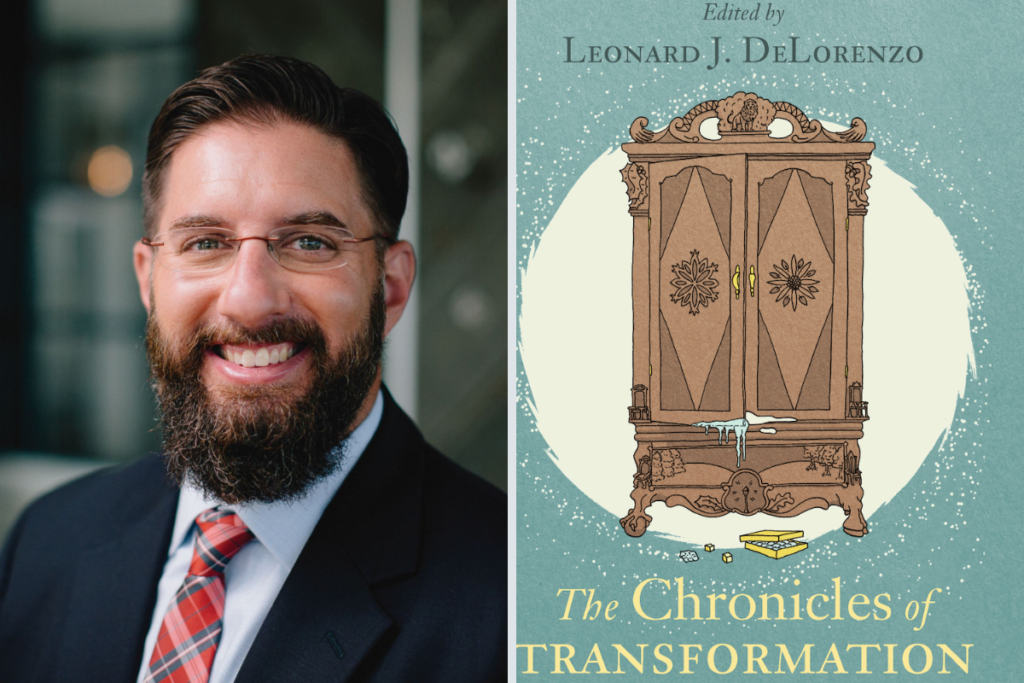
<figure><img src="https://publisher-ncreg.s3.us-east-2.amazonaws.com/pb-ncregister/swp/hv9hms/media/20231122091112_a1460327044990101cb7bc148132ffdee1d50eaef107725b636e5255370a0391.png" data-media-id="editor_3" data-image-id="20231122091112_a1460327044990101cb7bc148132ffdee1d50eaef107725b636e5255370a0391" data-rendition-name="original" width="1200" height="800" loading="lazy" alt="Professor Leonard DeLorenzo and ‘Chronicles of Transformation’"/><figcaption>L to R: Professor Leonard DeLorenzo and ‘The Chronicles of Transformation’<span>(Photo: Courtesy photos)</span></figcaption></figure>
<p> <!-- EMBED END Image {id: "editor_3"} --> </p>
<p>No surprise, then, that he edited the Narnia-themed: <i>The</i> <a href="https://ignatius.com/chronicles-of-transformation-cotp/"><i>Chronicles of Transformation: A Spiritual Journey With C. S. Lewis</i></a><i> </i>(Ignatius Press), a collaborative work between scholars and artists, aimed at opening adult readers&#8217; eyes and hearts to the transformative power of the fictional world created by Lewis. Peter Kreeft described the collection of essays as: “standing head and shoulders above all the many other books about Lewis’ masterpiece, with unexpected insights and dimensions. … Other books about Narnia see and say the obvious, like boats that skim the surface of Lewis’ seven seas. But this one is a diving suit that takes the reader down into the depths.”</p>
<p>The Register spoke via email with DeLorenzo a few days prior to the 60th anniversary of the death of C.S. Lewis on Nov. 22, 1963. </p>
<p> </p>
<p> </p>
<p><i>Why this book on Lewis? </i></p>
<p>With this volume, we hoped to guide readers into a new kind of encounter with the fiction of C.S. Lewis, one where we are invited to reimagine the drama and joy of Christianity from within our very own world, which is often a world drained of wonder. Lewis created the world of Narnia so that those who entered there could learn to see our own world anew. As you can see from the subtitle of the book, we think of this as a “spiritual pilgrimage,” which means that by entering into the fiction as fully as possible, we are being drawn into a narrative where the development of character matters, where who you are and who you become matter, and where sacrifice and courage and the virtues also matter. You are supposed to be changed by the journey through these chronicles.</p>
<p> </p>
<p><i>Do we need another Lewis-related book? </i></p>
<p>Probably not, but this book is unique in at least two ways: First, it is, as I said above, about fostering a disposition for pilgrimage and spiritual transformation; and, second, it combines original essays with original artwork and an original poem cycle to allow readers multiple points of entry and reflection for engaging the <i>Narnia Chronicles</i> more openly, toward greater enjoyment, and with ample opportunities for new forms of delight.</p>
<p> </p>
<p><i>How did you come across the writer? </i></p>
<p>He’s everywhere, of course, so it is not hard to encounter Lewis. But I first really read Lewis in college with his little eschatological drama called <i>The Great Divorce</i>. I was so taken with that book because, in addition to telling a tale, Lewis also painted the scenery so well. In fact, that book is as much about the terrain (especially the terrain of heaven) as it is about anything else. That was fresh and invigorating: He gave me not only a lot to think about but also a lot to see and imagine. I think I learned how to read the <i>Chronicles of Narnia</i> better because of the way I read <i>The Great Divorce</i>.</p>
<p> </p>
<p><i>How has he influenced your thinking? </i></p>
<p>Among other things, I have learned from Lewis that if you want to communicate truth, beauty and goodness to people, it is never enough merely to tell them about such things. Indeed, it is much more powerful to show people what truth, beauty and goodness look like and feel like. This is the power of his fiction, I believe: He is dealing in matters of great significance and consequence, but never in a didactic manner. Rather, he created lands and worlds and narratives in which we can explore these things together; where we can see and feel and imagine. That has a lasting formative effect on people. </p>
<p> </p>
<p><i>As a Catholic, is there a point when Lewis and you part company? </i></p>
<p>The only thing that comes to mind is his book <i>Mere Christianity.</i> I like a lot of that book, and yet the idea that there could be anything like a “mere” Christianity is, I believe, faulty. Christianity is not reducible to some lowest common denominator or some essential things that every type of Christian agrees on. There is no hallway called “mere Christianity” where the rooms of all the various Christian traditions attach. Rather, Christianity is always embodied, particular, and formed in and as a tradition. </p>
<p> </p>
<p><i>Is he still relevant to today’s world? </i></p>
<p>I think so. When I teach him to college students, they are drawn into the narratives and the language that he uses. I think he allows people to lower their guard and consider things differently for a while. I think he gives us a taste of things of great importance, even when we don’t know we want those things, and yet we somehow seem to like and enjoy what he shares with us. Lewis doesn’t do everything, but what he does do, is, I believe, as relevant today as ever.</p>
<p> </p>
<p><i>Does he still have appeal to young people today? </i></p>
<p>Yes. I saw this with my own children, which is actually the basis of the essay I wrote for this volume on the first chronicle: <i>The Lion, the Witch and the Wardrobe</i>. Narnia is the children’s world. It is a world where children are meant to reign, where they must become brave and learn how to sacrifice, where their choices and loves matter absolutely. That is what is happening “in” the stories –– i.e., to and with the characters –– but young people who read these stories (or have these stories read to them) almost can’t help but care about Narnia, too. They want to become brave; they want to do great things; they want to make choices worthy of true kings and queens. Lewis takes children seriously, and he challenges them. Children need that.</p>
<p> </p>
<p><i>Why do the Narnia tales still find an audience? </i></p>
<p>I think the chronicles still find an audience because they are real. I don’t mean that in the sense that I believe there is actually some place called Narnia or talking beasts or celestial bodies that retire into human form. I think rather that Lewis managed to create stories that immerse us in a narrative world where what matters most to us –– and what speaks to our hearts –– is actually the core of the drama. Again, he doesn’t “tell” us these things; he shows us these things; he gives us the feel of them; he appeals to our imaginations with them. Children can sense that, and so, too, can adults if we are willing to become like children again and enjoy stories, rather than always having to break them apart and overanalyze them. I write about just this in the introduction to the volume: &#8220;The spiritual benefit of these stories is not intended for children alone. The benefit redounds to all who are childlike, as well as all those who will allow themselves to become so again. This includes adults who have been weighed down by life and those who have become too intellectually ‘puffed up’ or too spiritually sophisticated to immerse themselves easily in chronicles like these. For children and adults alike, the transformation does not happen aside from enjoying the chronicles, but happens precisely because they are enjoyed. That is the way to take these stories as seriously as possible: by enjoying them.”</p>
<p> </p>
<p><i>What was the most surprising discovery about Lewis in compiling the book? </i></p>
<p>Honestly, what surprised me most was how hard it was to get permission to include actual lines from Lewis’ works in this book. I have had to get permission to use quotes and excerpts from published works before, but nothing like this. I guess that says something about how valuable Lewis’ words are to people.</p>
<p> </p>
</p></div>
<p><br />
<br /><a href="https://www.ncregister.com/interview/c-s-lewis-and-narnia-today-an-interview-with-professor-leonard-delorenzo">Source link </a></p>
<p><!-- END THEIA POST SLIDER --></p>

An Interview With Professor Leonard DeLorenzo| National Catholic Register