<p><!-- BEGIN THEIA POST SLIDER --></p>
<p> <br />
</p>
<div>
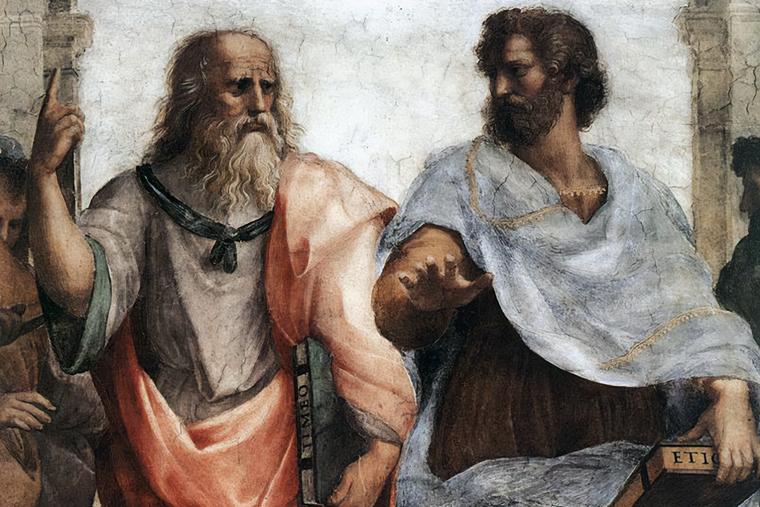
<p>Aristotle thought deeply about friendship. </p>
<p>I am, of course, aware that this statement seems as astonishing as declaring that the sun rose this morning. After all, St. Thomas Aquinas refers to Aristotle as “The Philosopher.” When we read anything that Aristotle has written, it is clear that he has thought deeply about it. What <i>is</i> astonishing though is that of the 10 books in the <i>Nicomachean Ethics, </i>Aristotle devotes fully two to the topic of friendship. He writes more on friendship than any other subject in the <i>Ethics. </i></p>
<p>In a word, it is one thing to speak about the depth of Aristotle’s thought on other topics, but quite another to speak of the depths he plumbs friendship. </p>
<p>Despite this, Aristotle raises a question (other translations render it “a doubt”) that he seems unable to answer in a wholly satisfying way for himself. He says:</p>
<blockquote><p>This gives rise to the question, is it not after all untrue that we wish our friends the greatest of goods? For instance, can we wish them to become gods? For then they will lose us as friends, and therefore lose certain goods, for friends <i>are</i> goods.<sup> </sup>If … a true friend wishes his friend’s good for that friend’s own sake, the friend would have to remain himself, whatever that may be; so that he will really wish him only the greatest goods compatible with his remaining a human being. And perhaps not all of these, for everybody wishes good things for himself most of all.</p></blockquote>
<p>This passage is achingly beautiful, for in it we find the virtuous pagan’s longing for the Incarnation — though he realizes it not. This, dear reader, is no less than the estuary of human reason meeting the ocean of Divine Revelation.</p>
<p>Aristotle has rightly identified multiple truths that seem inescapably true in isolation, and in profound contradiction when held together. </p>
<p>The truths are these. First, we wish our friends the greatest of goods, yet the greatest of goods would be to become a god. Second, friendship requires a certain equality between the friends, and therefore we need our friend to somehow still “remain himself.” Finally, we wish our own good primarily. How then could we wish the greatest good for our friend if it resulted in losing our friend?</p>
<p>The solution to Aristotle’s dilemma is found in the words of Our Lord, which we read during the sixth Sunday of Easter. “No longer do I call you servants, for the servant does not know what his master is doing; but I have called you friends.”</p>
<p>Such language would be utterly shocking to Aristotle. Aristotle recognized that true friendship involves a shared life. He is purported to have said that friendship is “one soul dwelling in two bodies.” Aristotle would argue that to be a friend to God would require sharing in his Divine life. </p>
<p>Sharing in the Divine life. This is precisely what Grace is, though sometimes we may forget. “For the Son of God became man so that we might become God,” as St. Athanasius reminds us. The entire purpose of our lives is to fulfill our final calling of theosis, that we may, as St. Peter writes “come to share in the divine nature.”</p>
<p>Not only do we merely <i>wish</i> our friends this highest Good, but we are called to actively <i>will</i> this for them, praying that they too may come “to share in the divinity of Christ, who humbled himself to share in our humanity.”</p>
<p>What though of Aristotle’s second truth, that “the friend would have to remain himself?” If our friend is transformed through grace in this life, does he remain himself? After all, St. Paul says of himself, “It is no longer I who live, but Christ who lives in me.” Aristotle may rightly ask whether St. Paul is claiming that theosis ultimately erases the uniqueness of each person. </p>
<p>Catherine of Siena wholeheartedly rejects such an idea with her famous exhortation “Be who God meant you to be and you will set the world on fire.” </p>
<p>If we think that Sts. Catherine and Paul seem to be in conflict, we need only remember this: Christ is infinitely good, and therefore his life is inexhaustible by any one of us. </p>
<p>No two persons have ever been called to show forth Christ and bring Christ to the world in exactly the same way, but make no mistake, we are called to be other Christs. </p>
<p>In what is surely one of the most shocking passages in the New Testament, Christ says “Truly, I say to you, as you did it to one of the least of these my brethren, you did it to me.” He does not say, “It is as if you did it to me.” No, “I was hungry … I was thirsty …I was a stranger …” This is so astonishing that not only are the wicked bewildered — “When did we see you?” — but the righteous themselves are equally shocked as they ask him precisely the same question.</p>
<p>We ought to wonder at this. He is telling us that we are so intimately connected to him, that we can truly live his life as ours.</p>
<p>Gerard Manley Hopkins writes on this theme:</p>
<blockquote><p>I say more: the just man justices;<br />Keeps grace: that keeps all his goings graces;<br />Acts in God’s eye what in God’s eye he is —<br />Christ — for Christ plays in ten thousand places,<br />Lovely in limbs, and lovely in eyes not his<br />To the Father through the features of men’s faces.</p></blockquote>
<p>Christ plays in 10,000 places. In some he is thirsty. In some, he is giving a drink to the thirsty. Sometimes he speaks with eloquence. Sometimes he is as mute as a lamb. Sometimes he carries, and sometimes he is carried. </p>
<p>But always lovely, for always Christ. </p>
<p>This then, is our answer to Aristotle: the more we live the Christ-life, the more we become ourselves, not less. For we are made in his image and likeness. As we move from grace to grace, so much more do we reveal of that original image that our souls were always meant to be. </p>
<p>Sometimes, we may look with awe at an old painting that is clearly a masterpiece. Yet if years of dirt and dust have dimmed its true brilliance, we wish to remove it so that we may behold the true luster and beauty as its artist always intended. So it ought to be with our friends. What we love about them we will surely love all the more as they reveal ever more who they truly are. </p>
<p>Then, far from losing our friends, we will ultimately share with them a friendship that the ancients could not have fathomed to hope for: a shared Divine life with Christ, our True Friend. For our Friend has prayed for us: “That they may be one even as we are one,<sup><b> </b></sup>I in them and thou in me, that they may become perfectly one, so that the world may know that thou hast sent me and hast loved them even as thou hast loved me.”</p>
</p></div>
<p><br />
<br /><a href="https://www.ncregister.com/blog/aristotle-and-christian-friendship">Source link </a></p>
<p><!-- END THEIA POST SLIDER --></p>

Aristotle’s Doubt and the Glory of Christian Friendship| National Catholic Register