<p><!-- BEGIN THEIA POST SLIDER --></p>
<p> <br />
</p>
<div>
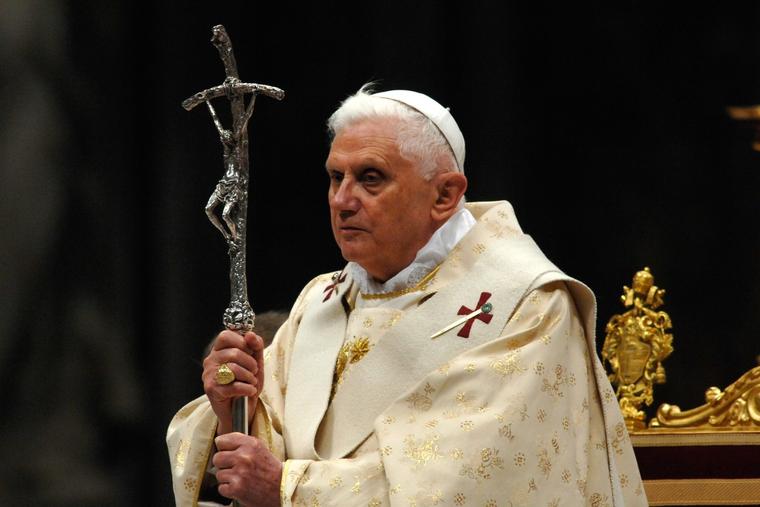
<p>The last words of normal human beings as they die are normally uttered in their mother tongue. That was not the case with Benedict XVI. He was not a normal mortal. Even in the hour of his death, in a final concentration of his consciousness, he switched once again from German to Italian, so that his last words would also be understood as his final testament: <i>“Signore, ti amo!”</i> Lord, I love you. </p>
<p> Actually, therefore, I could have rejoiced when I heard that on Dec. 31, 2022, at the age of 96, the oldest pope in history was relieved of his sufferings and died peacefully. In fact, though, I felt as his neighbor Cardinal Pell did, who admitted two days later to Colm Flynn of EWTN in his last interview: “I’m amazed how sad I am.” I felt that way, too. </p>
<p> Maybe because I honored and loved John Paul II as a saint even during his lifetime. Benedict XVI, in contrast, was closer to me than any pope ever before. Moreover, he was one of the most enchanting people I’ve ever met. Still, there was some joy at his death — first, because he had made it at last, and second, because the Dear Lord himself had, so to speak, put two blue check marks [signifying that the recipient had read the message] under an anthology of my coverage of his pontificate as Rome correspondent for <i>Die Welt</i>, a daily newspaper in Berlin. In the foreword to it I had written: “Benedict XVI will probably go down in history as the last European on the Throne of Peter.” Therefore I wanted that to be the name of the book, too. If I had had my way, it would have been entitled “The Last Westerner” or “The Last European.” This suggestion, however, did not convince my German publisher, which is why it finally appeared in German under the title <i>Benedict XVI: The Years of His Papacy at Close Range</i>, and in English as <i>Benedict Up Close</i>. I don’t mind. </p>
<p> Nevertheless Benedict died as “the last Westerner.” I had been right, and of course I was glad. For the force that drove Benedict in his innermost being had held out in an almost cosmic balance until Dec. 31, in other words, until the date on which the Church — as Benedict was quite aware — celebrates St. Sylvester, commemorating the pope who had accompanied and finally baptized the Emperor Constantine, who founded the West in the year 313 with his Edict of Milan proclaiming tolerance for the Christian faith. Thus Pope Benedict, the last Westerner, died on the day of the death of Pope Sylvester, “the first Westerner.” </p>
<p> With his death, an era came to an end and a new chapter was opened. He was rather like the Book of the Gospels on the coffin of John Paul II on April 8, 2005, which the wind paged through with the whole world watching and finally slammed shut. After the great European pope from Poland, the very last European really had come to occupy the papal throne. And not only that. With Joseph Ratzinger, at the beginning of the third millennium, a final Platonist had once again become the successor of the Apostle Peter. </p>
<p> The philosophical idea of Platonism is perhaps a bit vague; Raphael perhaps best condensed it into a symbol in the fresco <i>The School of Athens</i>, which he produced between 1509 and 1511 for Pope Julius II. In it we see, against the background of the towering construction of the new St. Peter’s Basilica, Plato pointing upward with his right hand at the sky — the realm of pure ideas — while Aristotle beside him spreads his hand downward over the earth — the realm of facts. </p>
<p> This symbol therefore also helps to explain why the Platonist Joseph Ratzinger was so receptive to the archetypical notion of the Church as a <i>societas perfecta</i> and to a Divine Liturgy in heaven, which he regarded as the source of all renewal, and how it came about that he could so serenely pursue the notion of true archetypes. Then, too, one of his first official acts in November 2005, which provided for the exclusion “of persons with homosexual tendencies” from the priesthood, can be understood only against this background — and indeed right in the middle of the Vatican where, to all appearances, throughout human history, nothing human has been strange, certainly not the different sexual preferences of the human species! </p>
<p> His later call to “de-secularize” the Church likewise fits into this view of the cosmos, as well as his serene analysis of the Islamic world in his Regensburg Address. It also explains how this slight man of culture, of all people, could already proclaim, as Prefect of the Congregation for the Doctrine of the Faith, a radical zero-tolerance policy for those who perpetrate sexual abuse, although it seems totally impossible to implement even to his much more robust successor. </p>
<p> In this sense Joseph Ratzinger, alias Benedict XVI, in many respects resembled that last Western knight from La Mancha in Spain, who, alone and unwearied, led his Rosinante toward the future, through countless legions of opponents.</p>
<p>“If we depart from the concept of truth, we depart from the foundations,” he said dryly. “Real peace is militant. I must not accept a lie in order to make peace. … Faith means resistance to the force of gravity.” </p>
<p> With that we have reached the core and essence of his pontificate. It was in many respects a genuine Christian faith in miracles, which the laws of nature cannot fence in. Above all, though, for Benedict truth was never relative, but rather completely absolute and unique. Truth “is a Person,” as the aged John Paul II still cried out with the last of his strength to the young people in Bern, Switzerland, on June 5, 2004. “It is a presence, a face: Jesus Christ!”</p>
<p>Or as Benedict after him put it in his first encyclical: “Being Christian is not the result of an ethical choice or a lofty idea, but the encounter with an event, a person, which gives life a new horizon and a decisive direction.” Jesus Christ is the way to the truth, because he is Truth itself. </p>
<p> That is the only way to understand how Benedict, by then in his 80s, despite the overwhelming abundance of his papal duties, the many obstacles, and even more the lack of understanding and the head-shaking, made the time to write a trilogy about Jesus of Nazareth. With this work he also proved to be the last pope of the Gutenberg era — Martin Luther stood at the beginning of it — although the overarching impression given by his pontificate is made up not only of major documents but also (and even more) of images and signs. Signs like the wind flipping through the Bible on his predecessor’s coffin, the rainbow at Auschwitz-Birkenau, and the lightning that struck the cupola of St. Peter’s Basilica on the evening of his resignation.</p>
<p>The seal of his pontificate, though, was the image of that imperceptible prayer that he recited on Sept. 1, 2006, before the forgotten facecloth in Manoppello, thus bringing the “true image” of the living God back into the Church: the mightily eloquent scholar fell on his knees like a child in silence and awe before the veil. </p>
<p> In the presence of the true image of the Son of God, Benedict himself stood in the presence of Truth, and afterward as pope he resolutely wrote his biography — a demanding task. We must keep that in mind in order to understand why, in a final feat of consciousness, he uttered his last words in Italian and not in German. Benedict XVI quite obviously wanted Brother Eligio, his Polish nurse and the last witness of his dying days, really to understand the words in the dark of the night and to be able to pass them on. At the end he embraced Truth itself, which is not Platonic or Aristotelian, but rather includes one and the same Person “on earth as in heaven”: Jesus Christ. </p>
<p><i>Translated by Michael J. Miller</i></p>
</p></div>
<p><br />
<br /><a href="https://www.ncregister.com/blog/benedict-xvi-was-the-pope-of-one-truth">Source link </a></p>
<p><!-- END THEIA POST SLIDER --></p>

Benedict XVI Was the Pope of the One Truth| National Catholic Register