<p><!-- BEGIN THEIA POST SLIDER --></p>
<p> <br />
</p>
<div>
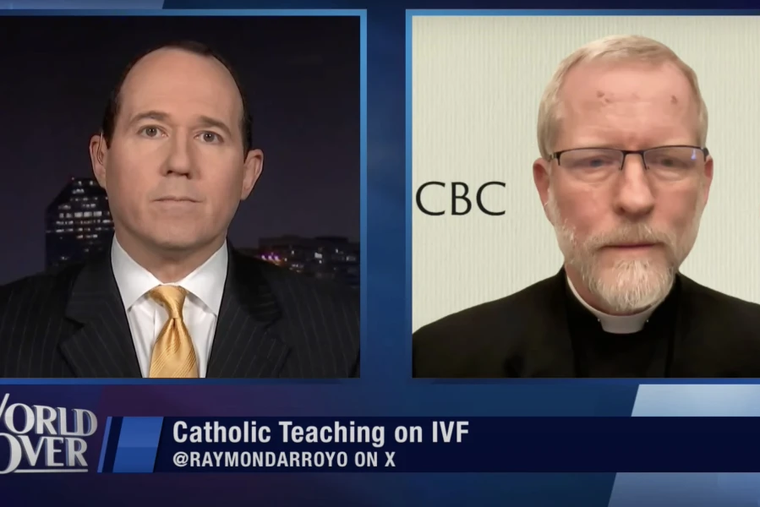
<p>Father Tad Pacholczyk discussed on EWTN this week the moral concerns and risks of IVF.</p>
</p></div>
<div>
<p>Father Tad Pacholczyk, senior ethicist at the <a href="https://www.ncbcenter.org/" target="_blank">National Catholic Bioethics Center</a> (NCBC), discussed on EWTN this week the moral concerns and risks of in vitro fertilization (IVF) following the Trump administration <a href="https://www.whitehouse.gov/presidential-actions/2025/02/expanding-access-to-in-vitro-fertilization/" target="_blank">executive order</a> promoting access to the treatment.</p>
<p>In a Feb. 20 interview on EWTN’s <i>The World Over with Raymond Arroyo</i>, Father Pacholczyk said IVF is “called a pro-life, pro-family technology, but at its core, it’s not.”</p>
<p>“I think it’s good to start out and emphasize that it’s good to hear the president seeing the importance of family formation,” Father Pacholczyk said. However, he continued, “there are a number of concerns that arise in the wake of this technology … that has just galloped forward largely driven by commercial concerns.”</p>
<p>Father Pacholczyk detailed numerous moral concerns with IVF that do not align with Catholic teaching.</p>
<p>“There is this propensity to produce extra embryos, many of whom will either be discarded or frozen. Sometimes they get caught in stasis for literally decades or forever,” he said. “They’re never rescued out of that freezing situation.”</p>
<p>“You’ve certainly heard of the situations when people are implanted with three or four embryos,” Father Pacholczyk continued.</p>
<p>“What happens if they all take? Well, then you have to have what’s called ‘selective reduction,’ and they go in and destroy one or two of the growing babies in that case to help with the pregnancy for the remaining two babies,” he said.</p>
<p>Father Pacholczyk has previously addressed this concern in his <a href="https://www.ncbcenter.org/making-sense-of-bioethics-cms/column-217-poking-the-hornets-nest-of-ivf" target="_blank">NCBC column</a> “Making Sense of Bioethics,” where he referred to discarded or frozen embryos as the “collateral damage” of IVF.</p>
<p>In the interview, Father Pacholczyk also highlighted the moral issues involved when families opt for sex selection of embryos during the IVF process.</p>
<p>“Do you want a boy? Do you want a girl? There’s this quality control, which is, of course, just a fancy word for eugenics that is part and parcel of this entire technology.”</p>
<p>The priest called IVF a “two-edged sword.” He said: “There’s a death-dealing edge to the sword that pops up throughout the entire practice of in vitro fertilization.”</p>
<p>Father Pacholczyk also said there are risks to surviving embryos. </p>
<p>“There is known to be a higher risk of birth defects in the babies that are born this way,” he said.</p>
<p>Father Pacholczyk said that even in cases where women adopt embryos from other couples and implant them in their own wombs, it is still morally wrong. He explained that embryo adoption contributes to the commercialization of human life by creating a demand for embryos.</p>
<p>“So you actually feed into the cycle of cooperation in evil by promoting something like this,” he said. </p>
<p>Father Pacholczyk added that the Alabama Supreme Court law that ruled embryos created via IVF are children under state law brought “some coherence to this issue.”</p>
<p>“We’ve been in this situation where we’re calling the embryo different things depending on what it is we want. I think the Alabama decision cut through that and said: ‘No, we can’t do that. We’ve got to be consistent and coherent here,’” he said.</p>
<p>The priest emphasized funding and developing treatments for infertility must take priority over IVF to figure out the “underlying causes” of why couples are unable to have babies. </p>
<p>Father Pacholczyk said, “That whole approach gets sidelined. As soon as you offer the IVF industry to couples, they go down that road almost immediately.” </p>
</p></div>
<p><br />
<br /><a href="https://www.ncregister.com/cna/catholic-bioethicist-details-significant-concerns-of-in-vitro-fertilization">Source link </a></p>
<p><!-- END THEIA POST SLIDER --></p>

Catholic Bioethicist Details ‘Significant Concerns’ of In Vitro Fertilization| National Catholic Register