


‘Catholic Feast Days’ offers fresh ideas.
Parish life outside of Mass often centers around religious education and evening talks.
But for seven years at St. Veronica Catholic Church in Chantilly, Virginia, “Cooking With the Saints” was a culinary-based highlight.
My former pastor, Father Edward Hathway, approved of holding this cooking class, and the recipes used for each class were dedicated to a particular saint (think rose-inspired for St. Thérèse) and were derived from his or her devotion or country of origin. To help lead each class, a Catholic visitor, a native of that particular country, came and presented — for example, yucca cake from a devotee of St. Peter Claver. Those classes’ festive foods sparked the creation of Cooking With the Saints, my co-written cookbook.
Given the Catholic liturgical calendar, connecting food to the Church’s celebrations for saints and solemnities is a fitting way to live the faith. Finding the ideal recipe for that day meant looking at Catholic communities in different countries and then getting the approval to use that recipe in the book.
After all, God has provided mankind with the right food and faith to keep body and soul alive.
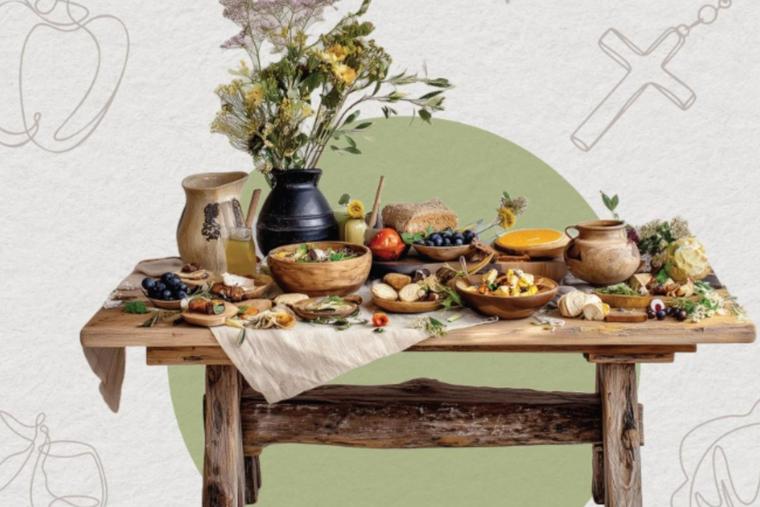
My new cookbook, Catholic Feast Days, recently published by Sophia Institute Press, connects food with faith, too. The text leads readers through the liturgical days on the Catholic calendar and presents the biographies of 30 Catholic saints whose faith has inspired people, even today, to lead good lives.
“In a world where meals are often rushed and taken for granted, I have no doubt that this book will be treasured by many; by families seeking a catechetical tool; or by neighbors hoping to practice hospitality by starting a fun supper club. I encourage you to dig in, to try out the tasty recipes, and to take time to learn from the rich lives of so many saints,” Father Hathaway observed.
Discover a few recipes that I have gathered for liturgical and saints’ days in the book for the current season (and a look ahead).
St. Patrick: On March 17 annually, a favorite celebratory dish with an Emerald Isle flair is “Beef and Guiness Pie,” as it combines Irish beef and Irish beer, topped with a thin layer of pastry dough.
St. Joseph: St. Joseph’s Day, also known as the Solemnity of St. Joseph, on March 19 honors the patron saint of the universal Church. “Zeppole di San Giuseppe” is a popular filled pastry throughout Italy on this special day.
Good Friday: Try an American-based corn chowder that includes shrimp, aptly named “Creamy Corn Chowder with Shrimp.”
Easter Sunday: One of the most delightful ways to launch Easter Sunday at family breakfast is to serve “Resurrection Rolls,” which are symbolic of Easter and are also known as “Empty Tomb Rolls.” Large marshmallows represent the body of Jesus; the crescent roll symbolizes the wrapping of Jesus’ body or the tomb; melted butter relates to the oils of embalming; the cinnamon-and-sugar mix references the spices used to anoint Christ’s body; the oven serves as the tomb — and after baking, the cavity in the bun depicts the empty tomb or the empty cloths. (Also, for the Second Sunday of Easter, you can try “Divine Mercy Shortcake.”)
St. John the Baptist: As noted in the Gospel of St. Matthew, John the Baptist lived a simple life and survived on eating locusts and honey, so a great way to celebrate this day is to serve a “Honey Cake” for dessert.
Pentecost: A fitting way to celebrate the Church’s birthday is to, after gathering to pray with others, enjoy “Pentecost Cake” — a birthday cake.
Solemnity of the Sacred Heart of Jesus: Christ’s heart is celebrated eight days following Corpus Christi. To honor the Sacred Heart of Jesus, consider baking “Pistachio Rosewater Cookies” and joining in the U.S. bishops’ consecration of America for its 250th birthday.
In the book, also discover fast recipes like “Red-Green Salad” and “Spinach Lentil Soup” to make your meal plan more Catholic, too, amid liturgical living.
As the book’s introduction explains, “The liturgical year is the Church’s way of helping us sanctify time. … And what better way to mark these moments than around the family table?”