


Style has never been my specialty. Take it from the girl who dressed up as a hobo for Halloween in the eighth grade, only to be met with genuine surprise when her friends realized she was, in fact, wearing a costume. It was a humbling moment, and perhaps a telling one. Even then, my wardrobe choices were less a matter of intention and more a matter of survival.
Thankfully, as I grew older, my fashion sense somewhat improved. But when I reached college and began practicing my faith more intentionally within my Catholic campus ministry community, a new question emerged, one far more pressing than any trend: What did it mean to dress well in the eyes of the Lord?
For many Catholic women, questions of fashion, modesty and faith can feel surprisingly complicated in a culture that often treats clothing as pure self-expression or an endless source of scrutiny.
In high school, my standard for Mass attire amounted to avoiding sneakers, mostly to appease my mother. In college, however, those questions deepened. What did modesty actually require? Is there a difference between daily Mass and Sunday Mass attire? And beyond church walls, how was I to navigate clothing choices in a secular world while remaining authentically Catholic?
These thoughts resurfaced as I read The Liturgical Style Guide, a limited-edition book released in early 2026 by Catholic writer Mary Harper. The author’s premise is both simple and surprisingly profound: Clothing itself can be a form of prayer.
Harper describes “liturgical style” as reflecting the rhythms of the Church’s liturgical year through personal style. The colors, textures and accessories we choose each day can mirror the seasons of the Church — Advent longing, Lenten repentance, Easter joy — and serve as quiet reminders of the Gospel in everyday life.

Harper is well suited to explore this intersection of faith and style. A graduate of Ave Maria University with bachelor’s and master’s degrees in theology, she has written extensively on Catholic social teaching and the fashion industry for Litany NYC, a Catholic women’s made-to-measure clothing line grounded in ethical and sustainable practices.


Organized around the liturgical year, the book moves from Advent and Christmas to Lent, Holy Week, Easter and Pentecost, with Ordinary Time carefully divided into two parts. Each section includes reflections on color palettes, fabrics and materials, along with suggestions for specific feast days and meditations drawn from Scripture, the saints and Catholic thinkers.

Harper frequently cites Pope Benedict XVI, whose writings on beauty as a pathway to God provide the theological depth of her project. Beauty, Benedict argued, has the power to awaken the human heart to truth and God. Harper applies that insight to the unexpected context of one’s closet.
Her reflections on Advent, for instance, connect darker winter shades with the longing of a “weary world” awaiting Christ, gradually introducing brighter colors as the season moves toward Gaudete Sunday and the joys of the Incarnation. Christmas, by contrast, bursts forth in celebration, inviting readers to dress with delight in response to the coming of Christ into the world.
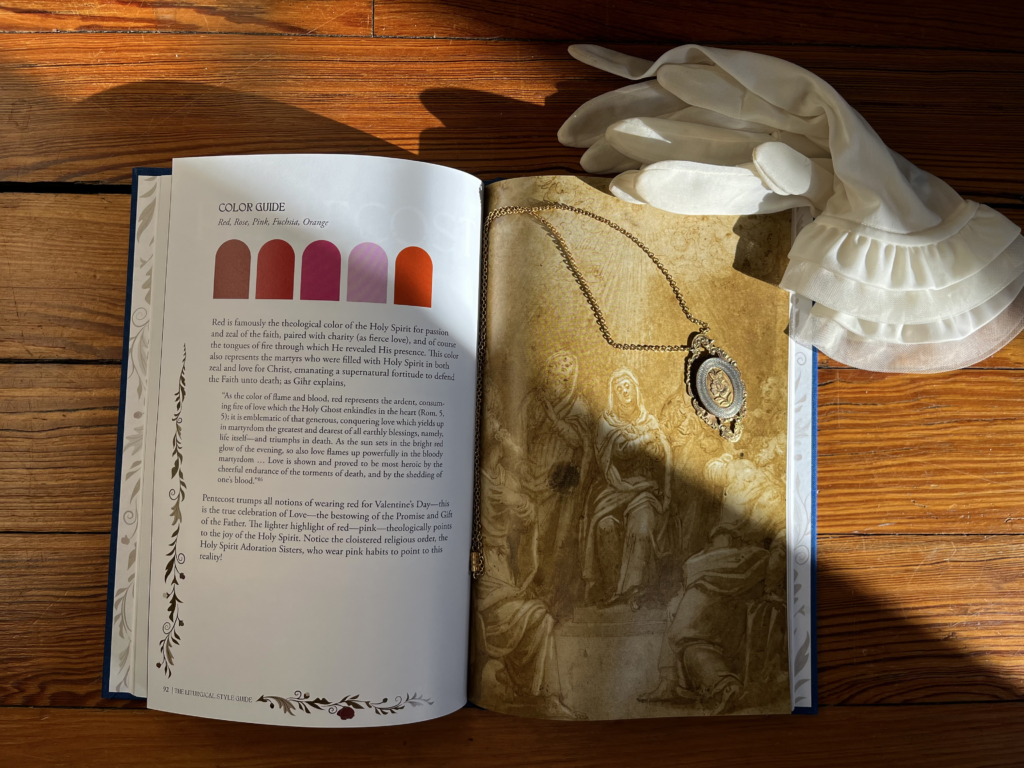
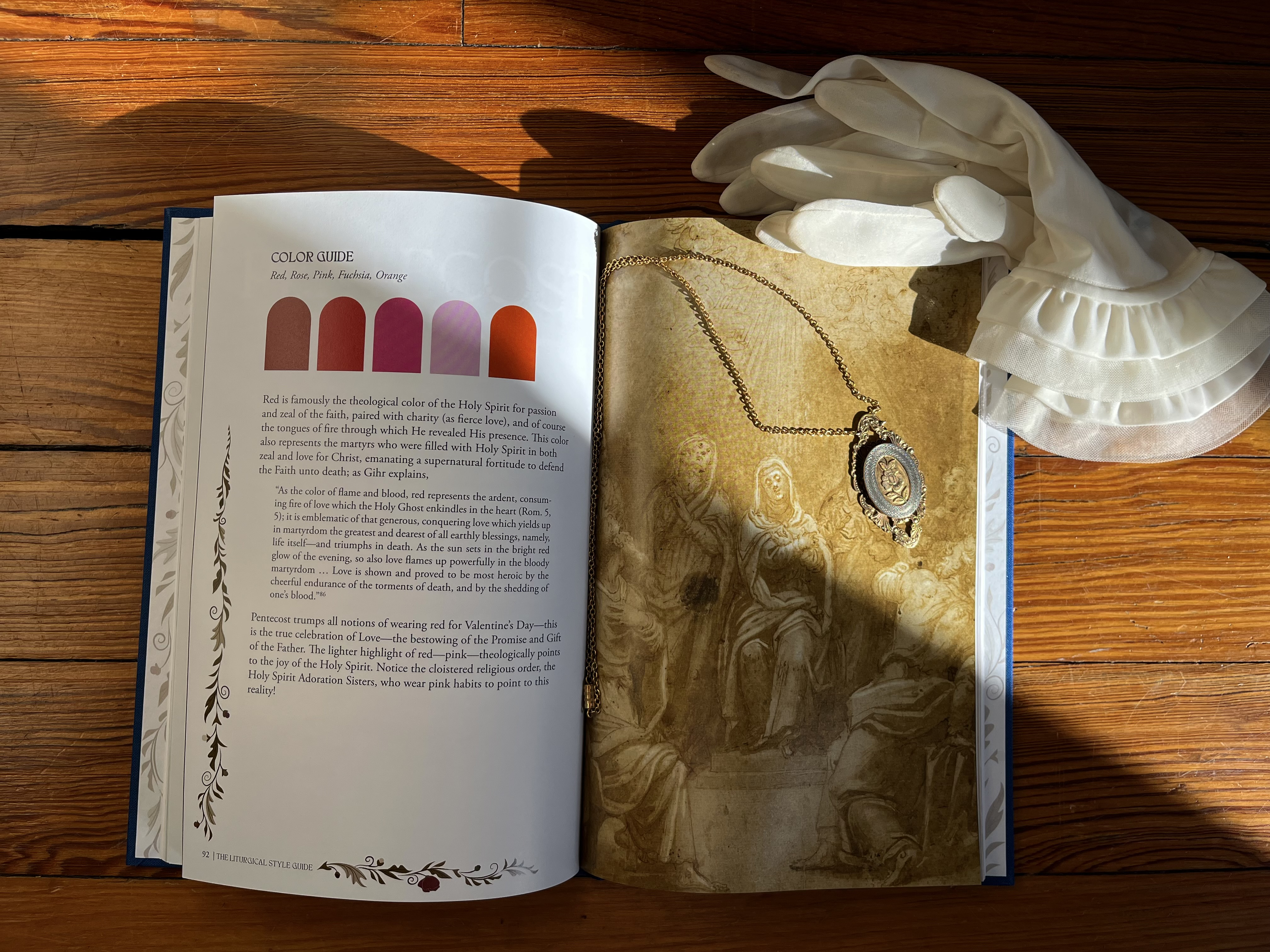
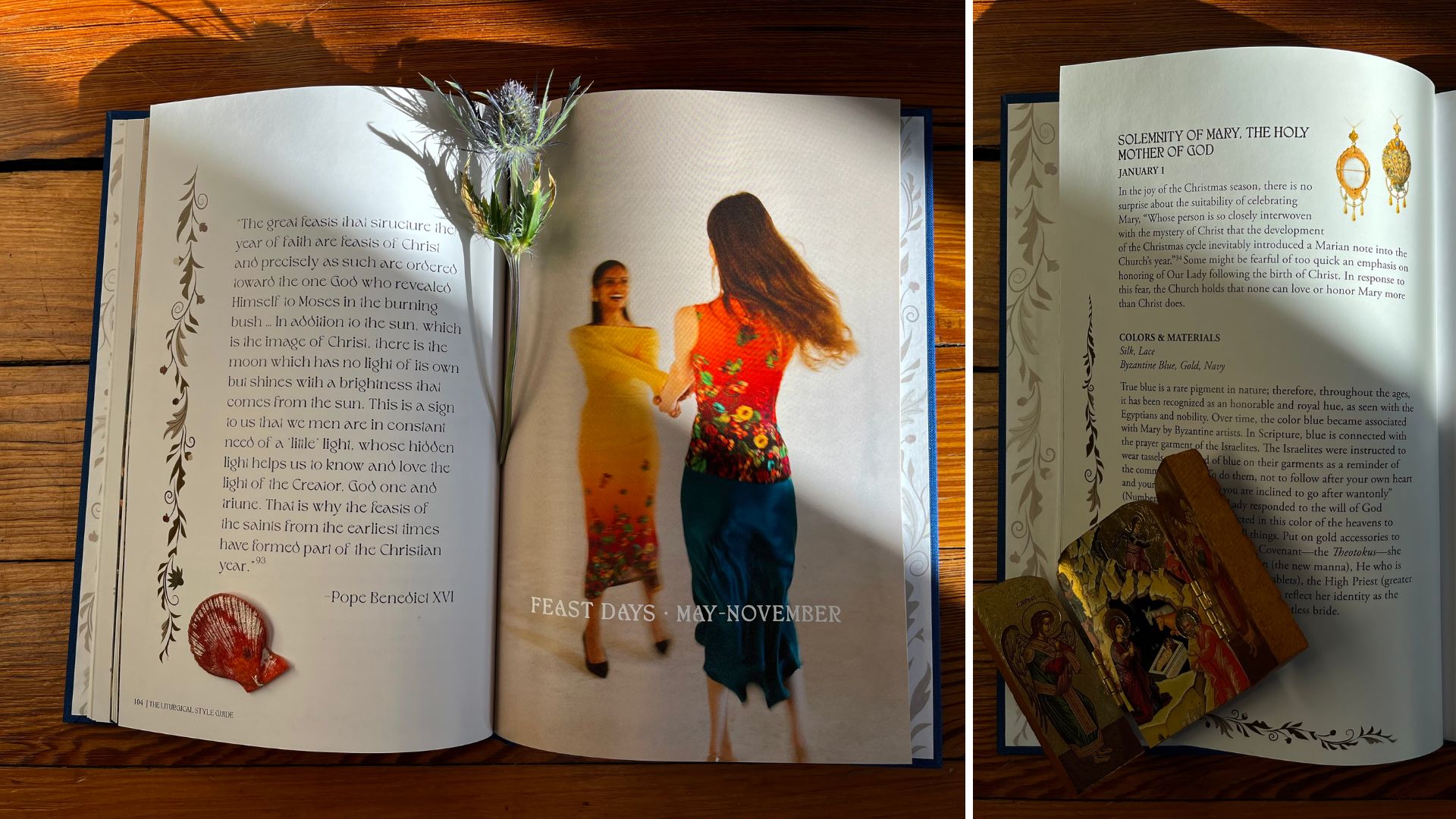
Visually, the book is elegant and approachable. Sacred art, sketches, and photographs illustrate Harper’s reflections without intimidation, making both fashion and the liturgical calendar accessible.
What makes the guide particularly engaging are the small but creative details suggested along the way. For Marian feast days, for example, Harper encourages floral patterns and accessories that reflect the beauty of Our Lady. During Holy Week, she proposes wearing silvery jewelry on Spy Wednesday as a reminder of Judas’ 30 pieces of silver and the ways we, too, betray Christ with our sins.
It is precisely this kind of detail that makes the guide feel fresh yet timeless. I had never considered something so simple as a silver necklace being an invitation to deeper reflection.
Some suggestions resonated with me in a more personal way. Harper’s reflection on the feast of Our Lady of Lourdes immediately brought to mind my pilgrimage there last summer. She writes:
“Shades of blue are fitting for both the flowing waters from Massabielle, now in the baths at Lourdes, and the sash around Our Lady, indicating she has the womb which bore Christ. Wear yellow for the roses at Our Lady’s feet when she first appeared to St. Bernadette. White vestments are worn on this day reflecting the name Our Lady gives Bernadette: ‘I am the Immaculate Conception.’”
Reading this made liturgical style feel less like a creative concept and more like a means of intentionally and visibly honoring Our Lady of Lourdes beyond pilgrimage.
For the “triumphant season” of Easter, Harper suggests embodying the joy of the Risen Christ by mirroring in one’s attire the splendor of a church on Easter morning, when the “altar is lavished with silk and lace, covered in lively lilies, all artwork and statues are uncovered and appear brighter, incense perfumes the air.”
She welcomes women to echo this celebratory interior through luxurious materials and floral patterns — soft lace and flowing tulle, delicate silk and blossoms in shades of white, pearl, gold, pink and rose — allowing the beauty of the season to shine through both fabric and color. In doing so, readers can outwardly express the joy and radiance of a season defined by Christ’s resurrection.
Most importantly, Harper presents these ideas as invitations rather than rules. Her tone remains consistently gentle and encouraging, reminding readers that liturgical style is not about buying entirely new wardrobes or crafting elaborate outfits each morning; rather, it is about cultivating attentiveness and prayer to the spiritual meaning behind everyday choices.
As Harper explained in an interview with the Register, the goal is to help women rediscover a sense of joy and creativity in something as simple as getting dressed. “The Lord is inviting us to a time of healing and freedom in remembering what it is to enjoy playing dress up again and … restoring that sense of playfulness,” she said.
Harper hopes for women to be reminded of “your current season, of your vocation, and wearing something that allows you to be present to whatever it is [the Holy Spirit] calls you to do that day.”
What ultimately makes The Liturgical Style Guide so compelling is its ability to transform something ordinary into something holy. Harper reminds readers that beauty is not frivolous or vain. At its best, it reflects the visible with the invisible, the ordinary rhythms of life and the sacred rhythms of the Church.
By the final pages, I found myself reconsidering my old habits. Style is still not something I would claim to have completely mastered, but Harper’s guide makes the effort feel both joyful and worthwhile.
If this eighth-grade “hobo” is inspired to approach her wardrobe with a bit more intention and prayer — and perhaps a touch of liturgical flair — then there is hope for the rest of us as well.