<p><!-- BEGIN THEIA POST SLIDER --></p>
<p> <br />
</p>
<div>
<p>One of America’s greatest novels about the Catholic Church, <a href="https://www.ncregister.com/blog/this-lent-read-death-comes-for-the-archbishop"><i>Death Comes for the Archbishop</i></a>, based on the life and episcopacy of the first Archbishop of Sante Fe, Jean-Baptiste Lamy, was not written by a cleric nor a Catholic. The author was celebrated novelist Willa Cather, who published the classic in 1927. Today we might ask: What gives Cather the right to pen such a story?</p>
<p>A wave of censorship is taking hold that demands writers only write about their own race, religion and experiences. This has come to light in a few recent incidents, one of which centered around the 2023 film <i>Golda</i>, starring Helen Mirren as Golda Meir, former Israeli prime minister from 1969-1974. The screenwriter was Nicholas Martin. According to <a href="https://deadline.com/2023/10/helen-mirren-writers-censorship-1235561554/">Deadline</a>, criticism arose against Martin and Mirren because they were non-Jewish.</p>
<p>“It’s more frightening for a writer to be told they are not allowed to write about subjects with which they don’t have an immediate DNA connection,” Mirren said in response. “I imagine it must be very alarming. And ridiculous.” Martin himself called this censorship mentality “creeping authoritarianism.” “Am I just supposed to write about middle-aged men living in south London?” he asked.</p>
<p>Performances of a play at Santa Monica College were canceled over this very issue. The play in question was <i>By the River Rivanna</i> by G. Bruce Smith, about a contemporary Black man who discovers an enslaved ancestor’s journal and begins to have dreams about his ancestors. According to Robin Abcarian of the<i> Los Angeles Times</i>, a student was “offended that it was written by a white man and directed by a South Asian woman. ‘It’s not their story to tell,’ the student wrote to the administration.</p>
<p>“The censorship impulse on both extremes of the political spectrum is strangling discourse, critical thinking and, really, the human spirit,” Abcarian wrote. “As a writer, I have to believe in my bones that anyone can write about anything.”</p>
<p>Abcarian goes on to mention a few examples — <i>Porgy and Bess</i>, for one, which James Baldwin deemed “a white man’s version of Negro life,” and <i>The Adventures of Huckleberry Finn</i> by Mark Twain. “Told from a white point of view? Yes, but a brilliant and moving story nonetheless,” Abcarian wrote.</p>
<p>There is perhaps unintentional irony in criticism for <i>Golda</i> leveled by British actress Maureen Lippman: “I’m sure [Helen Mirren] will be marvelous, but it would never be allowed for Ben Kingsley to play Nelson Mandela. You just couldn’t even go there.” Kingsley, who is English with Indian heritage on his father’s side, won an Oscar for playing Mahatma Gandhi. <i>Gandhi </i>won Best Picture, and was directed by Englishman Richard Attenborough and written by a white man from Michigan, John Briley, who won Best Original Screenplay.</p>
<p>Younger viewers would recognize Richard Attenborough for portraying the grandfatherly John Hammond in Steven Spielberg’s blockbuster<i> Jurassic Park</i>. The casting was a bit of a wink between the two, as Spielberg’s <i>E.T.</i> was defeated by <i>Gandhi</i> in the Best Picture category, and Attenborough won the Director prize over Spielberg (and Briley bested Melissa Matheson’s script for <i>E.T.</i>). “This should be yours,” Attenborough whispered to Spielberg before ascending the stage to accept the Oscar.</p>
<p>Spielberg himself was the recipient of criticism similar to Helen Mirren and Nicholas Martin. In 1985, Spielberg adapted Alice Walker’s novel <i>The Color Purple</i>, set in rural Georgia from 1909-1949. A 2023 musical remake is overseen by Black director Blitz Bazawule. Spielberg is credited as a producer. In 1997, Spielberg directed <i>Amistad</i>, which depicts the horrific Middle Passage. The central drama of the film is the legal question of whether the Mende captives — kidnapped Africans from Sierra Leone illegally transported across the Atlantic on a Portuguese slave ship before transferred to a Spanish ship, <i>La Amistad</i>, in Cuba — were legally free or not. Anthony Hopkins, the English actor, plays former U.S. president John Quincy Adams, who assists in defending the Africans before the Supreme Court.</p>
<p>“No American court should have jurisdiction to try foreigners for crimes alleged to have been committed against other foreigners on a foreign ship outside U.S. waters,” law professor Douglas O. Linder wrote in a 2000 essay, “<a href="http://law2.umkc.edu/faculty/projects/ftrials/amistad/Salvaging.html">Salvaging Amistad</a>.” </p>
<p>“Nor should an American court have ordered free human beings to be sold at a salvage sale or award salvage based upon their market value,” Linder added. Linder’s point about jurisdiction echoes today’s criticism that “It’s not their story to tell.” And yet, what would have become of those on<i> La Amistad</i> if they weren’t brought before an American court? Whose story is it anyway?</p>
<p>Spielberg’s most acclaimed film, <i>Schindler’s List</i>, finally won him his Best Director and Best Picture. Much was made at the time of the film’s release about Spielberg’s personal connection to the material. “I go to Poland and I get hit in the face with my personal life,” he told David Ansen of <i>Newsweek</i> in 1993. “My upbringing. My Jewishness. The stories my grandparents told me about the Shoah. And Jewish life came pouring back into my heart. I cried all the time. I never cry on sets making films.”</p>
<p>And yet the title character, Oskar Schindler, was a Czech Catholic, who was played in the film by Northern Ireland native Liam Neeson. The movie was based on the historical novel by Australian Thomas Keneally, <i>Schindler’s Ark</i> (renamed <i>Schindler’s List</i> for the U.S. edition).</p>
<p>Whose story is it anyway?</p>
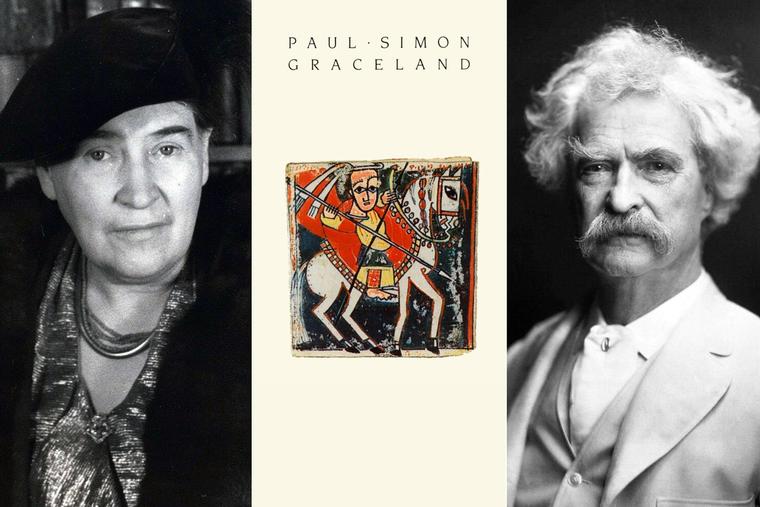
<p>Consider <i>Graceland</i>, Paul Simon’s 1986 Afropop album which drew inspiration from South African street music. The New Jersey-born Simon took heat for incorporating African musicians, but not only did the album win the Grammy for Album of the Year, it brought attention to South African apartheid, inspired an untold number of musicians, and “let millions of people hear the beauty of that African music they never would have [otherwise],” my friend, musician Nick Tolar remarked.</p>
<p>Which brings us back to Willa Cather (1873-1947) and her ninth novel, <i>Death Comes for the Archbishop</i>. During the 15 years Cather spent in the American Southwest before working on the novel, she found the Catholic Church’s presence in that region “the most interesting of all its stories.” And for a non-Catholic to grasp and beautifully articulate the depths and complexities of missionary life — particularly during such a monumental time as the confluence of Navajo, American and Spanish cultures — shows just the depth of Cather’s writing talent, and how well-deserved <i>Death Comes for the Archbishop</i> is considered in the canon of great American novels.</p>
<p>The insight and quality of <i>Death Comes for the Archbishop</i> shows that great art exists beyond the artist, that such art envelops the reader into the work’s setting, so much that you come to care about the characters who leap out of the pages into our imaginations and emotions.</p>
<p>Cather achieved this in her final novel,<i> Sapphira and the Slave Girl</i>, published in 1940. Set in Virginia in 1856, the novel revolves around the jealousies of a miller’s wife, Sapphira Dodderidge Colbert, and her fixation with one of her slaves, Nancy. The writing is the work of a mature author at the height of her capabilities. There is not one wasted line; everything has a purpose. However, author Toni Morrison criticized Cather’s portrayal of African Americans. “A major difficulty for contemporary readers, in my view,” Ann Romines wrote in <a href="https://cather.unl.edu/scholarship/catherstudies/8/cs008.romines"><i>Cather Studies</i></a>, Volume 8, “is that Cather gives us little sense of the complexity of the slave <i>community</i> in the book.” And yet the narrative is about the lady of the house, Sapphira, and Nancy. The novel is not about the community. There are supporting characters, but it is not an ensemble where all characters are main protagonists.</p>
<p>And if<i> Sapphira and the Slave Girl</i> was not Cather’s story to tell, the novel’s Epilogue includes a remarkable twist that inserts Cather herself into the narrative.</p>
<p>French filmmaker Robert Bresson (1901-1999) implored his younger cinephiles Jean-Luc Godard and Michel Delahaye, “Must one look at the life of someone to judge his work? This is his work. And that is his life.”</p>
<p>While the argument wages on, artificial intelligence programs loom to usurp and threaten a writer’s obsolescence. In Steven Spielberg’s <i>A.I.</i> (2001), a humanoid robot, Gigolo Joe, remarks, “We are suffering for the mistakes they made because when the end comes, all that will be left is us.” Science fiction writers have long warned about such technocracy. While we sit debating whether it was their right to do so, their story to tell, Rome is burning.</p>
</p></div>
<p><br />
<br /><a href="https://www.ncregister.com/blog/whose-story-is-it-anyway">Source link </a></p>
<p><!-- END THEIA POST SLIDER --></p>

From Mark Twain’s ‘Huckleberry Finn’ to Paul Simon’s ‘Graceland,’ Whose Story Is It Anyway?| National Catholic Register