<p><!-- BEGIN THEIA POST SLIDER --></p>
<p> <br />
</p>
<div>
<p>I hope to live the life of virtue that great poetry inspires</p>
</p></div>
<div>
<p>I recently taught a short six-class course for Homeschool Connections on “Poems Every Catholic Should Know.” The text for the course was my book of the same title, which is an anthology of Christian verse of the past thousand years, arranged chronologically, beginning with the Middle Ages and ending with “a little wayside dandelion” of my own. </p>
<p>I told the students in my class that the book they are reading might contain poems that every Catholic should know but that it doesn’t contain <i>every</i> poem that every Catholic should know. It is designed to be the beginning of a life of exploration of the glories of verse. Similarly, a short course of only six 55-minute classes could not even hope to cover many of the poems in the book. We would scratch the surface in the hope that it would inspire the students to want to dig further for themselves.</p>
<p>The key point I wished to convey in the course, aside from the overarching hope that the students would discover a love for the beauty of poetry in its own right, was that great Christian poetry teaches us many priceless lessons about life.</p>
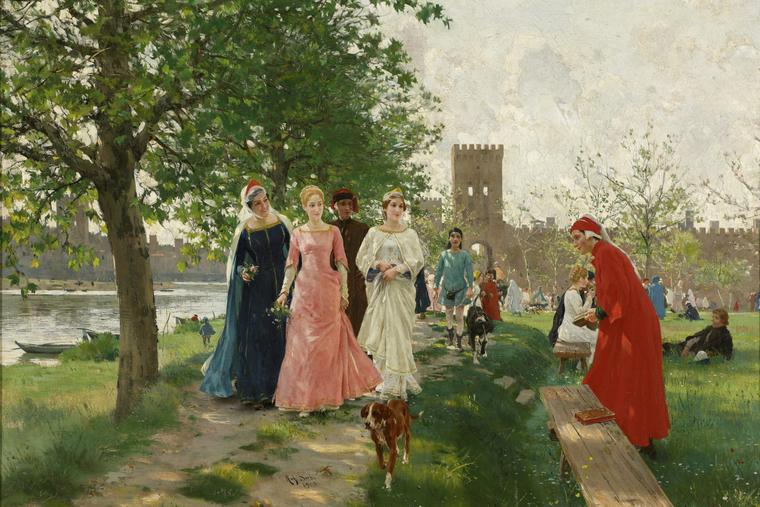
<p>We began in class one with a discussion of Dante’s <i>Divine Comedy</i>. Like the long poems of Homer and Virgil, and the Anglo-Saxon epic <i>Beowulf</i>, it is a narrative poem, telling a story. Specifically, it tells of a middle-aged man, locked in a midlife crisis and lost in a forest of sinful habits from which he is unable to escape. He is then granted, as a gift of grace, a journey into the depths of hell so that he can understand the ugliness and self-destructiveness of sin. Feeling contrition for his own sins, through this vision of their hellish consequences, he is granted the grace to climb purgatorially on an ascent into the wisdom of suffering and love, which is also an assent to the will of God. His reward is a miraculous vision of the communion of the saints in heaven, culminating in a fleeting glimpse of the mysteries of the Beatific Vision itself. We compared the translation of the poem by Dorothy L. Sayers with that of Longfellow, enabling my students to see how translation from one language into another inevitably results in a shadow falling across the meaning of the original work. “Between the potency and the existence falls the shadow,” I told them, quoting T. S. Eliot.</p>
<p>In the second class, we looked at the poetry of the Jesuit saint and martyr, St. Robert Southwell, discussing his connections with, and his influence on, William Shakespeare. We looked at the employment of paradox in his poetry, especially in the manner in which he uses worldly images, such as those associated with war or riches, or political power and celebrity, to convey the countercultural power of Christianity to fight a different sort of war in pursuit of different riches, and in the service of a different power. Finally, we looked at two of Southwell’s poems, “Upon the Image of Death” and “Decease Release,” discussing how these poems are alluded to by Shakespeare in <i>Hamlet</i> and <i>King Lear</i> respectively. </p>
<p>In class three, we moved on to the 19th century, focusing on the poetry of Coleridge, Newman and Hopkins. We spent some time on Coleridge’s marvelous poem, “Hymn Before Sun-Rise in the Vale of Chamounix” which echoes, in its engagement with the beauty of nature and the process of perception, namely that the virtue of humility leads to the gratitude which opens the eyes to wonder, thereby leading to the contemplation of God’s presence in his Creation, the reward for which is the dilation of the soul into the fullness of that presence; or, as Coleridge says, gazing upon the beauty of the mountain, “the dilating Soul, enrapt … swelled vast to Heaven!” Needless to say, Hopkins has the same “enrapt” approach to beauty and its expression as does Coleridge, examples of which we plucked from selections of his verse, including “Pied Beauty,” “The Habit of Perfection” and “God’s Grandeur.” This engagement with the enraptured vision of these wonder-filled poets enabled the students to learn that virtue is the necessary prerequisite for the perception of the fullness of the beauty of reality. A priceless lesson!</p>
<p>In class four, we plunged from the heights of the dilating soul of Coleridge and Hopkins into the depths of the Decadence. Discussing the French Decadents briefly, Baudelaire, Verlaine and Huysmans, we then moved to the poetry of Oscar Wilde and Francis Thompson. We read Wilde’s sonnet, “E Tenebris,” comparing it to the penitential psalms, and then spent some time reading passages from his “Ballad of Reading Gaol.” The focus of our engagement with the sublime poetry of Francis Thompson was his masterpiece, “The Hound of Heaven,” in which the poet recounts his life as a prodigal son, doing his utmost to escape from God’s clutches:</p>
<p>I fled Him, down the nights and down the days:<br />I fled Him, down the arches of the years;<br />I fled Him, down the labyrinthine way<br />Of my own mind …</p>
<p>Ultimately the lesson we learned from our time with the Decadents is that a life of self-gratification and the indulgence of sinful habits does not lead to happiness in this life or the next but is self-destructive and destructive of others. The sinner becomes addicted to his sin, and an addict is neither free nor happy in his life of slavery. In bondage to his bad habits, he is miserable. Seen in this light, and this is the light in which the Decadents see it, suffering is a gift and a blessing which brings us to our senses. “God’s eternal laws are kind,” says Wilde, “and breaks the heart of stone.”</p>
<blockquote><p>Ah! happy they whose hearts can break<br />And peace of pardon win!<br />How else may man make straight his plan<br />And cleanse his soul from Sin?<br />How else but through a broken heart<br />May Lord Christ enter in?</p></blockquote>
<p>The penultimate class focused on the poetry of G. K. Chesterton and Hilaire Belloc, and the final class looked at the poetry of Siegfried Sassoon. We ended with a brief discussion of my own “wayside dandelion,” illustrating, I hope, how I have endeavored to learn the lessons that the great poems have taught me and how I hope to live the life of virtue that the great poems inspire. </p>
</p></div>
<p><br />
<br /><a href="https://www.ncregister.com/blog/great-christian-poems-teach-priceless-lessons">Source link </a></p>
<p><!-- END THEIA POST SLIDER --></p>

Great Christian Poems Teach Priceless Lessons About Life| National Catholic Register