<p><!-- BEGIN THEIA POST SLIDER --></p>
<p> <br />
</p>
<div>
<p>(<i>Reading: Genesis 16:1-17:27; 21:8-20</i>)</p>
<p>This week and next we’ll address what might be called “Abraham and the Child Problem.” We’ll see the human solution … and the divine one.</p>
<p>We saw last week the central point of Abraham’s (still, technically, Abram’s) life: God made a covenant with him. Having led him out of his homeland to an unknown foreign land, God now enters into a relationship with Abraham, promising him descendants outnumbering the sands of the seashore or the stars of heaven (Genesis 15:5-7) in the land God was giving him (vv. 18-21). God makes this covenant with Abraham, who has complained that — despite what God has given <i>him — </i>he has nobody to whom to pass those gifts on: “The one who will inherit my estate is Eliezer of Damascus” (15:3), his servant.</p>
<p>No, promises God. Abraham’s descendants will outnumber the stars of heaven (imagine what that looked like to a man in the middle of a desert without light pollution). And Abraham believed him (15:6).</p>
<p>But, still, how?</p>
<p>Mary, too, believed Gabriel … but she knew enough to ask, “How can this be, since I do not know man?” (Luke 1:34). And yet she had faith. As did Abraham.</p>
<p>But, in Abraham’s case, there remains the question: <i>that </i>God’s promise will be fulfilled, he has no doubt; <i>how </i>it will happen, well …</p>
<p>Which is what sets off the “Abraham and the Child Problem.”</p>
<p>Now Abraham, a married man, undoubtedly “knew woman,” i.e., his wife, Sarai. Yet they had no children. So, if the <i>how </i>question remains, perhaps the path forward is a child through Sarai’s slave woman, Hagar? It’s even Sarai’s idea, and a successful one at that (Genesis 16:1-4).</p>
<p>Catholic teaching affirms that sexual intercourse has two meanings: it serves procreation and it serves the mutual unity of the partners (who should be spouses). Hagar’s pregnancy, particularly given the value both Abraham and Sarai attach to it, changes the relationship between servant Hagar and mistress Sarai. Now, Hagar holds her maternity over Sarai and Sarai blames Abraham for what has happened. Sarai began to mistreat Hagar and Hagar became a runaway slave.</p>
<p>During the flight, Hagar also encounters an angel of the Lord, who assures her that her boy, too, would have numerous descendants, even while telling Hagar to go back to Sarai. She does and gives birth to Abraham’s first boy: Ishmael. </p>
<p>What can we learn from this episode? Well, the whole situation is the result of man taking into his own hands the terms by which God will fulfill his promises through a child. That’s neither the first nor last time that God’s plans have been subjected to human-planned parenthood — with the usual problematic outcomes.</p>
<p>The episode reveals certain constant truths about human experience: that sex binds people together in unique ways, ways that are complementary to the bond of marriage but the source of friction when marriage and parenthood get separated. It points to the rootedness in human nature — especially women’s — of monogamy and sexual exclusivity. </p>
<p>But God’s not done with Abraham. By purely human logic, Abraham has the offspring necessary to realize God’s plan. But man’s ways are not God’s ways, who again promises that Abraham will continue through a child of his wife, Sarai, and that <i>this </i>boy (Isaac) will be the bearer of God’s covenant. God again asks Abraham to make a covenant with him, the sign of that covenant being the circumcision of all the males of his house.</p>
<p>We speak almost blithely of the “covenant” and its details, but consider that this covenant involved <i>grown adult men</i> being circumcised as a sign of faith in God’s promise to the leader of their clan! But they did.</p>
<p>Several events intervene — Abraham’s encounter with his three visitors, who prefigure the Trinity, being the most important. Skipping ahead, Sarah (her name, like Abram’s, is changed after the covenant of circumcision) gives birth to Isaac. Isaac and Ishmael grow up together. The tensions between Sarah and Hagar continue and, like mother like son, Ishmael joins in them. Things come to a head and, eventually, Sarah presses Abraham to send Hagar and Ishmael into exile (though not without promises of God’s protection).</p>
<p>So, what more do we learn? Well, that the human experience of exclusivity (coupled with human passions of pride and envy), especially in matters sexual, is deeply rooted. We also learn that we should not impose our plans on God’s plans in matters of children, not just in terms of the promise but in the manner of its fulfillment, because things generally don’t turn out well.</p>
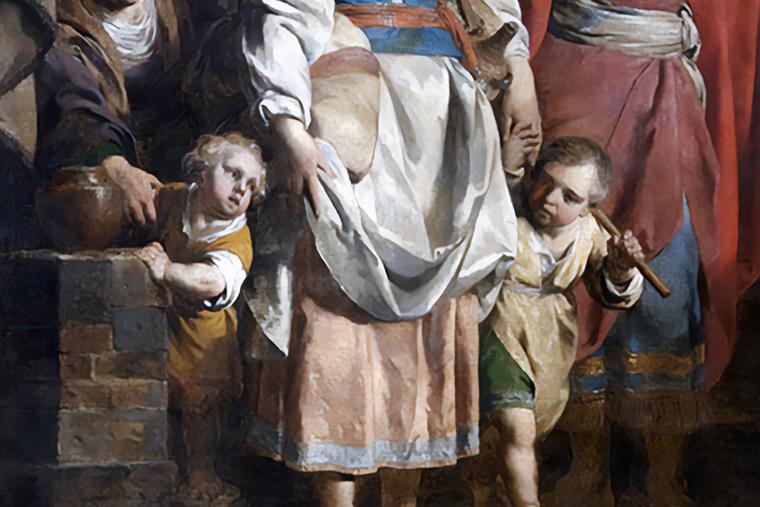
<p><b>The whole episode of Abraham and Ishmael</b> is captured by 18th-century Flemish painter, Pieter Jozef Verhaghen. He’s often called the last representative of the Flemish School of Painting and, considering he died in 1811, comes very late in terms of continuing the Baroque tradition. Religious topics were one of his specialties.</p>
<p>This very large (5 by 6-plus feet) oil painting, <a href="https://commons.wikimedia.org/wiki/File:Verhaghen,_Pieter_Jozef_-_Hagar_and_Ishmael_Banished_by_Abraham_-_1781.jpg">“Abraham verdrijft Hagar en Ismaël Abraham”</a> [Abraham Drives Off Hagar and Ishmael] dates from 1781 and hangs in Antwerp’s Royal Fine Arts Museum. The figures, in terms of size, color palette, and contrasts of light/shadow, all check the primary characteristics of Baroque art.</p>
<p>Hagar occupies center stage, the place to which she by her behavior aspired. She is rendered particularly attractive compared to Sarah in the left corner. Abraham, on the right, is clearly the master of the house (though Sarah is making sure he does what he’s supposed to). His look and gesture seems less one of conviction than of “let’s get this over with.”</p>
<p>Hagar and Ishmael stand on the porch, Sarah leans out from the house, holding Isaac back: it’s clear who stays and who goes. Hagar and Ishmael look somewhat disparagingly at Isaac, the cause of their downfall, Ishmael clearly ready to be a traveling man, staff over his little shoulder. Each mother holds her son’s hand. The road into the distance winds off to the right.</p>
</p></div>
<p><br />
<br /><a href="https://www.ncregister.com/blog/abraham-and-the-child-problem-i">Source link </a></p>
<p><!-- END THEIA POST SLIDER --></p>

Hagar, Heartache, Abraham and the Child Problem| National Catholic Register