<p><!-- BEGIN THEIA POST SLIDER --></p>
<p> <br />
</p>
<div>
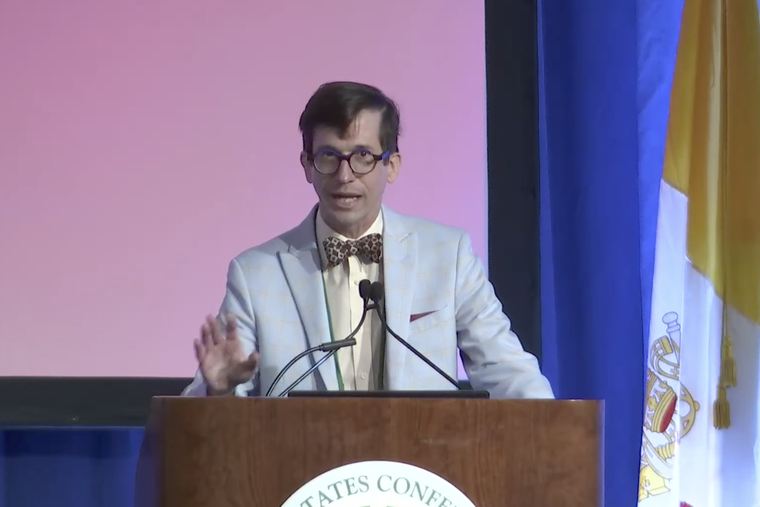
<p>ORLANDO, Fla. — A prominent Catholic academic urged a gathering of the U.S. bishops to take a more assertive role in ensuring that Catholic universities live out their distinctively religious mission. </p>
<p>Santiago Schnell, the provost of Dartmouth University and a former dean at the University of Notre Dame, told members of the United States Conference of Catholic Bishops at their plenary assembly in Orlando that they “could be more vocal” and “more pushy” when it comes to making sure that Catholic universities are faithful to their unique identity. </p>
<p>“I think you are being too respectful,” Schnell told the bishops during his June 10 talk. “You own the word ‘Catholic.’ We academic administrators, we don’t.” </p>
<p>Schnell delivered his pointed observations to the bishops at the end of a presentation on the state of Catholic higher education, during which the Ivy League administrator suggested that Catholic universities have focused more on imitating secular universities and chasing college rankings than on imaginatively living out their distinctive mission. </p>
<p>As a result, Schnell contended, the Church is failing to impact the intellectual and cultural life of the nation and even retain its own members. </p>
<p>“They’re leaving it because we don’t have intellectuals and we don’t have a proper formation in higher education that allows them to articulate effectively their faith, to themselves and others,” said Schnell, a frequent commentator on Catholic higher education and influential advocate for higher education reform in America. </p>
<p>One bishop in attendance described Schnell’s presentation as a “sober moment for the bishops.” </p>
<p>“Hopefully the topic motivated bishops to continue the hard work of calling our universities back to their ecclesial and evangelistic mission,” Bishop Andrew Cozzens of the Diocese of Crookston, Minnesota, told the Register. </p>
<p>Schnell’s talk preceded a closed-door conversation on Catholic higher education with the U.S. bishops. </p>
<p>The Dartmouth provost’s talk marked the 25th anniversary of the U.S. implementation of <a href="https://www.vatican.va/content/john-paul-ii/en/apost_constitutions/documents/hf_jp-ii_apc_15081990_ex-corde-ecclesiae.html" target="_blank"><u><i>Ex Corde Ecclesiae</i></u></a> <i>(“From the Heart of the Church”</i>), the 1990 apostolic constitution in which St. John Paul II outlined the Church’s vision for Catholic universities and their relationship with bishops. </p>
<p>Promulgated amid growing tension between Catholic universities and the Church hierarchy, the document presents Catholic universities as participating directly in the Church’s mission. </p>
<p>While <i>Ex Corde Ecclesiae</i> emphasizes that a Catholic university itself has a responsibility for upholding its Catholic identity, St. John Paul II also taught that the local bishop “has the right and duty to watch over the preservation and strengthening” of the Catholic character of Catholic universities in his diocese. </p>
<h3><b>A ‘Catholic Paradox’</b> </h3>
<p>In his presentation, Schnell described a widening gap between the Church’s vision for Catholic higher education and universities that increasingly resemble their secular counterparts. </p>
<p>“These days, both Catholic institutions and non-Catholic institutions have become very secularized, and they’re doing this through imitation,” he said. </p>
<p>A major driver, he argued, is college rankings, which reward convergence more than distinction. </p>
<p>“Twenty-five years ago when I moved to the United States, I would give a seminar at the University of Chicago, I would give a seminar at Yale, and I would give a seminar at the University of Michigan, and I knew that I was in those universities,” said Schnell, who was born and raised in Venezuela and completed his graduate work in mathematical biology at England’s Oxford University. “Today … we have become so good imitations of each other that you cannot distinguish the place where you are.” </p>
<p>Catholic universities, he added, have followed the same path, becoming “indifferent and indistinguishable” from secular peers. </p>
<p>That shift, he said, has narrowed higher education’s purpose, reducing it to credentials and job preparation rather than intellectual and moral formation. </p>
<p>“It’s about training for the first job,” , critiquing the current status quo. “It’s not training for life.” </p>
<p>Schnell also argued that Catholic institutions are not producing enough intellectual and cultural leaders within the Church. He pointed to Hispanic Catholics, who represent a growing share of the Church but lag in educational attainment, as evidence of what he called a “Catholic paradox”: strong infrastructure paired with uneven outcomes. </p>
<p>He also criticized mission statements that increasingly resemble social-service or advocacy organizations. </p>
<p>“All academic institutions and mission statements, particularly the Catholics, have become what I call ‘NGOs,’” he said, referring to the acronym for “non-governmental agencies.” “That’s not the mission of the Catholic university.” </p>
<h3><b>Forming Future Doctors </b> </h3>
<p>When Schnell turned to what he described as the core of his proposal, he pointed to a slide outlining a three-part framework for renewal in Catholic higher education focused on forming the Church’s next generation of intellectual leaders, clarifying the role of bishops in university life and strengthening the formative culture of Catholic campuses. </p>
<p>“Our mission shouldn’t be creating individuals who go to the workplace,” Schnell said. Instead, he said that Catholic universities should form scholars who have the potential to be Doctors of the Church, <u>i.e.,</u> saints who have made significant contributions to theology or doctrine. “That’s the primary mission of a Catholic institution.” </p>
<p>Schnell said Catholic identity is sustained not only through governance but through campus culture — what St. John Henry Newman called the <i>genius loci</i>, or spirit of place, formed in daily life. </p>
<p>“It’s the conversations that the students have while they are walking to their dorms or they are walking to the chapel,” he said. “It’s the conversations that they’re having about their faith.” </p>
<p>Schnell warned that Catholic character can erode when faculty and administrators do not actively share the Church’s mission. </p>
<p>In some cases, he said, universities have prioritized conformity over fidelity to that mission. Schnell recalled declining an invitation to lead a Catholic university after learning that only about 12% of its faculty and fewer than a quarter of its students were Catholic. </p>
<p>“According to your definition, that’s no longer a Catholic institution,” he recalled his wife telling him. </p>
<p>As the presentation concluded, Schnell returned briefly to the role of bishops in helping to shape the character of Catholic universities. </p>
<p>“What is the participation of the bishops?” he said, telling the gathered Church leaders that the members of a Catholic university were “their flock.” “They’re not mine. They’re not going to be the flock of any academic administrator.” </p>
</p></div>
<p><br />
<br /><a href="https://www.ncregister.com/news/you-own-the-word-catholic-higher-ed-leader-urges-bishops-to-protect-catholic-identity-at-universities">Source link </a></p>
<p><!-- END THEIA POST SLIDER --></p>

Higher Ed Leader Urges Bishops to Protect Catholic Identity at Universities| National Catholic Register