<p><!-- BEGIN THEIA POST SLIDER --></p>
<p> <br />
</p>
<div>
<p><i>Editor&#8217;s Note: The following homily was preached on the evening of March 6th at </i><a href="https://www.stdominicchurch.org/"><i>St. Dominic&#8217;s Church</i></a><i> in Washington, D.C. It is reprinted here with permission marking the 750th anniversary of St. Thomas Aquinas&#8217; death. </i></p>
<blockquote><p>“Put on then, as God&#8217;s chosen ones, holy and beloved, compassion, kindness, lowliness, meekness, and patience, forbearing one another and, if one has a complaint against another, forgiving each other; as the Lord has forgiven you, so you also must forgive. And above all these put on love, which binds everything together in perfect harmony. And let the peace of Christ rule in your hearts, to which indeed you were called in the one body. And be thankful. Let the word of Christ dwell in you richly, teach and admonish one another in all wisdom, and sing psalms and hymns and spiritual songs with thankfulness in your hearts to God. And whatever you do, in word or deed, do everything in the name of the Lord Jesus, giving thanks to God the Father through him.” </p></blockquote>
<blockquote><p>— Colossians 3:12-17 </p></blockquote>
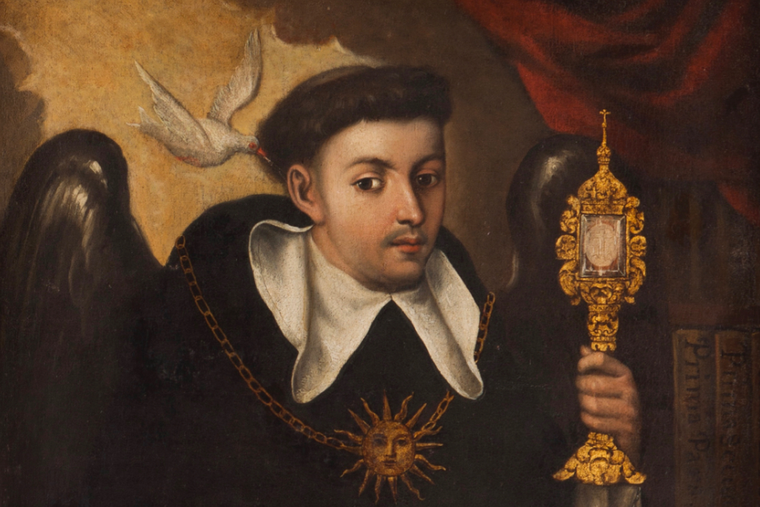
<p>St. Thomas lay dying at Fossanova. After confessing his sins and receiving absolution, he readied himself to receive his Eucharistic Lord as he formulated his last testament:</p>
<blockquote><p>“I receive you, price of my soul’s redemption. I receive you, viaticum of my pilgrimage, for love of whom I have<i> studied, watched </i>and<i> labored. </i>I have<i> preached </i>you. I have<i> taught </i>you<i>. </i>Never have I said anything against you, and if I have done so, it is through ignorance, and I am not stubborn in my error. If I have taught wrongly concerning this sacrament or the others, I submit it to the judgment of the Holy Roman Church, in obedience to which I now leave this life.” </p></blockquote>
<p>We find ourselves at the culmination of St. Thomas’ life. But how did he come to this moment? What led him here? As his biographers recount, St. Thomas had fallen ill in the midst of one of his many journeys. He had been called to the Second Council of Lyons to address the wounds of a divided Church. With his <i>Contra Errores Graecorum </i>(<i>Against the Errors of the Greeks</i>)<i> </i>in hand, he set out in early 1274 from southern Italy to arrive in time for the May gathering. But <i>this</i> journey would ultimately prove too much for him, for even before he had set out, he was already fading.</p>
<p>A man given to contemplation, St. Thomas was known for his abstraction, even his reveries, but something had happened as of late that distanced him further from this present life. Since the end of the following year, he had been drifting. One episode seems to have been largely responsible. On the feast of St. Nicholas, after the celebration of the Holy Mass, St. Thomas beheld a vision. In that mystical encounter, he saw something — saw someone. In what transpired, he drew closer to heaven than ever before. In the weeks that followed, he found himself somehow less on earth. He ceased to dictate the <i>Summa Theologiae,</i> though he was only midway through the treatment on the sacraments. “I can do no more,” he said. “Everything I have written seems to me as straw in comparison with what I have seen.”</p>
<p>Some authors suggest this pronouncement shows that St. Thomas saw his work as meaningless, erroneous and that this moment signaled the capitulation of a broken man. That’s unlikely, as he didn’t ask for his works to be corrected or to be burned. He simply showed little interest in further elaboration. His studies, his labors, his night watches weren’t worthless; they were simply coming to an end.</p>
<p>So, what was it, what was weighing on him? Other authors suggest a physical or mental breakdown. Perhaps, here, we see the surrendering of a feeble body or the shattering of a fragile psyche. Certainly, the demands placed upon him, both by others and by himself, were astonishing. At the end of his life, he was producing at a rate of 13 pages per day, mind you, some of the most theologically rich and mystically sensible pages ever written. His opinion was solicited from every corner of Christendom. His travels took him near and far, and the burden weighed heavily on his hulking frame. The testimony seems to be that, yes, his health <i>was</i> failing, <i>some</i>. But that can’t be the whole of the explanation, for among the final things that he dictated (even in the last months of his life), we have lucid explanations of vexing questions. Even if his body had slowed, his mind quickened, with luminosity undiminished.</p>
<p>So what was it, what was preying on him? Perhaps, in the circumstances, the simplest explanation is best. Perhaps it was that St. Thomas <i>knew</i> that his life was drawing to a close. Holy indifference and poor health provide the setting, but the real drama lies in the embrace. In the final weeks of his life, St. Thomas is preparing for death. He had spent years serving as a university master, a moderator of studies, a preacher general and a papal adviser. He had demonstrated wisdom and been recognized for it. He had studied. He had labored. He had watched. He had lectured. He had disputed. He had preached. Ultimately, he had offered — offered his talents, his wisdom, his very life. Perhaps, in these last months, St. Thomas was doing what he could to see that it was a most pleasing offering and to strip away all that remained of the unpleasing. </p>
<p>There’s little sense in inventing existential musings proper to a later age, but we can imagine St. Thomas examining his heart, asking the Lord to fill up what was lacking, bringing his life’s efforts before the mirror of eternity.</p>
<p>For, beyond any shadow of a doubt, the sheer grandeur of his vocation would have crushed a lesser man, or a man blessed with fewer graces. St. Thomas had endeavored a truly magnanimous offering, which, we know, is always a risk. He had set out in dogged search for truth, for God, all at a time bedeviled by philosophical novelty and theological foment. He had joined a religious order ambitious and idealistic in its apostolic vision in a time of untested evangelical excess. He had lived his priestly life at the heart of the Church and the center of the city; he had endeavored to illumine and not merely to shine, and so been implicated in contentious affairs — both temporal and eternal. His was a public life, an important life, a perilous life. </p>
<p>St. Thomas’ accomplishments had brought him renown, honor, power and some modicum of pleasure. How difficult in the circumstances to possess without possessing or being possessed thereby? One biographer recounts that, along the way to Lyons, perhaps near the Abbey of Monte Cassino, one of his secretaries spoke to him of the near-certain cardinal’s hat awaiting him at the journey’s end. We can picture St. Thomas musing to himself: “Might it have been safer to stay at Monte Cassino? Might it have been better to remain hidden and humble? Or would that even have been possible?” And so, in his final days, we witness him entrusting his soul to the only one who can guard it safe unto eternity — Christ, his Eucharistic Lord.</p>
<p>St. Thomas reveals the real gamble of each and every Christian life. To endeavor great things is a risk, for one risks endeavoring those great things for less than greatest reasons. Each Christian must labor in all his efforts, in all that he does, to bring forward the Lord Jesus Christ for love of the Lord Jesus Christ. Along the way, he must confront the attachments and allurements posturing as sufficiently noble goods for which he might offer his life for sufficiently good reason. In this confrontation, crass goods prove less dangerous as clearly less worthy — wealth, fame, pleasure, power. It’s the subtle goods that prove more ambiguous, those approaching closer the ideal and thereby abetting our rationalizations. Refinement, intelligence, ambition &#8230; all wonderful if referred to their source and end. All pitiful if divorced therefrom.</p>
<p>On the one hand, the temptation to settle for something not quite Christ makes little sense for the would-be saint. Why strive so hard and climb so high only to compromise? Why expend oneself for created goods when the Uncreated good lies just beyond? On the other hand, we feel acutely the difference that “just beyond” makes. As one preacher has it, “It is so much less costly, so much more spiritually efficient to do everything merely for a very, very good reason.” Why not let one of those serve? Many do, and their lives bear the mark of their succumbing. </p>
<p>As we know from our many abortive attempts, only the Lord Jesus can bear the weight of our whole heart’s love. Every other motive, however good or noble, buckles under the burden of an infinite desire. In the end, nothing short of bringing forth the Lord Jesus Christ will amount to anything of abiding worth. It’s all or nothing.</p>
<p>If not for Christ, then the intellectual life is but a cultivated form of literate gluttony, the religious life a sterile exercise in self-denial, and priestly life a pastoral accountancy reducible to profit and loss. To settle for something less is, as one preacher has it, to end up “respectable but unworthy of respect; honorable but never ourselves a true honor; solid citizens but not solid gold.” In the end, though, we want solid good. Or, rather, we want the refiner who can make us such.</p>
<p>And so, we return to St. Thomas as he stands before the door through which Christ beckons. The prospect of crossing the threshold has been with him now for several weeks. Truth be told, it has been with him for several years. It’s just that now the door swings open. Having fallen ill at his niece’s house, St. Thomas asked to be transferred to the nearby monastery at Fossanova. St. Thomas knows what awaits: “If the Lord must visit me, it is better for him to find me in a religious house than in laymen’s dwellings.” </p>
<p>Seen from this vantage, the formulation of his testament takes on a new aspect. At this critical point, he does anew what he has sought always to do: to bring forward the Lord Jesus Christ, at once desperately and serenely, mindful of the risk. Here, we can move his labors to the background as Christ stands clearly in the foreground. </p>
<blockquote><p>“I receive <i>you</i>, <i>price of my soul’s redemption</i>, I receive <i>you</i>, <i>viaticum of my pilgrimage</i>, for love of <i>you</i> I have studied, watched and labored. I have preached <i>you</i>. I have taught <i>you. </i>Never have I said anything against <i>you</i>, and if I have done so it is through ignorance, and I am not stubborn in my error. If I have taught wrongly concerning this sacrament or the others, I submit it to the judgment of the Holy Roman Church, in obedience to which I leave now this life.”</p></blockquote>
<p>We behold in his words equal parts profession and confession, realization and aspiration. As if to say, it was only ever <i>you</i>, Lord. And where it was not wholly, may it be so fully, now and for all eternity. But if it is to be such, it is <i>you</i> who will see it through. </p>
<p>From whence the certainty? From whence the confidence? St. Thomas believed because Christ had promised, for in another vision, the Lord once addressed St. Thomas: “Well have you written of me, Thomas, what would you have in return?” St. Thomas famously responded: “Nothing but you, Lord, nothing but you.” What we see at Fossanova is but the fulfillment of this promise.</p>
<p>So, when we happen upon St. Thomas at the end of his life, he’s not simply preparing for death, he’s straining for it. What he has received his whole life long under signs, he means to embrace in reality, “that whatever [he does], in word or deed, [he may do] in the name of the Lord Jesus, giving thanks to God the Father through him.”</p>
</p></div>
<p><br />
<br /><a href="https://www.ncregister.com/commentaries/st-thomas-aquinas-death-750-years-eucharistic-testament">Source link </a></p>
<p><!-- END THEIA POST SLIDER --></p>

His Eucharistic Testament| National Catholic Register