<p><!-- BEGIN THEIA POST SLIDER --></p>
<p> <br />
</p>
<div>
<p>In the light of Christ’s Resurrection, even the resting place of the dead points to the promise that all shall be made new.</p>
</p></div>
<div>
<p>“Look, Dad — a burial garden!”</p>
<p>It took me a moment to process our 6-year-old’s exclamation from the back of the minivan. Burial, yes — she was referencing the cemetery we were passing across the road — but did she just say “burial <i>garden</i>?”</p>
<p>A few days before, we had visited the grave of her great-grandmother, who died three years ago. My mom had brought flowers to the cemetery, distributing them to the grandkids for them to place on the ground. We cried; we laughed; we told stories — we <i>remembered</i>.</p>
<p>This was the first time our 6-year-old — who has always had a deep curiosity about death and the afterlife — had visited a cemetery. But apparently, she wasn’t afraid or disturbed at all. On the contrary: Whether it was the flowers, the family bond, or just the orderly rows of headstones in that plot of land, she walked away conceiving of it as a <i>garden </i>— a place not only of tranquility and peace but of vibrancy and color.</p>
<p>Out of the mouths of the young, God has prepared praise for himself (Matthew 21:16) — and almost immediately, the phrase struck me as a perfect summary of the paradoxical attitude of the Christian toward death. On the one hand, a cemetery is a place of “burial,” the interment of our mortal remains into the earth. Burial signals to us the inevitability and finality of death. “We must all die,” a wise woman of Scripture declares. “We are like water spilled on the ground, which cannot be gathered up” (2 Samuel 14:14).</p>
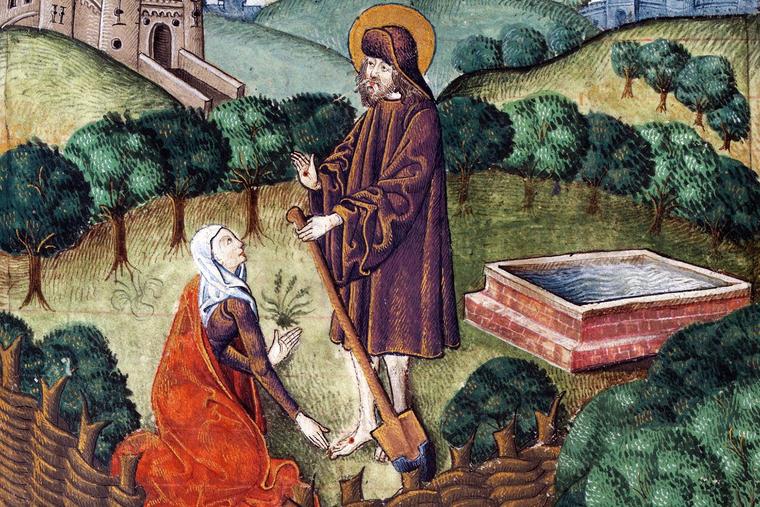
<p>On the other hand, a cemetery is a kind of garden, a charged place of patient waiting, hidden growth, and, above all, of hope for a future flowering. Indeed, in the Gospel of John, we hear that Jesus himself was buried <i>in</i> an actual garden: “Now there was a garden in the place where he was crucified, and in the garden there was a new tomb in which no one had ever been laid” (John 19:41).</p>
<p>What draws these two images together, the very condition for its possibility, is the <i>bodily</i> <i>resurrection</i> of Jesus from the dead. Jesus did not remain dead in that garden but, through the power of the Holy Spirit, emerged as a “spiritual body” (1 Corinthians 15:44) — supernatural yet “flesh and bones” (Luke 24:39) — leaving behind an empty tomb.</p>
<p>The paradisal Garden of Eden, lost through disobedience, has touched down in the sorrowful garden of Calvary, claimed by the Son’s obedience; and death is now, in Christ, the door to eternal life. St. Paul uses a harvest image for Christ’s resurrection: “Christ has been raised from the dead, the <i>firstfruits</i> of those who have died” (1 Corinthians 15:20).</p>
<p>Dante beautifully captures this same paradox in a canto from the <i>Purgatory</i> of his <i>Divine Comedy</i>:</p>
<blockquote><p>Have you not learned that we are only worms<br />
born to form the angelic butterfly<br />
which flies to justice shorn of its cocoon?</p></blockquote>
<blockquote><p>About what do your spirits crow so high,<br />
defective insects all of you — like grubs<br />
falling short of their form’s maturity?</p></blockquote>
<p> Anthony Esolen, in his <a href="https://www.amazon.com/Purgatory-Divine-Comedy-Dante/dp/0812971256/">commentary on this passage</a>, explains, “The worm of corruption is a common enough biblical image for man ‘that is rottenness, and the son of man who is a worm’ (Job 25:6), while the association of the soul with the butterfly goes back to classical Greece. The genius of Dante has combined two commonplaces and fused them into an image at once artistically and theologically potent.”</p>
<p>We’re not mere butterflies — pure spirits fluttering and flitting about in the air with no connection to the messiness of the ground. Nor are we mere worms — corruptible bodies wearily winding our way down into the ground with no connection to the life-giving air. We’re something far stranger: creatures <i>on the way</i> to the perfection of our form. And that perfection isn’t the denial of our wormy past but rather its full “maturity” in the life of the butterfly, a creature drawn, appropriately enough, to gardens.</p>
<p>Someone recently remarked to me that, in her opinion, cemeteries are likely to fall into desuetude and vanish from the face of the earth. Between the collapse of faith in the Resurrection and the increasing popularity of cremation — <a href="https://www.nationalcremation.com/cremation-information/why-is-cremation-becoming-more-popular-in-the-us">by some estimates</a>, 70% of Americans will choose it over traditional burial by 2030 — cemeteries may soon be looked upon culturally as unsanitary, inconvenient, primitive — even bizarre.</p>
<p>Yet the cemetery remains a vital aspect of Christianity, and it has everything to do with our worm-butterfly nature — and our burial-garden faith in Jesus. Is a cemetery the ultimate place of horror? Only to those still living under the reign of death rather than Christ. Is it the ultimate place of liberation? Only to those who take no stock of the body and this world.</p>
<p>For the Christian, it’s something else: a sign of hope amid despair, a flash of light in the darkness, a whisper of a promise that, as Julian of Norwich prophesied, “all shall be well, and all shall be well, and all manner of thing shall be well”; that, as Samwise Gamgee dreamt, everything sad is “going to come untrue” — or more precisely, be integrated into the greater whole of joy; that those grains of wheat that fall into the earth to die will bear much fruit (John 12:24).</p>
<p>Throughout the month of November, Catholics will visit cemeteries to remember and pray for their beloved dead. May we continue to be the people of the burial garden, until death is no more (Revelation 21:4).</p>
</p></div>
<p><br />
<br /><a href="https://www.ncregister.com/commentaries/becklo-burial-gardens">Source link </a></p>
<p><!-- END THEIA POST SLIDER --></p>

How a Cemetery Visit Becomes a Lesson in Hope| National Catholic Register