<p><!-- BEGIN THEIA POST SLIDER --></p>
<p> <br />
</p>
<p>From the well-meaning attempt to canonize a noble pup to a streamlined administrative process reserved to the Vatican, the practice of declaring saint has come a long way.</p>
<div data-cy="articleBody">
<p>Around the 1250s a French Dominican priest heard from local women during confession about “St. Guinefort,” an object of devotion in the region near Lyons.</p>
<p>“As I thought that this was some holy person, I continued with my enquiry and finally learned that this was actually a greyhound …” the priest, Stephen of Bourbon, later <a href="https://www.historyclass.org/2PM/04apr-may/guinefort.htm">wrote</a>.</p>
<p>As the story goes, the dog had saved a baby boy from a snake, only to be unjustly killed by the child’s father, who wrongly thought the dog had killed the child.</p>
<p>While some people might be disappointed to hear this, for the record, dogs can’t be Christians, let alone saints, so the priest attempted to root out what he called an “insulting superstition.”</p>
<p>Misguided veneration of the noble dog is one example of what historian Donald Prudlo describes as “the proposal of unworthy candidates” for sainthood, which helped lead to the highly formal process for declaring saints that the Catholic Church uses today.</p>
<p>That process was already well underway by the 13th century, as popes began to gradually take control of public veneration of deceased Catholics thought to be in heaven, eventually replacing the purely local processes that had been in place before. With papal authority, investigators eliminated hypocrites, heretics, non-humans and the nonexistent from the list of potential worthies and examined the lives of other candidates for signs of holiness and approval from heaven, including miracles attributable to their intercession with God.</p>
<p>For at least the past 800 years, Church authorities have required reams of evidence — literally, in the case of Blessed Fulton Sheen, whose pre-beatification <i>positio</i> describing his life ran to 15,000 pages — to determine whether the person led a life of what the Church calls “heroic virtue.”</p>
<p>“You have a process which privileges the voices of all of these people who venerate the saint. … Pro and con come and they give their depositions. And then the people that record receiving miracles come, and they give their depositions, in formal legal structure,” Prudlo, author of <a href="https://cornellpress.cornell.edu/book/9780801454035/certain-sainthood/#bookTabs=1"><i>Certain Sainthood: Canonization and the Origins of Papal Infallibility in the Medieval Church</i></a> (2015), told the Register.</p>
<p>The medieval Church’s processes, he said, “are of such legal sophistication” that “they form the basis of our own grand jury systems” in the United States today.</p>
<h3><b>From Local to Universal</b></h3>
<p>Individual Christians venerated the earliest saints long before documentary evidence demonstrates it.</p>
<p>“By the fourth and fifth centuries, bishops had begun to exercise control over the recognition and worship accorded to various saints in their own territories,” Prudlo writes in <i>Certain Sainthood</i>, using the word “worship” to mean respect and honor, not adoration, which the Catechism of the Catholic Church says is “due to God alone” (<a href="https://www.vatican.va/content/catechism/en/part_three/section_two/chapter_one/article_1/iv_you_shall_not_make_for_yourself_a_graven_image.html">2132</a>).</p>
<p>Bishops honored deceased holy people by “canonization,” meaning “insertion of the saint’s name into the Eucharistic Canon” and thus making the saint “<i>embedded liturgically</i> in the community,” Prudlo writes, with italics in the original.</p>
<p>This liturgical aspect of sainthood is key to understanding it, Prudlo writes in the book, because “the canonization of a saint was a primarily liturgical event and not initially a juridical one.”</p>
<p>What was originally a purely local act eventually took on meaning for the entire Church, as the pope’s role increased gradually.</p>
<p>In time, many Catholics enamored of a local deceased person with a reputation for holiness wanted the pope to weigh in on the person’s sanctity, since the bishop of Rome offered an authority superior to a local bishop or synod of bishops.</p>
<p>“This superiority would be realized by any number of strategies: increased prestige from papal approval, universality of the appeal of papal saints, approval by recognized and respected authorities, and last and perhaps most essentially, the idea that papal canonization gave one certitude over the results,” writes Prudlo, <a href="https://utulsa.edu/people/donald-prudlo/">professor of Catholic studies</a> at the University of Tulsa.</p>
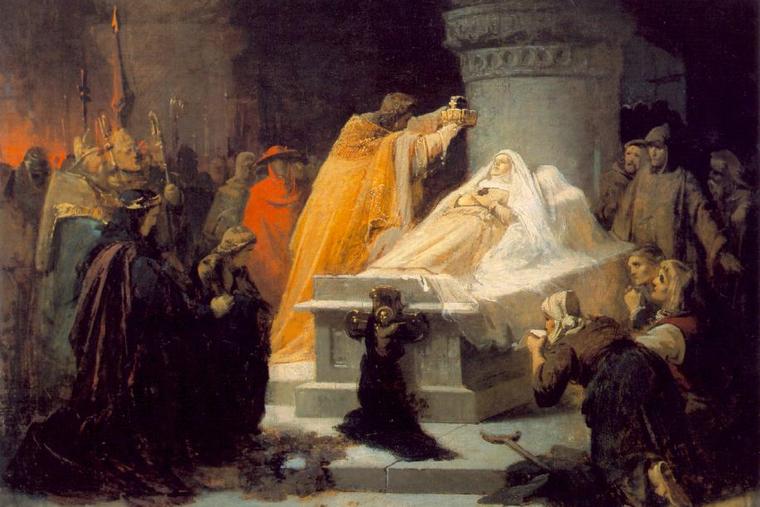
<p>In 993, Pope John XV declared Ulrich of Augsburg (890-973) a saint in the presence of German bishops — “the first recorded international canonization by a bishop of Rome,” Prudlo writes.</p>
<p>The pope’s role became even clearer in 1173, when Pope Alexander III canonized the martyred English archbishop Thomas Becket “on his own authority” and commanded “the observance of his feast” for the whole Church, Prudlo writes.</p>
<p>In 1199, Pope Innocent III canonized the Italian merchant Homobonus of Cremona while codifying rules for making such determinations, including, writes Prudlo, “well-founded biography, solid testimony of miracles, and the considerable application of papal authority.”</p>
<p>Innocent’s canonization of Homobonus and (in 1200) the 11th-century Holy Roman empress Cunigunde of Luxembourg “were the first ones that look pretty much like canonizations do today,” Prudlo told the Register.</p>
<p>In the 1250s, St. Thomas Aquinas <a href="https://api.pageplace.de/preview/DT0400.9780190069544_A38593147/preview-9780190069544_A38593147.pdf">wrote</a> that canonizations are infallible (“the honor that we give to the saint is a sort of profession of our faith in the glory of saints,” such that “the Church cannot err in judgments about them”), a view Catholic theologians generally hold today, though the Church has never formally defined it.</p>
<p>“A doctrine unheard of in 1150 became, by 1350, the common theological consensus of the Roman Catholic Church,” Prudlo writes.</p>
<p>In 1634, Pope Urban VIII <a href="https://www.causesanti.va/content/dam/causesanti/interventi-e-articoli/Paul-Pallath---Evolution-of-the-Special-Law-on-Canonization-Especially-after-the-Second-Va.pdf">reserved</a> canonization of saints to the pope.</p>
<p>In 1983, Pope John Paul II (himself later canonized) <a href="https://www.vatican.va/content/john-paul-ii/en/apost_constitutions/documents/hf_jp-ii_apc_25011983_divinus-perfectionis-magister.html">streamlined</a> the canonization process, reducing the number of miracles required. He also eliminated the adversarial role of a position traditionally known as “the devil’s advocate” — although Prudlo told the Register that change is sometimes misunderstood.</p>
<p>“All of the negative information that the devil’s advocate used is still included in all the theological and historical assessments. It’s just not in such an odd forensic way,” Prudlo said.</p>
<p>While final approval of saints has become standardized and centralized over the centuries, the road to being declared a saint still begins with ordinary Catholics believing that a particular person was a saint and stumping for the Church to recognize it.</p>
<p>“It’s absolutely critical that you have a mass of faithful who are convinced that this person is holy,” Prudlo told the Register. “And so it has to start there.”</p>
</div>
<p><br />
<br /><a href="https://www.ncregister.com/features/catholic-history-of-canonization">Source link </a></p>
<p><!-- END THEIA POST SLIDER --></p>

How the Pope Became the Final Word on Sainthood