


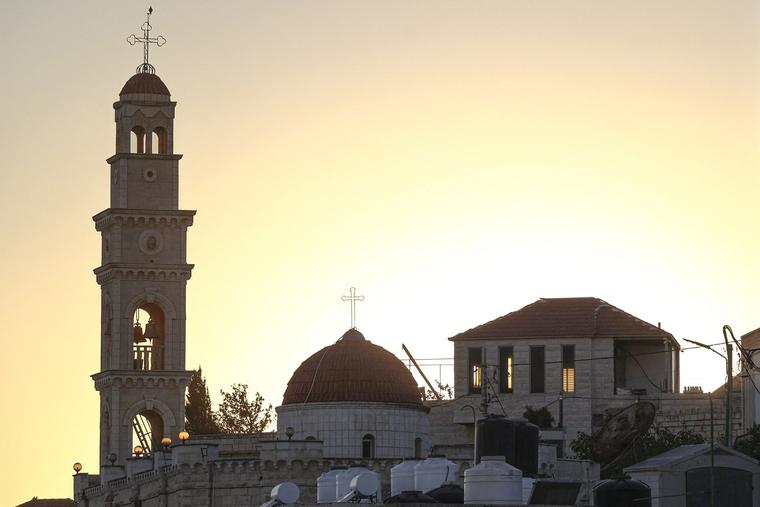
COMMENTARY: The faith remains strong, but confidence in a secure future is fading as Christians increasingly leave their ancestral homelands.
How much are you willing to pay for your faith?
That often seems a rhetorical question for Western Christians, although the cost can be very real even here. One only has to look at the death of Father Jacques Hamel or the case of former Finnish government minister Päivi Räsänen as two examples.
In the Muslim East, for centuries the cost was literally measured in gold as Christians had to pay punitive taxes to keep their faith, the notorious jizya tax imposed on religious minorities by Muslim rulers well into the 19th century (and which the Islamic State terrorist group sought to revive). The history of Christians under Muslim rule is a complex one and included both periods of great flourishing and great slaughter — but mostly, it was costly to be a Christian.
Despite headlines when there is some terrorist attack, as happened at a Damascus church last year, the cost for many Middle East Christians today is less dramatic, less newsworthy, more subtle, but no less inexorable.
This week, on the eve of the Feast of the Exaltation of the Holy Cross, two masked men on a motorcycle threw what was described as a “sound bomb” into the Greek Orthodox Cathedral of St. George in the Syrian city of Hama. There were no casualties but some physical damage inside the church. The intimidation factor was clear. Earlier this year, what are dubbed “sectarian tensions” led to extensive damage to shops, cars and homes in the Syrian Christian town of al-Suqaylabiya caused by Sunni Muslims on motorcycles from a neighboring town.
Syria is impoverished, with soaring unemployment rates and poor governance, all factors that make that sectarian friction even worse.
The undramatic, under-the-radar, almost routine process of Middle East Christians paying a heavy price for merely existing is everywhere to be seen. It is not state-sponsored, not usually, nor is it always Islamic in origin, nor is it usually targeted — but the results are devastating.
In 1947, the city of Jerusalem had 27,000 Christians. Today it has 4,000 remaining. The Catholic priest in the West Bank Christian village of Taybeh, Father Bashar Fawadleh, lamented last December that more than 13 Christian families had left the town in the preceding two years, emigrating to Spain and the United States. The environs of the town have seen repeated incursions and vandalism by Israeli settlers over the past years.
Here is the push-pull factor of Christian emigration in stark action. The cost of remaining became too high for those families; the pull of leaving became too attractive to resist. There are more Palestinian Christians in Australia than in Jerusalem, more in America than in Ramallah.
The Hamas War that began on Oct. 7, 2023, only accelerated Christian emigration from the West Bank as IDF checkpoints, settler attacks and economic crisis all increased.
According to Palestinian Christian activist Khalil Sayegh, in Gaza “less than 500 Christians remain, the elderly, sick and poor.” Those with the financial means and connections to escape have already done so. Most of those who remain have lost their homes in the fighting as well as any economic activity or business they may have had.
But the attraction of flight is not limited to Christians. Polling shows large percentages of populations in the Middle East and North Africa, from Tunisia to Iran, would emigrate if they could. The economic crisis triggered by the Iran War this year has affected everyone, making life more expensive and difficult everywhere. Christians are more likely to emigrate because many of them have ties in the West already or have increasingly precarious, middle-class lives that make movement a bit easier.
Even in Lebanon, the ancient stronghold of Middle Eastern Christianity and where the Christian presence has been informally and traditionally codified, there is a sense of slow loss. Recent labor studies in Lebanon have revealed an ongoing decline in Christian representation in some state institutions.
Recent appointments in the government ministries of health, finance, and energy and water showed Christians to be heavily underrepresented (two of these ministries are headed by pro-Hezbollah Shiite Muslims). With Lebanon in economic decline, government jobs are some of the few lasting employment opportunities that remain.
Christians are torn between staying in their homelands and leaving. Father Fawadleh asked departing Taybeh Christians to maintain their ties and not to sell their lands. In Lebanon this week, many Lebanese Christians — especially Maronites — noted the great cost they had borne to survive and endure as they remembered the 44th anniversary of the assassination of President-elect Bashir Gemayel during the Lebanese Civil War. The week saw the passing of two other historic figures of the Lebanese Christian Resistance, former Superior General of the Lebanese Maronite Order Abbot Bulos Naaman and politician Dory Chamoun, both aged 94.
It was Naaman, who was also a great scholar of the Maronite Church and of Eastern Christianity, who saw Lebanon as a refuge that persisted because it provided Christians and non-Christians a precious measure of freedom, including economic and religious freedom, that did not exist elsewhere in the region. He wrote, “We are Christians and we will remain Christians without parting with the virtue of hope that carries us towards the other with a historical love, making our own destiny responsible for it and witnesses to it.”
The faith of Middle East Christians is strong, a reality that is obvious to anyone who knows them. They have paid much for that faith, sacrificed through the centuries, and have proven to be steadfast. The faith that is declining now is not faith in God, but faith in the temporal future, faith in justice and in human institutions and governments and nations that have failed miserably to provide the hope and security all societies need to flourish. There is a lesson for us too here.