<p><!-- BEGIN THEIA POST SLIDER --></p>
<p> <br />
</p>
<div>
<p>Corsica is one of the few French territories to have a repertoire of songs that are steeped in history and still in use today, songs that blend the sacred and the secular and which will be given pride of place during the papal visit. </p>
</p></div>
<div>
<p>Pope Francis is visiting Corsica to take part in a symposium on popular piety in the Mediterranean. A central element of this popular piety are the songs, both religious and secular, handed down through the generations and sung by all Corsicans. These songs will be given pride of place during the Mass, bearing witness to the great diversity of Corsican heritage.</p>
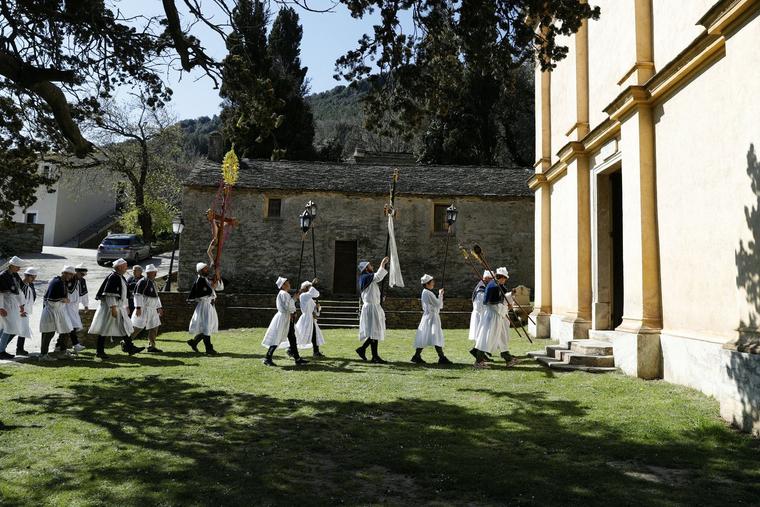
<p>These songs accompany Masses and major family events such as weddings and christenings, as well as everyday life. The tradition is preserved and passed on by confraternities, but also by numerous choirs, mainly male, and by families. To mark the Pope’s visit, a new confraternity (or “brotherhood”) will be created especially for the occasion, dedicated to St. Anthony of Ajaccio.</p>
<p>“The confraternity has a dual function: religious and social. It is responsible for organizing Christian life, but also for helping the poorest and supporting the elderly. It is linked to a parish and therefore to a particular saint,” explained Yannick Campo, a journalist with <i>Le Petit Bastiais</i>.</p>
<p>Such confraternities have a long history in the island region of France’s culture.</p>
<p>“Most confraternities are confraternities of penitents under the protection of the Holy Cross. The place where the confreres meet is called the Holy Cross. The confreres are dressed in white: They are the white penitents. In the 1770s, the king of France imposed a cape to distinguish the confraternities. Each color of cape has a particular meaning: red, martyr; blue, holy cross; black, St. John the Baptist or sign of mourning during the Mass for the dead,” said Paul-Noël Giacomoni, member of the confraternities of Patrimonio. </p>
<p>Singing plays a major role in confraternities. Most of the hymns are in Latin.</p>
<p>“Latin has always been used in Corsica and has never been abandoned. So the use of Latin is perfectly normal and is still used in the liturgy. The Corsican clergy let the confraternities do their thing; they didn’t intervene to change the songs. There is a choral technique which means that the songs can only be sung in Latin,” explained Giacomoni. </p>
<p>A glimpse of this musical wealth will be given on Dec. 15 during the Pope&#8217;s visit. </p>
<p>The first song to be performed is <a href="https://www.youtube.com/watch?v=mMAx4Syqg40"><i>Terra Corsa </i>by Patrick Fiori</a>. A contemporary song paying homage to Corsica<i>, Terra Corsa </i>is inspired by the traditional harmonies and a cappella<i> </i>mastery of Corsican songs. This secular song will be performed in front of the Pope in the morning.</p>
<p>For the Mass, the program will be extremely rich. Most of the songs are classic prayers from the Roman liturgy, sung in Latin and Corsican, performed without instruments and a cappella.<i> </i></p>
<p>The opening hymn of the Mass will be sung by the diocesan choir of Ajaccio, made up of 350 singers and directed by Jean-Louis Blaineau, choirmaster of the Chœur de Sartène. Founded in 1995 by Jean-Paul Poletti and made up of six men, the <a href="http://choeurdesartene.fr/">Chœur de Sartène</a> has renewed the heritage approach to Corsican song. Poletti has carried out extensive research in archives, liturgical books and song books to recover the memory and history of sacred songs, which he has combined with secular songs. A great deal of work has been done on medieval Franciscan chants, as this confraternity played an important role in the evangelization of Corsica. The Sartène Choir is keen to pass on its knowledge and is involved in training younger singers, as well as promoting Corsican song beyond the island by giving numerous concerts around the world. </p>
<p>The <i>introït</i> will be sung in Corsican by the group <a href="https://www.youtube.com/results?search_query=chjami+aghjales+introitus">Chjami Aghjales</a>. Founded in 1977 in Bastia, this group has contributed to the renewal of Corsican culture through song, bringing together many young men from working-class neighborhoods and mixing secular and sacred songs. Chjami Aghjales has translated several Soviet and South American revolutionary songs into Corsican, as well as revived the classics of Corsican music. As part of the Third World political logic of the 1970s, Chjami Aghjales represented left-wing nationalism, which is now on the wane in Corsica but which marked an era and structured political struggles. </p>
<p><i>U Domu¸ </i>a polyphonic group associated with Ajaccio Cathedral, will sing the <i>Kyrie</i>, while the Offertory will be performed by more than 1,300 members of various Corsican confraternities. </p>
<p>The confraternities play a major social, cultural and religious role in Corsica. Linked to neighborhoods and one or more patron saints, they look after the vulnerable, attend to the upkeep of churches and organize religious ceremonies such as funerals, first Communions and baptisms. Perceived as archaic, they fell into disuse in the 1970s and were sometimes even opposed by priests and bishops in the name of “modernity.” Aware of their essential role in the practice of faith and popular piety, the confraternities have been revived since the 2000s, and Cardinal François Bustillo of Ajaccio has made them one of his episcopate’s development priorities. The fact that they are taking part in the Pope’s Mass will therefore be an important moment for them and a visible way to show just how closely they are linked to the daily lives of Corsicans. </p>
<p>The Mass will conclude with the Corsican national anthem<a href="https://www.youtube.com/watch?v=blJNFSrTR_0"><i>, Dio vi salvi Regina</i></a><i> </i>(“God save you Queen”). Composed in 1635 by the Jesuit François de Geronimo, who took up medieval chants of the <i>Salve Regina</i>, this Marian hymn was adopted as Corsica&#8217;s national anthem in 1735 after the Corsicans revolted against Genoese domination. The insurgents placed themselves under the protection of the Virgin Mary, singing this hymn as they went into battle, hence its adoption as the national anthem. As for Corsica’s national feast day, it was set for Dec. 8, in homage to the Immaculate Conception, even though the dogma of the Immaculate Conception was not pronounced until a century later. The <i>Dio vi salvi Regina </i>is still sung today, at sporting competitions, particularly football (soccer), and at family events, and Dec. 8 is still considered one of Corsica&#8217;s bank holidays. The fact that the Mass ends with this song illustrates the links that exist between the sacred and the secular and the Catholic roots of Corsica. </p>
<p>“Corsica is deeply Christian,” explained Giacomoni. “Many young people have crosses tattooed on them or wear crosses around their necks, which is a different vision of secularism, unlike the rest of France. Corsica has been under the protection of the Virgin Mary since the 18th<sup> </sup>century, who is queen of Corsica. The cardinal comes to football stadiums without any problems. It’s completely his place to be with the people, and people find it normal for the cardinal to be present.” </p>
<p>The Pope’s visit to Corsica is therefore a joyous occasion for the whole of Corsica and a model for France. </p>
<p><i>Jean-Baptiste Noé is a historian and writer.</i></p>
</p></div>
<p><br />
<br /><a href="https://www.ncregister.com/news/corsican-songs-to-welcome-pope-francis">Source link </a></p>
<p><!-- END THEIA POST SLIDER --></p>

In Corsica, Songs of the Sacred and the Secular Will Welcome Pope Francis| National Catholic Register