


It is, perhaps, more important than ever to bring children to Mass. Beyond being our weekly worship, beyond the sustaining power of receiving Our Lord in the Eucharist, and beyond just establishing family traditions, Mass is often the one place children can truly witness their parents putting their beliefs into action.
But taking kids to Mass isn’t easy. And I’m not talking about the inevitable theological discussions with pre-teens and teens who would much rather sleep in on Sunday and follow their friends’ more worldly paths. I’m talking about taking my three children age 6 and under to weekly Mass, even when sometimes it seems I might never actually participate without spending half my time hissing all manner of pleading and threats at the trio who are just moments away from inciting pure chaos.
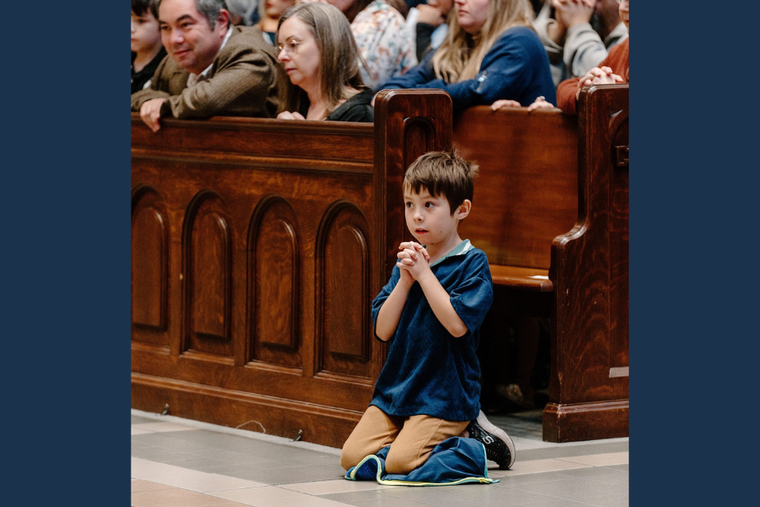
On All Souls’ Day, though, my son was photographed by the Nashville Diocese’s own photographer, pious as an angel, kneeling in the aisle, eyes raised to heaven, so that he could witness Bishop Mark Spalding. He later told our pastor at the Cathedral of the Incarnation that he wanted to be a “baby priest” (which is what we call the seminarians we pray for, pictured on a holy card taped to our fridge) and planned a “priest outfit” for a special “What do you want to be when you grow up?” dress-up day at school.
You’d think we were perfect pious parents! Our little 6-year-old so enchanted by the Blessed Sacrament that he moved where he could see it clearly, my husband and I behind him in the front row.
But if you look closely, you can see, etched in our faces, that, perhaps, all is not so angelic.
You might also clue in to what happens behind the scenes when you spot our other son, halfway out of the row, nearly asleep. Or our daughter, who is in the row behind us, ignoring our whispered pleas to stop kicking the back of the pew. And the photographer may or may not have happened to snap the picture right before my kneeling son tried to concelebrate, and I had to yank him back into the pew.
Most weeks, we spend a considerable portion of the liturgy wrestling with one child or another; this has been the norm for the few years we’ve been Nashville churchgoers. Sometimes, the kids are great and attentive — they go to Mass at least twice a week at school, and they know the prayers by heart — but if I took stock of exactly how many homilies I’ve fully heard in the last few years, I could probably count them on one hand (and that’s not the fault of our pastor, who is truly a great homilist). Sometimes, I’ve resorted to promises of post-Mass Happy Meals; sometimes, I’ve tried a submission hold (from combat sports). Sometimes, I’ve dragged a screaming daughter out of Mass to have a chat in the women’s bathroom. Sometimes, my only prayer is for God to please make them behave just this once.
One time, I cried.
But we always show up. Not because it’s easy, but because it’s what our children — and we — need.
Back when we first had kids, we thought about what it meant to raise Catholic children. My husband is an adult convert. I was raised Catholic, but my parents weren’t particularly orthodox, or even weekly Massgoers, and even though I went to years of Catholic school, it never quite sank in (though I do fondly remember those ’90s Friday Mass bangers, like I Am the Bread of Life). I came back to the faith as an adult. Neither of us knew how to catechize children; I’d been catechized poorly as a child and my husband not at all.
But both of us knew how to show up. So that’s what we did.
We made a schedule for prayer. We made Mass every Sunday. We said grace before meals and said the St. Michael Prayer at night, between teeth-brushing and story time.
And we keep showing up.
This isn’t to say it’s been particularly easy. Mass with small children is a trial, and not just for parents. I’m sure there are weeks when the people behind us regret their choice of pew and other weeks where we are visibly in the throes of sheer survival. My sons will often, for example, get into a sort-of “peace-off” wherein they compete to see who can more fervently offer the other one the peace of Christ. Almost inevitably, this results in a full-on wrestling match during the most reverent part of the Consecration.
My kids prefer to welcome Father in with the Blippi Monster Truck song, and they have regularly punctuated the solemn liturgy with flying Hot Wheels cars. A few weeks ago, I had to sit next to a giant, green Bigfoot Squishmallow — the only way we were getting out the door was if “Ben” came, too. Once, all of the children wore helmets.
But then there are weeks where my kids shout every word of the Our Father and weeks where they ask deep theological questions; and there are weeks that include Mass moments like All Souls, when it looks like it’s paying off.
And every week, there is grace. And every week, there is a Gospel.
The grace of Our Lord is there, even in the trials. We don’t go to Mass because we’re perfect. We go to Mass because we’re broken. We come to the Lord’s table seeking healing and acceptance and divine love. We, and our kids, don’t have to be perfect because God doesn’t expect perfection, and Mass doesn’t make us perfect.
After all, the way that I look at my kids misbehaving during Mass is probably how God looks at me, resisting his will, giving in to temptation, judging and sinning, and then there are those moments of turning my back on everything he has given me in my life. And yet, God’s there.
One of my kids once asked me if I would still love him even if he was the world’s worst supervillain. I answered that, while I wouldn’t approve of his plans to take over the world, and I would probably object to the condition of his island lair, and I’d pray a Rosary every day for his conversion to superhero, I would still love him because that’s what love is about.
Grace is love we don’t deserve.
The Gospel, too, isn’t meant to be lived in perfection; it’s meant to be lived in the world, in houses, and schools, between neighbors, in communities, and where things are messy and complicated and painful.
These trials are also temporary. One day, Mass will be quiet. Too quiet. And our hope is that if we keep showing up to Mass in the short term, we’ll create good Catholics in the long term.
So, if you’re discouraged, keep going. Be consistent about Mass — for them and for yourself. Beyond that, I’d recommend sitting close to the front so kids can see what’s going on, instead of just staring at the back of someone’s head for an hour. Let them ask questions, help them learn the prayers, tour the church and greet your priest (my kids never leave Mass without saying hello to every celebrant, no matter how many). Teach them the parts of the church and help them bless themselves with holy water. Show them how to kneel in front of the tabernacle — where Jesus dwells in the church outside of Mass — and make the Sign of the Cross.
But more than anything, keep showing up. Even when the behavior is bad. Even when the “shhhhhhs” are loud. Even when you don’t hear the homily, or someone puts a plastic necklace down a grate, or someone almost lights the entire church on fire because he wants to know what those votive candles are for.
Grace is there, and so is the Gospel — and our Eucharistic Lord.
That’s why we make it to Mass.