


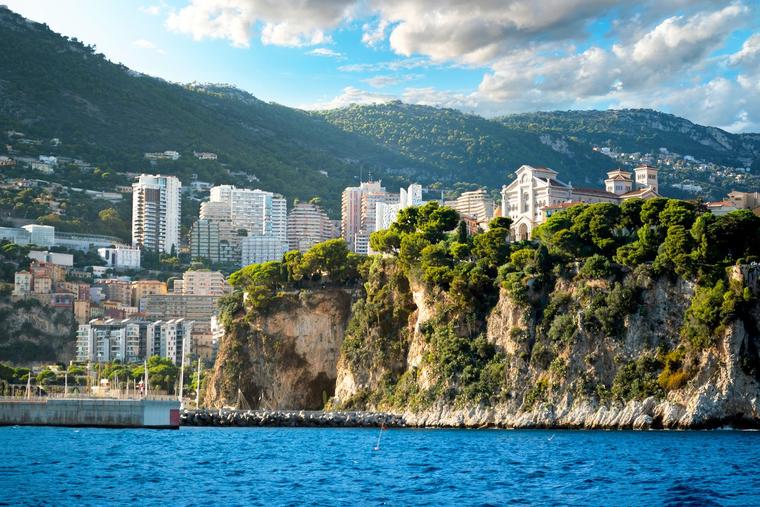
Pope Leo XIV is preparing on March 28 to be the first pope in modern times to visit Monaco, the last European country where Catholicism is the state religion.
Abbé Christian Venard, episcopal vicar for communications of the principality’s archdiocese, recently sat down with EWTN News to discuss the context of the visit and some of the challenges facing the roughly 38,000-person archdiocese.
What is the context for this event?
This event must be placed in the general context of the invitations given to the Supreme Pontiff by Prince Albert II, already during the reign of Pope Benedict XVI. He had repeatedly invited Pope Francis, and I believe this is one of the factors that must have prompted Pope Leo XIV to respond favorably this time. It is known that during [a] Jan. 17 visit [at the Vatican], Prince Albert II and the Pope had a private conversation, and it was during this audience that the Sovereign of Monaco presented the Pope with the official letter inviting him to the principality. The Pope stated that he would consider the request favorably, and subsequently, the Archbishop of Monaco also presented an official letter of invitation.
What are the characteristics of the Archdiocese of the Principality of Monaco? How do the faithful participate? How is Catholicism practiced?
Geographically nestled within French territory, the Principality of Monaco displays the nuances of a society certainly marked by French influence, but also strongly influenced by Italian and international culture. In addition to the Monegasques, French and Italians, who each represent a fifth of the population, there are approximately 150 nationalities (the most significant being Portuguese and Filipino, both of which are heavily involved in church life) — only three or four of the world’s nationalities are reportedly not represented in the principality. This diocesan sociology reveals a type of religiosity that cannot be confused with that of France or even neighboring French dioceses.
This sociology is also characterized by a social mix, combined with the country’s cosmopolitanism. Thus, while there are very wealthy people, ordinary people, sometimes even very simple ones, are also needed to make the system work. This social mix gives our diocesan Church a truly unique character. Sometimes in church, a billionaire and a housemaid can sit on the same pew. The Church is one of the rare places of social intermingling in the principality and must take this important aspect into account in its daily apostolate. In numbers, we have a diocese of 38,000 inhabitants, 25% of whom are under 24 years old. The rate of practicing is slightly less than 10%.
What do you think Leo XIV’s message to the Principality of Monaco will be?
It’s an excellent question, and one that should obviously be posed to the Holy Father himself! Without prejudice, of course, we can nevertheless identify some points of convergence. We know that the Holy Father and Prince Albert II share numerous commitments: a particular attention to respect for human life from its beginning to its end, concern for integral ecology and the protection of our “common home,” and a shared passion for sport and what it represents for humanity. We could also add the issue of the “social doctrine of the Church,” so dear to Leo XIV, which could have particular resonance in our principality.
Monaco is a country where Catholicism is the official religion, and where Prince Albert recently refused to sign legislation legalizing abortion. How is this situation an advantage for the Church, and how is it a disadvantage?
Article 9 of the Constitution states: “The Catholic, Apostolic, and Roman religion is the state religion.” This recognition confers a special character on our diocese. The state thus supports the Church’s activity, recognizing its role in the country’s institutions and providing financial support for its work. However, despite the privileged position guaranteed by a Catholic state, a sore point, as in many other European dioceses, remains a form of secularization of society. So much so that in Monaco, too, there has been a certain decline in the number of children attending catechism classes, First Communions and Confirmations, as well as a weakening of youth movements.
Finally, the highly institutional nature and strong roots of the Church in Monaco in the national community can sometimes lead the clergy and faithful to lack enthusiasm for a renewed pastoral ministry of evangelization. In this sense, everyone hopes that the Holy Father’s visit will bring about a profound individual and community renewal, in faith and mission.
How do you experience proximity to secularized France? And is there a phenomenon in the principality like the Parisian boom in adult baptisms?
Although geographically enclosed within French territory, the Principality of Monaco displays the nuances of a society certainly marked by French influence, but also strongly influenced by Italian (just remember Monaco’s Genoese origins) and international culture. Monaco, nestled in a European civilization increasingly distant from its Christian roots, is also a testing ground for social legislation. On the one hand, the confessional nature of the state; on the other, the steamroller of contemporary ideologies, pressure from the Council of Europe … demands for the decriminalization of abortion, bioethics laws, marriage for all … the Church is an essential partner in legislative processes. Monaco can serve as a model for responding to all these questions.
Here too, the challenge of being an exemplary Catholic state is considerable. As in France, the diocese is now seeing a significant number of catechumens or people starting anew. This year, 70 men and women, mostly young people, are following the formation program offered by the diocese to guide them toward the sacraments of baptism, confession, first Communion and confirmation. Added to the issue of their guidance is the concern of finding a point of reference for them within the parish communities, in order to continue their education in the Christian life.
How are you preparing for Leo XIV’s trip? And what will be the highlights of the visit?
On a spiritual level, everyone is invited to pray especially during this Lent so that this visit may bear much fruit. Our Archbishop, Monsignor Dominique-Marie David, has released a prayer to this effect, an excerpt from which is: “We thank you for the upcoming visit of Pope Leo XIV to our country and we ask you to watch over him. Lord, watch over all those who will gather around our pastor, Pope Leo XIV. May we, through his presence, his teachings, and his prayer, be renewed in our faith in Christ, our hope, and strengthened in our desire to follow him.”
Logistically, the confessional nature of the state means that the Church, the Princely Government, and the Princely Palace walk hand in hand and are already accustomed, throughout the year, to jointly preparing the many events that punctuate the life of Monaco. Naturally, there is a strong mobilization of all the priests and faithful of Monaco — we are a small diocese of 38,000 inhabitants. In a few days, it will also be possible to register as a volunteer on the diocese’s website.