


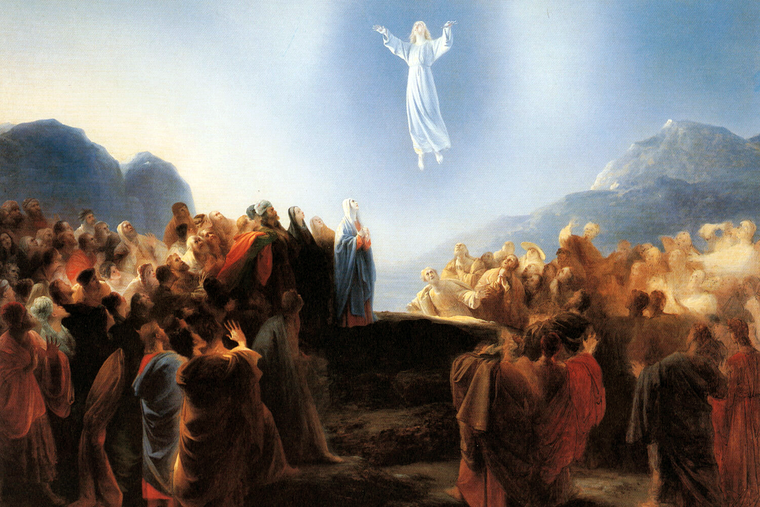
Far from being a moment of loss, the Ascension opens up a joyful reality: Christ is closer than ever, not limited by space or time.
In the Acts of the Apostles, after the Ascension, we hear how the disciples went back to the Upper Room and “with one accord devoted themselves to prayer, together with the women and Mary the mother of Jesus, and with his brethren” (Acts 1:14).
I have often thought about this time as a hiding in fear, similar to the days immediately after Easter when they were not sure of the Resurrection and were waiting to see what would happen next. However, the accounts in the Gospels and Acts do not talk about fear after the Ascension. They talk about praying together (Acts 1:14), worshipping Jesus (Matthew 28:17), going forth and preaching everywhere (Mark 16:20), and how Luke went about returning “to Jerusalem with great joy” and being “continually in the temple blessing God” (Luke 25:40).
Rather than fear and doubt, there seems to be an immediate change that overcomes them from the moment Jesus ascends to the “right hand of God” (Acts 2:33).
Pope Benedict XVI, in the epilogue of Jesus of Nazareth: Holy Week, locked in on this idea, drawing a connection between Jesus’ Last Supper discourse in the Gospel of John and the experience of the Church after the Ascension. Jesus says in John 14:28:
You heard me say to you, ‘I go away, and I will come to you.’ If you loved me, you would have rejoiced, because I go to the Father; for the Father is greater than I.
Benedict ties this going away to the Ascension and asks what it means for Jesus to both go away but also come to us at the same time. We know that he goes to the Father and that he is now “at the right hand of God,” which sounds far away from us. Yet Benedict writes that this “does not refer to some distant cosmic space, where God has, as it were set up his throne and given Jesus a place beside the throne.” As the Lord and Creator, “His presence is not spatial, but divine,” Benedict explains, adding that after going to the Father in his resurrected body, Jesus is not limited by space and time but is instead “participating in this divine dominion over space.” Through ascending to the Father, he can now be “with [us] always, to the close of the age” (Matthew 28:20).
Benedict writes that Jesus’ “going away is in this sense a coming, a new form of closeness, of continuing presence,” and this is linked with the same joy Luke talks about at the Ascension. Jesus ascends so that he can be very close to us, and this is our cause for joy.
We might wonder, though, how we can experience the joy of this closeness in our daily lives. We are in his physical presence at daily Mass or in Eucharistic adoration and when we receive the other sacraments, but this closeness does not depend on our proximity to the Eucharist — rather, it depends on our interior disposition toward God. Jesus wants us to know that he is present to us everywhere we are, dwelling in our souls since our baptism.
In The Practice of the Presence of God, Brother Lawrence of the Resurrection gives advice on how to always be aware of God’s presence and to “habitually to take pleasure in His divine company, speaking humbly and conversing with Him lovingly at all seasons, at every minute, without rule or measure.”
But this awareness of God’s presence is not limited to when we are alone. St. Francis de Sales, in his Introduction to the Devout Life, advises us “to retire at various times to the solitude of your own heart even while outwardly engaged in discussions or transactions with others.” St. Elizabeth of the Trinity prayed for her heart to be a “little Bethany” — like the home of Sts. Mary, Martha and Lazarus, where Jesus would go for leisure and conversation with his friends (see He Is My Heaven).
In all of these practices, there is a common truth that Jesus being at the right hand of the Father makes himself available to all of us, at all times, and is not limited by space or the number of people who spend time in his presence. He can be with each of us fully and always and at the same time. As he is everywhere, he is always very close to us.
Is this not a cause to return to Jerusalem — that is, our place of mission — with great joy?