<p><!-- BEGIN THEIA POST SLIDER --></p>
<p> <br />
</p>
<div>
<blockquote><p><i>“There is no such thing as a bad boy.” — Servant of God Father Edward Flanagan, founder of Boys Town</i> </p></blockquote>
<p>By 1937, the success of Boys Town in Omaha, Nebraska, founded by Servant of God Father Edward Flanagan, was gaining notice. A year later, in 1938, he and Boys Town became household names with the phenomenal success of the MGM movie <i>Boys Town</i>, starring Spencer Tracy. </p>
<p>Today, Father Flanagan’s life story and that of Boys Town — founded in a cornfield in October 1921, with more than 150 charges — is getting another boost with Spirit Juice Studios’ new documentary, playing in theaters across America for one night only, Oct. 8. </p>
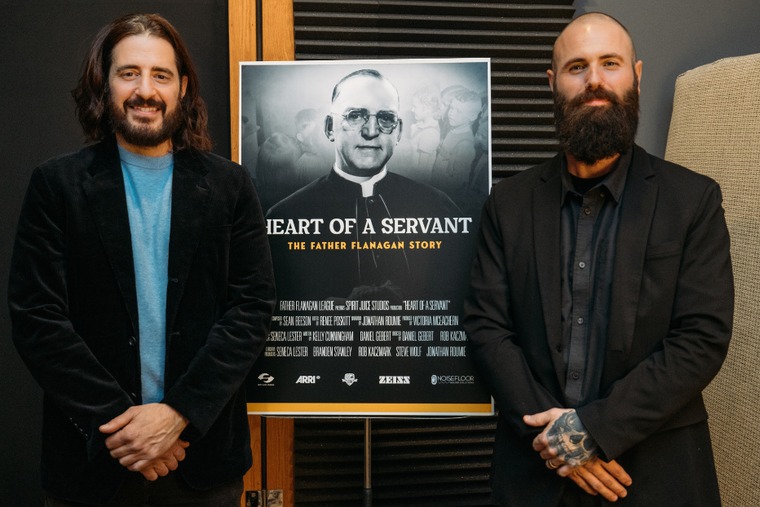
<p>With Catholic actor Jonathan Roumie serving as narrator and executive producer, <a href="https://www.fatherflanaganfilm.com/" target="_blank" rel="noopener"><i>Heart of a Servant: The Father Flanagan Story</i></a> follows the life of this shepherd of young souls from his birth in Ireland through his years at Boys Town. </p>
<p>“He was somebody who saw the common humanity we all share as brothers and sisters in Jesus Christ,” Roumie says in the film, setting the theme. “And if other people didn’t, he would fight for what was right.” </p>
<p>The film chronicles the priest’s life and eventually charts his trips to war-torn Europe and Asia at the request of Presidents Roosevelt and Truman to help save children after World War II. The film is poignantly uplifting because of the love and relief he not only brought to others but also inspired them to imitate. </p>
<p>With vision, the filmmakers create a real feeling of the times through the bountiful use of old photos and film footage to set the scenes of a saint-to-be in action and illustrate life at Boys Town. What results is far more than a nostalgic look into the past. The effect is more than only flipping through older photos or replaying old 16mm films. It’s a you-are-there document, as viewers watch Father Flanagan’s story unfold and what he had to face and sometimes fight — including the Ku Klux Klan — all to accomplish his work for the benefit of the most vulnerable. </p>
<p>The sense of the time and place, conveyed through various shots from the early part of the 20th century, including the Great Depression scenes of disillusioned men, shows what prompted Father Flanagan to solve the problem at the root: to change the way abandoned and orphaned boys were treated and raised. Films from those early years in the 1920s, ’30s and ’40s give an exceptional portrayal of why he succeeded. </p>
<p> </p>
<h3><b>‘It Was a Home’</b> </h3>
<p>The scenes lift viewers’ hearts as they show the beauty of the place the boys called home. The story shows how happy they were and joyful in their play, sports and classwork. It is amazing to see how even the large dining rooms were homey, with curtains and chairs that looked like those found in a home. There was a family feeling at Boys Town, thanks to Father Flanagan’s vision. </p>
<p>Viewers will also learn that the Boys Town venture was literally a family affair: Father Flanagan’s mother, sister and nephew joined him in his important work. </p>
<p>Alternating with the photos and films are moving stories and insights from bishops, those working on Father Flanagan’s cause for canonization, and former residents of Boys Town, including Steve Wolf, the vice postulator for the beatification and canonization cause and a Boys Town alumnus himself. </p>
<p>“His most-prized material possession was the desk that the boys at Boys Town made for him in secrecy for three years,” Wolf recalls, “a one-of-a-kind work of art with a quarter of a million inlaid pieces of wood … made by kids. I think he knew how much his boys loved him because that desk was made with love. And they put themselves into that desk in much the way he put himself into their lives and the work of trying to save them.” </p>
<p>Segments of <i>Heart of a Servant</i> were filmed on location in five countries. Bishop Michael Duignan of Clonfert, Galway and Kilmacduagh in Ireland offers insights on how Father Flanagan had that “esteem for the family and growing up in a family so that he knew the family culture and how important that was” — a conviction he carried over to Boys Town. </p>
<p>Bishop Kevin Doran of Elphin, Ireland, talks about how what Father Flanagan was doing “was, in a sense, state-of-the-art, cutting-edge social teaching of the Catholic Church.” </p>
<p>Edward Flanagan, the great-nephew of Father Flanagan, was a former resident who grew up in Boys Town after his mother died when he was very young and his father’s job kept him on the road. He explains, “We all had obstacles. That was struggling, and that’s the bond that we had. … This is our home. That was the difference. He would meet boys and create individualized education programs for him. It was a home, Father Flanagan said, not an institution.” </p>
<p>Heather Fryer, a former professor of history, brings out how the priest raised the boys in his care to be not just good, but strong and firm in their convictions, even if it was hard. </p>
<p>“He was an intuitive genius about the human heart,” says former Boys Town president Father Steven Boes. </p>
<p>And in everyone, Father Flanagan saw the face of Christ. </p>
<p>Through calm determination, he accepted every child in need, no matter his race or religion — in sharp contrast to the cultural times. </p>
<p>The professor characterized Boys Town as “the first racially integrated community in the United States.” </p>
<p>During World War II, when Japanese citizens were sent to internment camps in the United States, Father Flanagan brought Japanese children to Boys Town. One woman, Marilyn “Winkie” Takahashi-Fordney, who was a young child from the first family the priest helped, offers warm, moving and joy-filled recollections of Father Flanagan. </p>
<p>“He never raised his voice to anyone,” she recalls. “He had a very gentle way about him. He believed there was no such thing as a bad boy. Everyone has good in them.” Many of the young men who went off to World War II named the priest their next of kin. </p>
<p>Such eye-opening revelations fill the film — including how he was born in delicate health. Often sickly, he had to recuperate during his life from various ills such as pneumonia. </p>
<p>Above all, everything he accomplished was founded on his spiritual life. An alumnus said that when something was wrong with the crops they were growing, Father Flanagan called all the boys together to pray in the chapel. “He believed in the power of prayer,” the alumnus recounted, adding that the kindly priest wanted “the boys to be saints.” The film reveals what happened immediately after those prayers. </p>
<p>One lively section recalls the premiere of the hit film <i>Boys Town</i> in Omaha, with a colorful blend of film footage and stills of the people involved — and then relates how Tracy won a “Best Actor” Oscar that year for playing Father Flanagan. Viewers hear Tracy’s speech and what he did with his award by adding a plaque reading, “This is dedicated to Father Flanagan” — and donating it to Boys Town where it remains — and how the actor became a lifelong supporter of Boys Town. </p>
<p>Music is used superbly throughout the documentary. There’s a nostalgic <i>No Place Like Home</i> in the beginning, underlining old footage of daily life at Boys Town. There’s also a jazzy <i>Slap That Base</i> from a Fred Astaire film livening the movie premiere. And beautiful melodies support scenes in tones that softly accent the visuals. </p>
<p><i>Heart of a Servant: The Father Flanagan Story</i> touches the heart and inspires through the way it recounts the life and legacy of a devoted priest and the countless lives he touched with the love of Christ. It is a testament to be seen. </p>
<p> </p>
</p></div>
<p><br />
<br /><a href="https://www.ncregister.com/news/father-flanagan-documentary-review">Source link </a></p>
<p><!-- END THEIA POST SLIDER --></p>

Jonathan Roumie Tells the Real Story Behind Boys Town| National Catholic Register