<p><!-- BEGIN THEIA POST SLIDER --></p>
<p> <br />
</p>
<div>
<p>As noted <a href="https://www.ncregister.com/blog/scriptures-and-art-the-cleansing-of-the-temple-year-b">last Sunday</a>, the Church offers two possible Gospels for the Third, Fourth and Fifth Sundays of Lent. That’s because, although the Sunday readings are on a three-year cycle, the “scrutiny” readings of Year A are specifically connected to the baptismal preparatory purpose of Lent and can, therefore, be used in any year (even in parishes without catechumens). But there are alternate sets of readings in Years B (this year) and C for these three Sundays. When “Scriptures and Art” was written three years ago, I focused on the baptismal readings and so am making up for the missing Sundays in Year B.</p>
<p>If your parish is using the scrutiny readings this year, the Gospel will be from John about Jesus healing the man born blind. (<a href="https://www.ncregister.com/blog/fourth-sunday-of-lent-scriptures-and-art-man-born-blind">Here is a commentary on that reading</a>.) If your parish follows the rotational cycle, the Gospel will also be from John, but about Jesus’ first meeting with Nicodemus. Nicodemus is mentioned three times in the Gospel of John.</p>
<p>Nicodemus came to Jesus at night. That suggests mixed motives. People who visit you at night or through the back door generally want to keep the encounter discreetly out of the public eye. John (3:1) suggests a reason: Nicodemus “was a Pharisee … a ruler of the Jews.” He is part of the establishment. From John’s second reference to him (7:50), it’s clear Nicodemus had a certain following among the Pharisees; he is traditionally regarded as a member of the Sanhedrin, Israel’s Jewish governing council. Jesus in last week’s Gospel (about his driving the moneychangers from the Temple) has not endeared himself to them. Nicodemus’ openness to Jesus sets him at odds with his peers. </p>
<p>But, as John’s Gospel last week noted, “many began to believe in his name when they saw the signs he was doing” (2:23). That reference is important for two reasons. First, John’s Gospel is built around “signs.” John does not report all of Jesus’ miracles (which he never calls “miracles” but “signs,” because they express Christ’s identity). Second, with special reference to Nicodemus, John explains why the Pharisee came: Nicodemus tells Jesus, “Rabbi, we know you are a teacher who has come from God, <i>for no one can do the signs you are doing unless God is with him” </i>(3:2, emphasis mine). </p>
<p>[The whole discourse between Jesus and Nicodemus is in John 3:1-21. Today’s Gospel features only half of that text — verses 14-21 — leaving out the first two-thirds of the conversation. That is arguably because the Johannine Gospels for these three Sundays this year point out the path to Jesus’ Passion and Glorification. We also know that the post-Vatican II commission that designed the new lectionary generally avoided long readings. That said, today’s scrutiny Gospel (John 9:1-41) is long. Paradoxically, the omitted section of the Jesus/Nicodemus discourse (3:1-13) deals with Baptism, making it appropriate to Lent. There is a direct parallel, for example, between Nicodemus’ openness to Jesus because of his signs — which is taken as evidence that “God is with him” — and the blind man’s challenge to the Pharisees who impugn his healing. The blind man remarks, “If this man were not from God, he would not be able to do anything,” (9:33), an observation that closes the Pharisees’ eyes and gets him thrown out from their presence].</p>
<p>So, Nicodemus is not here out of idle “curiosity.” There’s something more. Unlike his pharisaical colleagues, Nicodemus has an open mind: Jesus could not do what he does absent God’s support, so we should give him a more honest listen. That’s exactly what Nicodemus says to the Pharisees in his second Gospel appearance, a cameo. The Pharisees are fighting among themselves, unable to reconcile what they see Jesus doing with their theology but, likewise, then unwilling to open their eyes to rethink what Jesus is telling them. Nicodemus challenges them (7:50-51): “Does our law condemn a person before it first hears him and finds out what he is doing?”</p>
<p>Nicodemus wants to know. He wants an honest repartee with Jesus. In the verses that are omitted, Jesus does that, insisting a man must be “born again of water and the Spirit” to enter the Kingdom of God (3:5).</p>
<p>That so troubles Nicodemus that he asks (3:4), “How can one be born again?” But Jesus does not backpedal — rather, he insists on the necessity of being reborn.</p>
<p>We can look at this text from a theological viewpoint: the necessity of Baptism. But I want to probe it from an even more basic, purely philosophical and experiential viewpoint.</p>
<p>Jesus does not say being “born again” is something discretionary, something only for those who want to be religiously involved. He insists on rebirth as a prerequisite to entering “the Kingdom of God,” i.e., to being saved.</p>
<p>Now salvation is <i>not </i>a take-it-or-leave-it thing. Man is not equally well off with or without it. Man needs salvation because <i>there is something wrong with man. </i>Human experience tells us that man is broken. He doesn’t need to be taught how to do evil, but he seems congenitally incapable of doing good. That’s not a uniquely religious insight. It’s the stuff of everybody’s human experience.</p>
<p>Which then tells us that natural man as he exists is broken. It means that every secular political project that presumes the “goodness of man,” his ability to “pull himself up by his moral bootstraps” or — worse — the “inevitable progress” of history or “justice” are all projects built on foundations of sand. They rely on anthropological visions of the human person that are false because they are unattainable. Natural man, not “reborn of water and the Spirit,” is a Humpty Dumpty who cannot reassemble himself after the great fall. And every project built on those false assumptions about human beings is going to — <i>have to</i> — fail. </p>
<p>The part of the Jesus/Nicodemus discourse that today’s Gospel does preserve is Jesus’ response. God does not leave man as Humpty Dumpty because “God so loved the world.” And he so loved the world that “he sent his only begotten Son” not to condemn but to save.</p>
<p>Saving, however, does not mean pretending that everything is fine. God does not want to condemn, but that does not mean condemnation is unwarranted. Salvation is <i>not</i> ignoring what might otherwise merit condemnation. It’s facing it and redeeming it, saving us <i>from </i>it.</p>
<p>And that is the context of this Gospel. It starts, “Just as Moses lifted up the serpent in the desert, so must the Son of Man be lifted up.” To understand the reference to Moses, you have to know Numbers 21:4-9 (curiously not the First Reading). It details another episode of Israel grumbling in the desert, doubting God’s power and blaming him and Moses for their sufferings. So “the Lord sent venomous snakes among them” (a not unheard-of desert phenomenon), from whose bite many Israelites died. That suffering causes them to repent (suffering and the proximity of death often have salutary effects in focusing people on God).</p>
<p>At God’s command, Moses fashions a bronze serpent, raised on a pole, upon which those bitten could look to be cured. Gazing on that bronze serpent had the miraculous effect of drawing out the venom from the stricken Israelites. But it also prefigures Jesus’ saving suffering on the cross because, as he himself will remark, “I, when I am lifted from the earth, will <i>draw all men</i> to myself” (John 12:32). Draw them to be saved, not condemned, not lost.</p>
<p>And unless one is born again, i.e., incorporated into Jesus’ saving death by Baptism (Romans 6:3), he spins his wheels futilely, expecting the impossible from a cracked Humpty Dumpty whose reassembly, all human efforts notwithstanding, is in vain. </p>
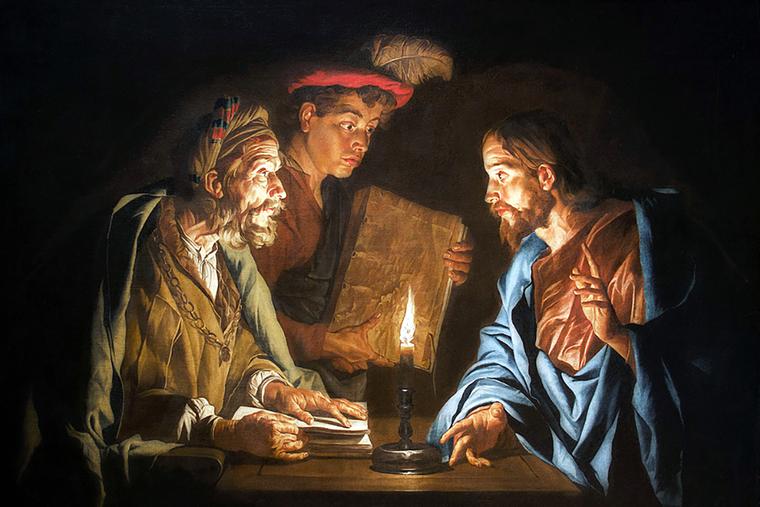
<p><b>Today’s Gospel is illustrated</b> in “Jesus Christ and Nicodemus,” an oil painting by <a href="https://en.wikipedia.org/wiki/Matthias_Stom">Matthias Stom</a>. Of the painter, we know more of his works than of his life. Even his name is unclear: in the past, he was called Matthias Stomer, though today his surname is more properly thought to be Stom. We think he’s Dutch, maybe from Utrecht. We posit he was born sometime around 1600 and died sometime after 1652.</p>
<p>Of his style, we know more. He is clearly influenced by Caravaggio and his school, i.e., who made pronounced use of light and shadows, the <a href="https://en.wikipedia.org/wiki/Chiaroscuro"><i>chiaroscuro</i></a> technique. It is evident in almost all of <a href="https://en.wikipedia.org/wiki/List_of_paintings_by_Matthias_Stom">Stom’s works</a>.</p>
<p><i>Chiaroscuro </i>is particularly appropriate to this painting, since the Gospel emphasizes that Nicodemus’ first meeting with Jesus occurs under cover of night. It’s why I chose the painting: the painting is absolutely dark but for the candle (a common device in Stom’s works but especially appropriate here, given that in John Jesus “is the light of the world”) revealing the faces of Jesus, Nicodemus and his student. Nicodemus is a Pharisee, so we would expect he was also teaching young people. He takes God’s word seriously: he has a religious text open in front of himself, while the boy carries another, presumably a Bible. Of course, we can forgive the anachronism: Nicodemus would have brought scrolls, not bound books. (The clothing is another anachronism: Jesus is dressed as a first-century Jew, but Nicodemus and the lad combine elements of their times and 17th-century Europe). </p>
<p>But while Nicodemus and his pupil buttress their ideas with references to the Word of God Jesus — who <i>is </i>the Word of God made flesh — needs no book to teach authoritatively. And it’s Jesus, by his focus and hand gestures, who is teaching a rapt and silent audience. </p>
<p>God meets men where they are, even if their motives might begin as mixed. But he draws them to himself, which is to the Truth (which he is incarnate). All man has to do is allow himself to be drawn. Jesus will draw Nicodemus, “the man who first came … at night,” into the open, ready to demonstrate his association in the light of a day when most of Jesus’ other friends and disciples have fled. Nicodemus will go and ask for Jesus’ crucified body. He will be the wise man who again brings myrrh and aloes, (John 19:39), intended for a rapid burial before the sun sets, ushering in the rest of a unique Sabbath night.</p>
</p></div>
<p><br />
<br /><a href="https://www.ncregister.com/blog/scriptures-and-art-year-b-fourth-sunday-of-lent">Source link </a></p>
<p><!-- END THEIA POST SLIDER --></p>

Just as Moses Lifted Up the Serpent, So Must the Son of Man Be Lifted Up| National Catholic Register