<p><!-- BEGIN THEIA POST SLIDER --></p>
<p> <br />
</p>
<div>
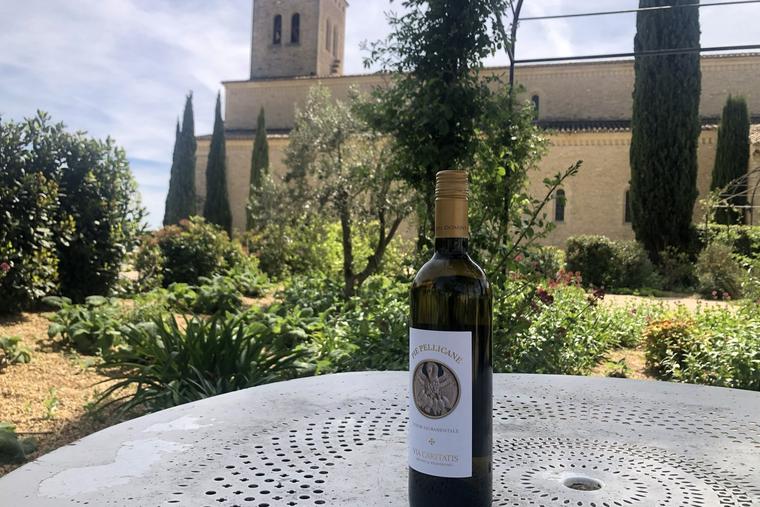
<p>Rooted in monastic and papal tradition as well as in canonical precision, ‘Pie Pellicane’ embodies a renewed attention to the material integrity of the Eucharist. </p>
</p></div>
<div>
<p>In medieval Christian iconography, the pelican represented one of the most powerful symbols of the Eucharist. </p>
<p>Believed to feed its young with blood drawn from its own breast, it evokes the self-giving love of Christ, who nourishes his children from his own substance. </p>
<p>It is this image that St. Thomas Aquinas contemplated when he wrote <i>Adoro te devote</i>, addressing Christ in the Blessed Sacrament as Pie Pellicane — the “loving, pious Pelican.” And it is this name that the Benedictine monks of the world-renowned Abbey of Sainte-Madeleine du Barroux, in southern France, have chosen for their liturgical wine, their newest and most intimate creation.</p>
<p>Via Caritatis has already <a href="https://www.ncregister.com/features/the-rehabilitation-of-the-first-papal-vineyard-in-france-thrills-the-wine-world">told the story</a> of monks, nuns and winegrowers joining forces to produce wines of rare quality from a terroir long overlooked — and of their plans to build the <a href="https://www.ncregister.com/features/le-barroux-abbey-museum-of-wines">world’s first museum</a> dedicated to abbey wines. Pie Pellicane is a different kind of project altogether. The result of several years of research conducted by monks in collaboration with theologians familiar with the technical aspects of winemaking, this wine is crafted from start to finish in strict conformity with the requirements of the sacred liturgy.</p>
<h3><b>A Wine for the Altar</b></h3>
<p>Pie Pellicane is a Muscat de Beaumes-de-Venise (a protected designation of origin wine), vinified as a <i>Vin Doux Naturel</i> — a naturally sweet, fortified wine in which fermentation is halted by the addition of grape-derived alcohol, preserving both sugar and aroma. </p>
<p>Speaking with the Register, Gabriel Teissier, director of development at Via Caritatis, insisted that the wine was designed first and foremost around the practical realities of priestly life. </p>
<p>Its naturally sweet profile and elevated alcohol content give it a remarkable stability once opened: A bottle can remain on the credence table for several days, or even weeks, without deteriorating. Its mild, pleasant aroma also makes it particularly well suited to priests celebrating Mass on an empty stomach, often early in the morning — a consideration that is rarely taken into account by most commercially available altar wines.</p>
<p>These qualities comply with strict canonical regulations. Canon 924 of the Code of Canon Law requires that the wine used during Mass be natural, made from grapes, and unaltered. The 2004 instruction <a href="https://www.vatican.va/roman_curia/congregations/ccdds/documents/rc_con_ccdds_doc_20040423_redemptionis-sacramentum_en.html"><i>Redemptionis Sacramentum</i></a><i> </i>by the Congregation for Divine Worship and the Discipline of the Sacraments, specifies that any blending or addition of inappropriate substances may compromise the validity of the celebration itself. <a href="https://boutique.barroux.org/pie-pellicane-blanc-via-caritatis-75-cl-ave1125?srsltid=AfmBOorJ5rA9Y7I8SMAEClAbNYbCtBKDhBdnvyT-4xSoYSVlew1Fmpc3">Pie Pellicane</a> is thus entirely natural, fermented without artificial intervention or post-fermentation sulfites. </p>
<p>“This is a Mass wine produced to fully meet these canonical requirements, at a time when this concept is often neglected by unscrupulous producers who label their wine as ‘Mass wine’ without regard for the Church’s recommendations, or by the celebrants themselves who do not adhere to these requirements — which can, in fact, invalidate a Mass,” said Teissier.</p>
<h3><b>Reviving a Papal Tradition</b></h3>
<p>The choice of Muscat de Beaumes-de-Venise is itself part of a long and prestigious history, as this wine — typical of the Rhône Valley in southeastern France — was among the favorites of the popes of Avignon in the 14th century. </p>
<p>The region itself, situated at the foot of the Dentelles de Montmirail, a mountain range with steep slopes, boasts a winemaking tradition dating back to Roman times. </p>
<p>It was Clement V, the first pope of Avignon and also the founder of the first papal vineyard on the lands of what is now the Abbey of Barroux, who had a particular fondness for Muscat de Beaumes-de-Venise. His successor, John XXII, carried on the tradition and served these wines at the papal court. Seven centuries later, Pie Pellicane is reviving this long and noble viticultural lineage.</p>
<p>The monks are now considering distributing it internationally, amid a growing demand for liturgical integrity. This move coincides with a broader renewal of the Catholic faith in the West, reflected in <a href="https://www.ncregister.com/news/in-paris-traditional-liturgy-is-drawing-a-new-generation-to-the-church">rising numbers of baptisms</a> within traditional communities. </p>
<p>Younger generations, drawn to the beauty of the classical rite, tend to show increasing impatience with the liturgical minimalism of recent decades. In such a context, attention extends even to the most concrete elements of the rite — including the wine placed on the altar.</p>
<p>“Uniquely, it is produced by the last remaining monk-winemakers,” Teissier noted. “With their sacramental wine, the monks of Le Barroux put wine back at the service of the liturgy. It is the fullest expression of what <i>ora et labora</i> can mean.” </p>
<p>For a community that has spent years working to restore the civilization of wine, placing the fruit of their vines on the altar is perhaps the most fitting gesture of all, allowing the loving Pelican to feed his young.</p>
</p></div>
<p><br />
<br /><a href="https://www.ncregister.com/blog/le-barroux-s-new-sacramental-wine">Source link </a></p>
<p><!-- END THEIA POST SLIDER --></p>

Le Barroux’s New Sacramental Wine| National Catholic Register