<p><!-- BEGIN THEIA POST SLIDER --></p>
<p> <br />
</p>
<div>
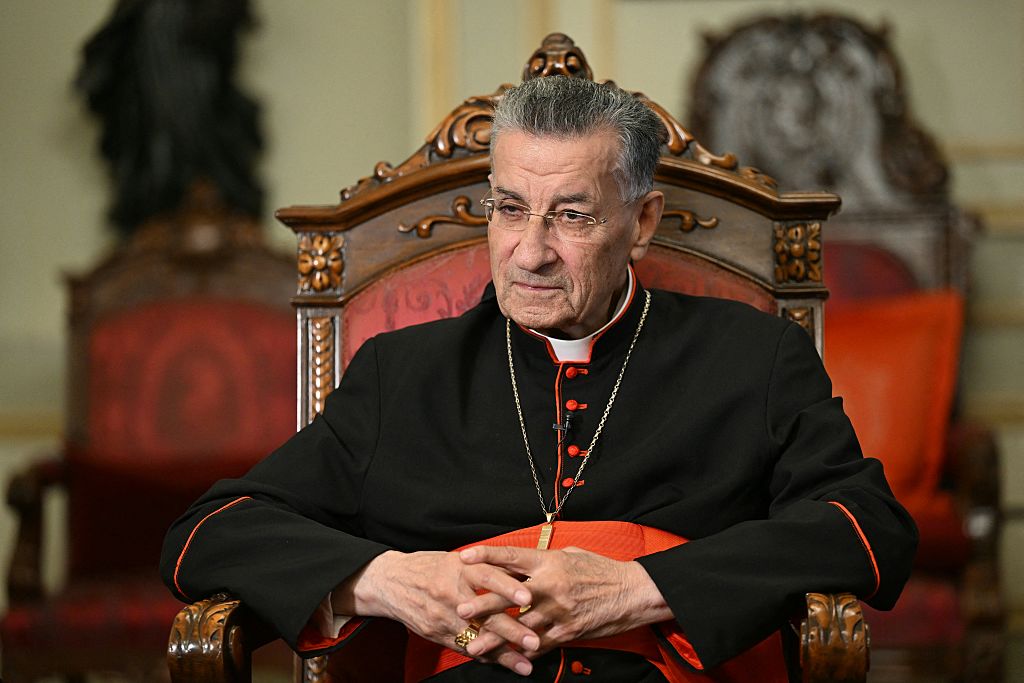
<p>Maronite patriarch Cardinal Bechara Boutros Rai, who <a href="https://www.acimena.com/news/8781/albaba-laoon-yltky-albtryrkayn-alraaay-omynasyan-oyokd-krbh-mn-lbnan">met</a> with Pope Leo XIV last week, said the Pope’s visit to Lebanon last December, held under the motto “Blessed are the peacemakers,” marked the beginning of a new phase of dialogue for peace. Cardinal Rai expressed hope that the ongoing negotiations between Lebanon and Israel would lead to a true, just, comprehensive, and lasting peace — but Christians there fear their country’s sovereignty may be at stake. </p>
<p>Cardinal Rai warned in his Sunday homily that Lebanon “must not become the price of any international or regional understanding, nor an arena for settling scores, but rather a message of peace.” He expressed hope that the efforts involving the United States, Lebanon, and Israel would bear fruit and lead to an agreement that removes “the specter of war” from Lebanon.</p>
<p>His remarks come as Lebanon finds itself at the center of two parallel diplomatic tracks: a U.S.-Iran agreement and a direct trilateral framework involving Lebanon, Israel, and the United States. In both, Lebanon’s future is at stake and the country’s Christians remain a central part of the national conversation on peace and sovereignty.</p>
<div class="embed-block">
 <img alt="Lebanon’s Maronite patriarch, Cardinal Bechara Boutros al-Rai, speaks during an interview with AFP at the Maronite Patriarchate in Bkerke, north of Beirut, on Oct. 15, 2025. | Credit: JOSEPH EID/AFP via Getty Images" src="https://res.cloudinary.com/ewtn/image/upload/v1777999687/ewtn-news/en/GettyImages-2240745488_sesyad.jpg"/></p>
<p class="embed-block__description">Lebanon’s Maronite patriarch, Cardinal Bechara Boutros al-Rai, speaks during an interview with AFP at the Maronite Patriarchate in Bkerke, north of Beirut, on Oct. 15, 2025. | Credit: JOSEPH EID/AFP via Getty Images</p>
</div>
<p>For many Christians in Lebanon, the fear is that their country’s future could once again be treated as part of a broader regional bargain rather than as a sovereign national question. </p>
<p>This concern was reflected in a letter sent by Lebanese Forces leader Samir Geagea to U.S. Vice President JD Vance, in which he <a href="https://today.lorientlejour.com/article/1538961/after-vances-remarks-on-christians-in-lebanon-geagea-urges-him-to-separate-the-lebanese-issue-from-negotiations-with-iran.html">urged</a> Washington to separate the Lebanese issue from negotiations with Iran. Hezbollah Secretary-General Naim Qassem <a href="https://english.aawsat.com/arab-world/5288772-hezbollah%E2%80%99s-qassem-says-iran-deal-declaration-us-israeli-defeat?__cf_chl_f_tk=9f0IAyMKQYDEssUgLRWGto0vyzgUNAtS7Zu2XDsHxDA-1783165640-1.0.1.1-ZtDofZbBtPV.wF3WhSkoZYxAhJbQb3WFdZUOTCA5yic">described</a> the agreement as “a great victory” and “a pivotal point for Lebanon.”</p>
<p>Speaking to EWTN News, Lebanese member of Parliament Pierre Bou Assi said that, as the Lebanese Forces leader stated in his letter to the U.S. vice president, their project remains the establishment of a real state in Lebanon. But he said such a state cannot fulfill its role as long as Hezbollah remains armed and continues to drag Lebanon into wars and suffering in service of Iran.</p>
<p>“We want to be freed from Hezbollah’s weapons in order to build a state that protects everyone, Christians and Muslims alike,” he said.</p>
<p>Bou Assi added that he does not believe the U.S.-Iran understanding will have a direct impact on Hezbollah’s behavior in Lebanon. According to U.S. sources, he said, the talks did not focus specifically on this point but rather on the Strait of Hormuz and a monitoring mechanism for Iran’s peaceful nuclear program. Many in Lebanon stress that including the Lebanese issue in these regional negotiations has allowed Iran to regain leverage over the Lebanese political sphere.</p>
<p>Moreover, President Donald Trump’s recent <a href="https://www.middleeasteye.net/news/trump-told-israel-let-syria-attack-hezbollah-lebanon">suggestion</a> that Syria could play a role in addressing the issue of Hezbollah has touched a deep nerve among many Lebanese Christians. For them, any talk of Syrian involvement in Lebanon triggers the memory of nearly three decades of Syrian military and political occupation, which only ended in 2005.</p>
<div class="embed-block">
 <img alt="Lebanon member of Parliament Pierre Bou Assi. | Credit: Photo courtesy of Pierre Bou Assi" src="https://res.cloudinary.com/ewtn/image/upload/v1783369493/ewtn-news/en/MP_PIERRE_BOU_ASSI_CREDITS_PIERRE_BOU_ASSI_ociryk.jpg"/></p>
<p class="embed-block__description">Lebanon member of Parliament Pierre Bou Assi. | Credit: Photo courtesy of Pierre Bou Assi</p>
</div>
<p>Bou Assi said that, as a Lebanese and Christian member of Parliament belonging to the largest Lebanese and Christian parliamentary bloc, and despite respect for the United States as a friendly country, “we cannot accept the return of the Syrian army to Lebanon.”</p>
<p>“The Lebanese suffered greatly under the occupation of the Assad regime, which lasted for 30 years between 1975 and 2005,” he said. “For this reason, as a sovereignist component that resisted that occupation, we cannot accept the repetition of this bitter and destructive experience.”</p>
<p>At the same time, Bou Assi pointed to repeated statements by the Syrian president that Syria has no intention of entering Lebanon again, out of respect for Lebanese sovereignty.</p>
<p>He said such positions are in line with the Lebanese Forces’ desire for the best possible relations with Syria, relations based on respect for the sovereignty, stability, and interests of both countries and peoples.</p>
<p>Toni Nissi, president of the Committee for the U.N. Security Council Resolutions on Lebanon and secretary-general of the National Council for the Cedar Revolution, echoed similar concerns in a conversation with EWTN News.</p>
<p>“For many Lebanese, and certainly for many Lebanese Christians, such remarks inevitably awaken painful memories,” Nissi said.</p>
<p>He explained that his generation remembers a period in which Lebanon’s sovereign institutions were overshadowed by external tutelage. For that reason, he said, any suggestion that Syria might once again assume a political or security role inside Lebanon naturally provokes concern.</p>
<div class="embed-block">
 <img alt="Toni Nissi, president of the Committee for the U.N. Security Council Resolutions on Lebanon and secretary-general of the National Council for the Cedar Revolution. | Credit: Photo courtesy of Toni Nissi" src="https://res.cloudinary.com/ewtn/image/upload/v1783369611/ewtn-news/en/TONI_NISSI_CREDITS_TONI_NISSI_h1gtps.jpg"/></p>
<p class="embed-block__description">Toni Nissi, president of the Committee for the U.N. Security Council Resolutions on Lebanon and secretary-general of the National Council for the Cedar Revolution. | Credit: Photo courtesy of Toni Nissi</p>
</div>
<p>Nissi also stressed that diplomacy becomes problematic when nations become objects of negotiation instead of subjects of their own history. </p>
<p>“For far too long, Lebanon has been treated as a battlefield where others settle their disputes and as a diplomatic mailbox through which regional powers exchange messages,” he added.</p>
<p>There are growing concerns in Lebanon, especially among Christians, that the U.S.-Iran memorandum and the wider diplomacy surrounding it could overshadow the Lebanon-Israel <a href="https://www.msn.com/en-us/news/world/new-lebanon-israel-talks-begin-in-shadow-of-us-iran-deal/ar-AA26mt6V?ocid=BingNewsSerp">talks</a> promoted by President Joseph Aoun as an effort to return decisions of war, peace, and sovereignty to state institutions.</p>
<p>For many Lebanese Christians, those talks carry a deeper meaning. They are not only a diplomatic opening with Israel but also a possible step toward restoring the authority of the Lebanese state after years in which Hezbollah’s weapons and Iran’s influence have shaped the country’s security choices.</p>
<p>Lebanese officials have described the move toward direct negotiations with Israel as a historic step through which the state could reclaim responsibility for Lebanon’s foreign and security policy. Yet the government now faces the delicate reality of seeing Iran negotiate with Washington over issues that directly affect Lebanon’s future, raising fears that Beirut could once again be treated as a secondary actor in decisions concerning its own sovereignty.</p>
<p>Nonetheless, last week’s signing of the <a href="https://www.state.gov/releases/office-of-the-spokesperson/2026/06/the-united-states-israel-and-lebanon-sign-the-trilateral-framework/">Trilateral Framework</a> Agreement between Lebanon, Israel, and the United States, announced by U.S. Secretary of State Marco Rubio, marked a major milestone, offering a possible path toward placing Lebanon’s sovereignty, security, and state authority back at the center of the diplomatic process.</p>
<p>Nissi explained that the framework “establishes a phased mechanism intended to strengthen security, extend the authority of the Lebanese state across its entire territory, and create a practical pathway for implementing long-standing international commitments while reducing the risk of renewed conflict.”</p>
<p>“It is neither a final peace treaty nor merely another ceasefire,” Nissi added. “It is a roadmap for restoring state authority through implementation.”</p>
<p>For Nissi, the framework also carries a deeper national significance. “Perhaps the greatest opportunity created by this framework is that Lebanon can finally stop being a battlefield for others,” he said. “For decades, Lebanon functioned less as an independent strategic actor than as an arena through which regional powers projected their rivalries.”</p>
<p>What these parallel diplomatic tracks will ultimately achieve for Lebanon remains uncertain. For now, the country’s sovereignty continues to be violated from both directions: by Hezbollah’s weapons and decision-making outside the authority of the state and by Israel’s continued occupation of Lebanese territory and military actions inside Lebanon. </p>
</p></div>
<p><br />
<br /><a href="https://www.ncregister.com/cna/lebanon-s-christians-fear-sovereignty-will-be-traded-in-regional-diplomacy">Source link </a></p>
<p><!-- END THEIA POST SLIDER --></p>

Lebanon’s Christians Fear Sovereignty Will Be Traded in Regional Diplomacy| National Catholic Register