


In 1925, Austrian writer Stefan Zweig looked out at a world increasingly shaped by radio, cinema, fashion and mass culture and saw something unsettling beneath the excitement of modernity.
He called it “the monotonization of the world.” Beneath technological novelty and cultural energy, Zweig feared that human beings were becoming increasingly interchangeable: adopting the same habits, consuming the same experiences, and surrendering themselves to what he described as a growing “mass soul.”
Writing after World War I and amid rapid social transformation, Zweig sensed that something deeper than politics or economics was shifting. Beneath the acceleration of modern life lay a quieter fear: that persons themselves were gradually becoming flatter, more uniform and less rooted.
If Pope Leo XIII confronted the social consequences of industrial modernity in Rerum Novarum, Zweig later witnessed many of its psychological and cultural aftershocks. The question was no longer simply how societies would organize work, but what kind of human beings would emerge from the world being built around them.
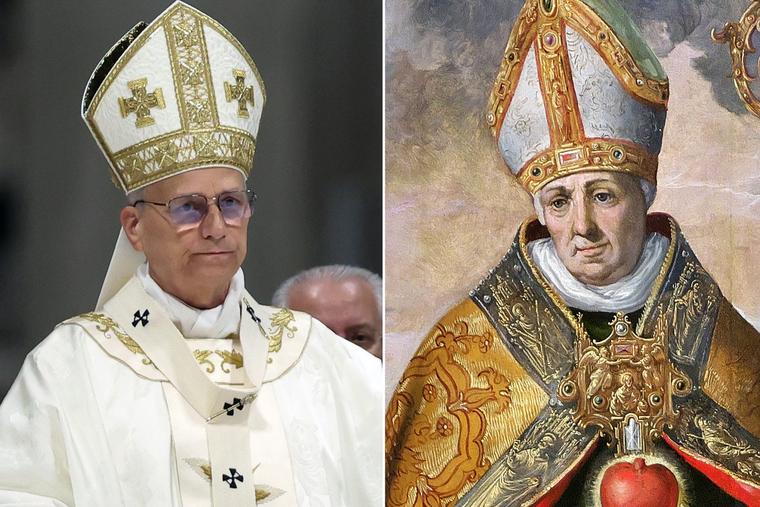
Nearly a century later, Pope Leo XIV appears to be asking a similar question in a different key. There is a providential symmetry in the emergence of a pope who appears heir to two traditions at once: to Leo XIII’s concern for the social upheavals of modernity and to St. Augustine’s concern for the formation of the human heart.
The Deeper Question Beneath Artificial Intelligence
Certainly, Magnifica Humanitas stands within the Church’s broader social tradition, which has long examined how political and technological structures shape human flourishing. Yet Leo seems to begin one layer deeper, like St. Augustine, who always asked a prior question: What kinds of persons are being formed beneath the surface?
Augustine understood that human beings are not merely thinking creatures who occasionally form communities. We are relational beings whose loves shape us over time. Human beings become what they love.
Augustine writes in the Confessions, “My weight is my love; wherever I am carried, my love is carrying me” (Confessions, XIII). Human beings are always moving toward something. If our loves are what carry persons, then the environments that shape our loves are never neutral.
The danger of technological societies is not that they create tools — that really is nothing new. The deeper danger is that tools become environments, environments become habits, and habits become forms of love.
From Communities to Systems
Well before he became Pope Leo XIV, then-Father Robert Prevost had already been wrestling with a more fundamental question than the possibilities and dangers surrounding AI: What sustains authentic human community?
In a 2005 reflection on Augustinian servant leadership, Father Prevost described community as resting upon “a relationship of fraternal love and mutual trust,” identifying the building of “authentic trust” as among the greatest challenges facing any community.
Already one sees themes that reemerge in Magnifica Humanitas. The problem the Holy Father identifies is not merely technological confusion but relational fragmentation.
This continuity becomes even more striking when one places Magnifica Humanitas beside some of the Pope’s earlier scholarly work. In his doctoral study on Augustinian authority and communion after the Second Vatican Council, he observed that modernity had ushered in “a new age of personalism.”
The phrase reveals something important. For Father Prevost, the central issue was never simply authority or institutions, but whether they support the dignity of the person and genuine communion.
Even in his early work on authority within the Augustinian tradition, Father Prevost repeatedly resisted understanding structures as ends in themselves. Authority existed not for domination but service, not to preserve systems but to safeguard the common life of the community.
That instinct now appears to reemerge in Magnifica Humanitas. The question is no longer merely how we govern religious communities, but whether our technological systems likewise remain ordered toward persons rather than becoming realities unto themselves.
Babel, Jerusalem and the Question of Formation
Leo’s concern begins to look remarkably Augustinian when read through the biblical images he introduces in the encyclical itself: the Tower of Babel and the city of Jerusalem.
Babel represented more than technological ambition; it reflected the temptation to construct unity through uniformity. Leo explicitly warns against what he calls the “Babel syndrome“: a tendency to neutralize difference and reduce the mystery of the person to data and performance (Magnifica Humanitas, §10). The danger was not diversity but homogenization.
Jerusalem, by contrast, was rebuilt through shared responsibility and communion. One can almost hear Augustine’s distinction between two cities and two loves echoing beneath the text. The question is not whether humanity will build, but what vision of humanity will guide the construction.
Seen in this light, Pope Leo’s discussion of artificial intelligence appears less like a departure and more like a continuation. Returning to what he presents as one of the document’s central questions — “What does it mean to safeguard our humanity?” — Leo warns that the technological paradigm risks normalizing “an anti-human vision” in which “human beings are tempted to see themselves as a project to be optimized rather than as persons called to relationship and communion” (Magnifica Humanitas, §112).
This echoes language Father Prevost used years earlier regarding community life itself. He insisted that “personal contact, often on a one-to-one basis, is necessary for the life of the community.” Later, as Pope Leo XIV, he writes:
In an era that favors speed and fragmentation, the human person still yearns to receive care and recognition from attentive minds, kind words and hands capable of tenderness. The digital culture multiplies connections and offers new opportunities for interaction; yet, the human heart retains an irrevocable need for genuine closeness. (Magnifica Humanitas, §239)
Across decades and across genres, the concern remains remarkably consistent. The question therefore is not whether technology possesses utility. Leo readily acknowledges its benefits. Nor is he proposing a retreat into nostalgia or a rejection of technological progress itself. Rather, the question is whether technological systems remain ordered toward the flourishing of persons or whether persons gradually become ordered around the logic of systems.
Learning to Become Human Together
The Church’s answer to this challenge may ultimately prove more ordinary than many expect. We often imagine technological crises requiring technological solutions alone. Yet Christianity has long insisted that persons are formed within concrete communities: around tables, in friendships, classrooms, families, parishes, pilgrimages and common prayer.
Leo himself points toward institutions that form human beings in ways technology alone cannot. Speaking of schools, he writes that they “are not called to follow the pace of the digital world, but to offer that which the digital sphere by itself cannot provide, namely a shared time for learning and developing trustworthy relationships” (Magnifica Humanitas, §174).
Formation has always been the Church’s answer to periods of cultural fragmentation. Augustine did not imagine communities as collections of isolated individuals pursuing parallel goals. He envisioned a common life in which persons learned to love rightly together.
For those of us working in Catholic education, this may be among the document’s most important Augustinian insights. Schools are among the few remaining institutions where young people still learn how to become human together: how to sustain friendship, resolve conflict, pray alongside others, and discover that formation involves much more than the acquisition of information. Catholic schools are not simply sites of information transfer; they are communities where students encounter the possibility that human flourishing is rooted not merely in achievement but in communion.
After his conversion, Augustine sought truth through friendship, conversation and shared life. Truth was not merely delivered; it was pursued together. Human beings were formed not through information alone, but through communion.
Resisting the Flattening of the Human Person
Perhaps this is what makes Magnifica Humanitas feel distinct. Beneath discussions of technology and AI lies a more enduring concern: whether increasingly mediated societies can still sustain genuine human encounter. Leo himself frames the task with striking simplicity: in the age of artificial intelligence, “ours is the pressing duty to remain profoundly human” (Magnifica Humanitas, §15).
The challenge before us may not simply be preserving human intelligence in the age of artificial intelligence. It may be resisting what Zweig feared nearly a century ago: the gradual flattening of the human person into something interchangeable, predictable and forgettable.
For Augustine, however, human beings were never meant to become copies of one another. They were made for communion, friendship, and ultimately for God himself. The question before us is whether our technologies will remain servants of that vocation — or whether we will slowly begin reshaping ourselves in the image of our own machines.