<p><!-- BEGIN THEIA POST SLIDER --></p>
<p> <br />
</p>
<div>
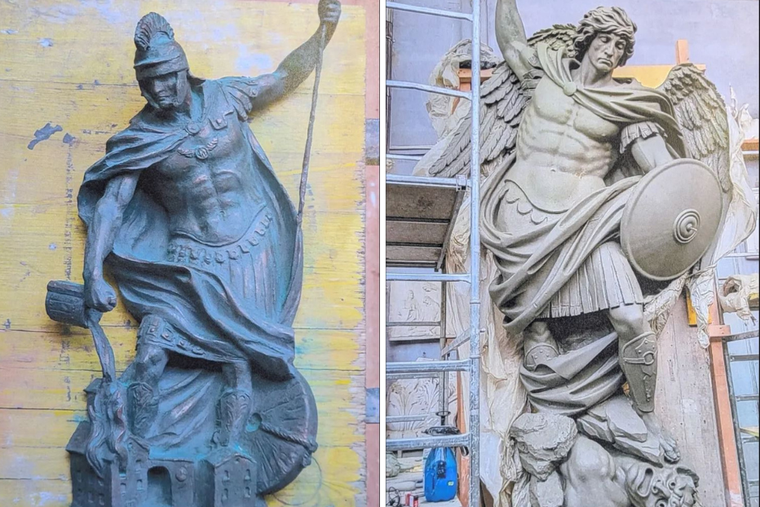
<p>A Massachusetts mayor is going to bat for including statues of two Catholic saints on the city’s new public safety building, saying he picked them because of their importance to police and firefighters and accusing opponents of harboring “‘negative attitudes’ toward Catholicism.” </p>
<p>But lawyers for local residents who object to the planned 10-foot-high bronze statues of St. Michael and St. Florian say the mayor is making non-Catholics “feel like second-class citizens” because of the statues, which they say violates the Massachusetts Constitution by favoring one religion over another. </p>
<p>The two sides exchanged pointed arguments in court papers filed recently in a state lawsuit brought earlier this year by the American Civil Liberties Union of Massachusetts and Americans United for the Separation of Church and State. </p>
<p>Thomas Koch, a practicing Catholic and the mayor of Quincy, a city of about 100,000 just south of Boston, wants to install on the façade of a forthcoming $175-million, 120,000-square-foot public safety building statues of St. Michael the Archangel (the patron saint of police officers) and St. Florian (the patron saint of firefighters). The statues are expected to cost about $850,000. </p>
<p>“I selected the statutes of Michael and Florian for installation on the Public Safety Building due to their status as symbols in police and fire communities worldwide. The selection had nothing to do with Catholic sainthood, but rather with an effort to boost morale and to symbolize the values of truth, justice, and the prevalence of good over evil,” Koch said in an affidavit filed last month. </p>
<p>“If Michael and Florian did not have significance in the police and fire service, respectively, I would not have selected them for installation,” the mayor added. </p>
<p>The mayor is asking a judge to dismiss the lawsuit, which was filed May 27 in Norfolk County Superior Court in Dedham. </p>
<p>But lawyers for the plaintiffs, who are 15 residents of Quincy who object to the mayor’s plan, described the statues earlier this week as “icons with unmistakable religious significance,” noting, “Saints in general, and patron saints specifically, are prominent within certain sects of Christianity, especially Catholicism.” </p>
<p>An “objective observer,” the plaintiffs’ lawyers argued, would see the statues as “permanent installations that will invoke and convey, on an ongoing basis, the City’s preference for Catholic religious doctrine.” </p>
<p>“The primary effect of the statues will be to advance religion over non-religion, and Catholicism over other Christian and non-Christian sects and denominations,” a motion filed Monday, Aug. 4, states. </p>
<p>The plaintiffs are seeking an injunction from the state Superior Court judge preventing the city from installing the statues when the public safety building opens, which is scheduled for October 2025. </p>
<p>A court conference in the case has been scheduled for Tuesday, Aug. 12. </p>
<h3><b>A Question of Massachusetts Law</b> </h3>
<p>The legal wrangling is over the Massachusetts Constitution, not the U.S. Constitution. Residents who object to the statues have appealed primarily to state law. </p>
<p>During colonial times and in the early decades of independence, the Massachusetts government favored the Congregational Church over other denominations, forcing property owners to support their local Congregationalist minister with their property taxes, whether they belonged to the church or not. </p>
<p>In 1833, the state disestablished the Congregational Church, declaring in an <a href="https://www.mass.gov/news/massachusetts-declaration-of-rights-article-3" target="_blank">amendment</a> to the state Constitution approved by a state constitutional convention that “no subordination of any one sect or denomination to another shall ever be established by law.” </p>
<p>On occasion, disputes over that language make it to the Massachusetts Supreme Judicial Court, as the Quincy statues’ case might. </p>
<p>One example: In 1979, the state’s highest court upheld the ability of both the state Senate and state House of Representatives to hire and pay a part-time chaplain for each chamber — both of whom at the time happened to be Catholic priests — in a case called <a href="https://law.justia.com/cases/massachusetts/supreme-court/1979/378-mass-550-2.html" target="_blank"><i>Colo v. Treasurer &; Receiver General</i></a>. In that same case, the Massachusetts Supreme Judicial Court adopted for the state the so-called <a href="https://supreme.justia.com/cases/federal/us/403/602/" target="_blank">Lemon test</a>, after a 1971 case in which the U.S. Supreme Court stated three standards for determining whether a law that affects religious entities passes constitutional muster: whether it has “a secular legislative purpose,” whether “its principal or primary effect … neither advances or inhibits religion,” and whether it fosters “excessive entanglement between government and religion.” </p>
<p>In June 2022, after years of expressing skepticism about the Lemon test, the U.S. Supreme Court formally disavowed it, in a case involving <a href="https://www.ncregister.com/news/washington-football-coach-resigns-citing-retaliation-for-his-supreme-court-victory" target="_blank">prayers offered by a high-school football coach</a> in Washington state called <a href="https://www.supremecourt.gov/opinions/21pdf/21-418_i425.pdf" target="_blank"><i>Kennedy v. Bremerton School District</i></a>. </p>
<p>In the Quincy statues’ case, the city solicitor, James Timmins, argued in court papers filed July 30 that since the U.S. Supreme Court has disavowed the Lemon test, “that test can no longer govern in Massachusetts, either.” </p>
<p>But the Massachusetts Supreme Judicial Court, which is the ultimate interpreter of the state Constitution, hasn’t heard a case on that point since then. </p>
<p>Lawyers for the plaintiffs in Quincy argue in court papers that since the state’s highest court hasn’t walked away from the Lemon test, then lower state courts must apply it — plus a fourth standard the state Supreme Judicial Court added in the 1979 <i>Colo</i> case: whether a “challenged practice” has “divisive political potential.” </p>
<p>Under those criteria, the plaintiffs’ lawyers argue, the state Superior Court judge must deny the city’s motion to dismiss and issue an injunction preventing the statues from being installed. </p>
<p>However the Superior Court judge rules, if the Quincy case makes the Massachusetts Supreme Judicial Court on appeal, it will provide the justices a chance to revisit the Lemon test, including how the state Constitution applies to disputes involving religion. </p>
</p></div>
<p><br />
<br /><a href="https://www.ncregister.com/news/quincy-mayor-patron-saint-statues-fire-police">Source link </a></p>
<p><!-- END THEIA POST SLIDER --></p>

Mayor Defends Saints’ Statues on Public Safety Building, Accuses Opponents of Anti-Catholic Bias| National Catholic Register