<p><!-- BEGIN THEIA POST SLIDER --></p>
<p> <br />
</p>
<div>
<p>President Donald Trump’s National Garden of American Heroes could potentially come into fruition within the next several years with the recent passing of the One Big Beautiful Bill Act, which allots $40 million to create a park that Trump first proposed during his first term. </p>
<p>According to the <a href="https://trumpwhitehouse.archives.gov/presidential-actions/executive-order-building-national-garden-american-heroes/?itid=lk_inline_enhanced-template" target="null">executive order</a>, this national garden would consist of over 200 individuals who embodied “the American spirit of daring and defiance, excellence and adventure, courage and confidence, loyalty and love.”</p>
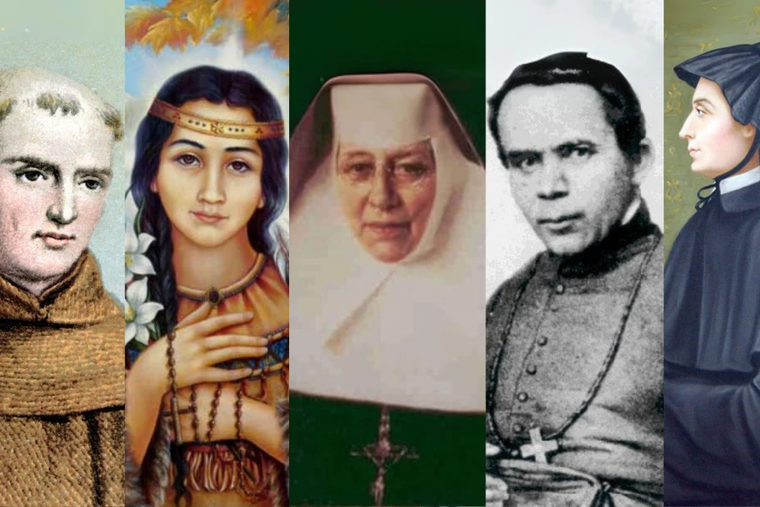
<p>Among those on the list are five Catholic saints: St. Junípero Serra, St. John Neumann, St. Katharine Drexel, St. Elizabeth Ann Seton, and St. Kateri Tekakwitha, as well as three Catholics whose cause for canonization are ongoing: Venerable Fulton Sheen, Venerable Augustus Tolton, and Servant of God Dorothy Day.</p>
<p><b>St. Junípero Serra</b></p>
<p>Born on the island of Petra Mallorca in Spain in 1713, <a href="https://www.catholicnewsagency.com/news/44937/who-is-st-junipero-serra-anyway" target="null">Junípero Serra</a> joined the Franciscans and quickly gained prominence as both a scholar and professor. He later gave up his life in academics to become a missionary in the territory of New Spain. Traveling almost everywhere on foot and practicing various forms of self-mortification, Serra founded mission churches all along the coast — the first nine of the 21 missions in what is today California. He also advocated for the rights of Native peoples.</p>
<p>​​On Aug. 28, 1784, at the age of 70, Junípero Serra died at Mission San Carlos Borromeo from tuberculosis.</p>
<p><b>St. John Neumann</b></p>
<p><a href="https://www.catholicnewsagency.com/saint/st-john-nepomucene-neumann-106" target="null">John Neumann</a> was born on March 28, 1811, in Bohemia, now part of the Czech Republic. After college, he entered the seminary and began reading about missionaries in the United States. Neumann decided to go to America and was ordained just 16 days after his arrival in the new country and sent to Buffalo, New York. </p>
<p>He lived in a small, log house and hardly ever lit a fire and often lived on only bread and water. He joined the Redemptorist order and continued his missionary work until he was elected bishop of Philadelphia in 1852. As bishop, Neumann built 50 churches, began the construction of a cathedral, and opened almost 100 schools. He died suddenly on Jan. 5, 1860.</p>
<p>He became the first American bishop to be beatified and was canonized by Pope Paul VI on June 19, 1977. He is buried in St. Peter the Apostle Church in Philadelphia.</p>
<p><b>St. Katharine Drexel</b></p>
<p><a href="https://www.catholicnewsagency.com/saint/st-katharine-drexel-166" target="null">Katharine Drexel</a> was born Nov. 26, 1858, into a wealthy and well-connected banking family. While traveling with her family through the Western U.S., Katharine witnessed the poor living conditions of the Native Americans. This inspired the young heiress to devote her whole life to the social and spiritual development of Black and Native American communities.</p>
<p>In February 1891, she made her first vows in religious life and formally renounced her fortune. She went on to start the Sisters of the Blessed Sacrament with the purpose of living with these communities while helping them acquire education and grow in faith. Between 1891 and 1935 she led her order in the founding and maintenance of almost 60 schools and missions, located primarily in the American West and Southwest.</p>
<p>She died on March 3, 1955, and was canonized by Pope John Paul II on Oct. 1, 2000.</p>
<p><b>St. Elizabeth Ann Seton</b></p>
<p><a href="https://www.catholicnewsagency.com/saint/st-elizabeth-ann-seton-105" target="null">Elizabeth Ann Seton</a> was born to Episcopalian parents into New York City high society on Aug. 28, 1774. After her husband died in 1803, Seton began getting to know the Catholic Church and converted in 1805. Her conversion unleashed a storm among her Protestant relatives and friends and made her financial strains even greater. </p>
<p>In 1808 she moved to Baltimore and privately took her first vows. In 1812, Seton became the foundress and first superior of the Sisters of Charity in the United States. </p>
<p>She died in Emmitsburg, Maryland, on Jan. 4, 1821, and was canonized on Sept. 14, 1975 — making her the first American-born person to be canonized. </p>
<p><b>St. Kateri Tekakwitha</b></p>
<p><a href="https://www.catholicnewsagency.com/saint/st-kateri-tekakwitha-521" target="null">St. Kateri Tekakwitha</a>, also known as the “Lily of the Mohawks,” was born in Auriesville, New York, in 1656 to a Christian Algonquin woman and a pagan Mohawk chief. When three Jesuit priests were visiting her tribe in 1667, they spoke to her of Christ, and though she did not ask to be baptized, she believed in Jesus with an incredible intensity. She also realized that she was called into an intimate union with God as a consecrated virgin.</p>
<p>At the age of 18, Tekakwitha was baptized and shortly after she fled from her village because it had become violent and debauchery was common. She went to the town of Caughnawaga in Quebec, near Montreal, where she grew in holiness and devotion to the Blessed Sacrament. She lived out the last years of her short life here, practicing austere penance and constant prayer. She died on April 17, 1680, at the age of 24.</p>
<p>She was beatified by Pope John Paul II in 1980 and canonized by Pope Benedict XVI on Oct. 21, 2012 — becoming the first Native American to be canonized.</p>
<p><b>Venerable Fulton Sheen</b></p>
<p>Born on May 8, 1895, in El Paso, Illinois, <a href="https://www.catholicnewsagency.com/tags/5634/fulton-sheen" target="null">Fulton Sheen</a> was ordained a priest in 1919 for the Diocese of Peoria. He earned a doctorate in philosophy from the Catholic University of Leuven in Belgium and later taught theology and philosophy at The Catholic University of America.</p>
<p>Sheen gained national fame through his preaching and media presence. In the 1930s and 1940s, he hosted the popular radio program “The Catholic Hour,” and in the 1950s, he reached millions through his Emmy Award-winning television show “Life Is Worth Living.”</p>
<p>In 1951, Sheen was appointed auxiliary bishop of New York, and in 1966, he became the bishop of Rochester, New York. He retired in 1969 but continued to write, preach, and teach until his death. Over his lifetime, he wrote more than 70 books on faith, philosophy, and spirituality.</p>
<p>Sheen died on Dec. 9, 1979, in New York City. In 2012, Pope Benedict XVI declared him venerable. His cause for canonization is ongoing.</p>
<p><b>Venerable Augustus Tolton</b></p>
<p><a href="https://www.catholicnewsagency.com/news/258042/juneteenth-and-the-life-of-the-first-black-american-catholic-priest" target="null">Augustus Tolton</a> was born into slavery in Brush Creek, Ralls County, Missouri, on April 1, 1854, to Catholic parents Peter Paul Tolton and Martha Jane Chisley. Peter Paul escaped shortly after the beginning of the Civil War and joined the Union Army, dying shortly thereafter. In 1862, Augustus Tolton, along with his mother and two siblings, escaped by crossing the Mississippi River into Illinois. </p>
<p>Tolton began to attend St. Peter’s Catholic School, an all-white parish school in Quincy, Illinois, thanks to the help of Father Peter McGirr. The priest went on to baptize Tolton, instruct him for his first holy Communion, and encouraged his vocation to the priesthood.</p>
<p>No American seminary would accept Tolton because of his race, so he studied for the priesthood in Rome and was ordained in 1886 at the age of 31, becoming the first African American ordained as a priest.</p>
<p>Tolton returned to the U.S. where he served for three years at a parish in Quincy. From there he went to Chicago and started a parish for Black Catholics — St. Monica Parish. He remained there until he died unexpectedly while on a retreat in 1897. He was just 43 years old. </p>
<p>Tolton’s cause was opened by the Archdiocese of Chicago on Feb. 24, 2011, and on June 12, 2019, Pope Francis declared him venerable.</p>
<p><b>Servant of God Dorothy Day</b></p>
<p>Born on Nov. 8, 1897, in Brooklyn, New York, and raised in Chicago, <a href="https://www.catholicnewsagency.com/news/249854/evidence-for-dorothy-day-s-sainthood-cause-sent-to-the-vatican" target="null">Dorothy Day</a> was baptized Episcopalian at the age of 12. In the 1910s, Day dropped out of college and moved to New York, where she took a job as a reporter for the country’s largest daily socialist paper, The Call.</p>
<p>After years of political activism, personal struggles, and a profound spiritual journey, Day converted to Catholicism in 1927. In 1933, she co-founded the Catholic Worker Movement, which combined direct aid for the poor with nonviolent action on behalf of justice.</p>
<p>Day lived in voluntary poverty, advocating for workers’ rights, racial equality, and peace, even when it meant challenging both Church leaders and government policies. Always speaking up for the marginalized, she was arrested multiple times for acts of civil disobedience.</p>
<p>She died on Nov. 29, 1980, in New York City. On March 16, 2000, the Vatican opened her cause for canonization, and she was declared servant of God, the first official step toward sainthood.</p>
</p></div>
<p><br />
<br /><a href="https://www.ncregister.com/cna/meet-the-catholic-saints-included-in-the-national-garden-of-american-heroes">Source link </a></p>
<p><!-- END THEIA POST SLIDER --></p>

Meet the Catholic Saints Included in the National Garden of American Heroes| National Catholic Register