<p><!-- BEGIN THEIA POST SLIDER --></p>
<p> <br />
</p>
<div>
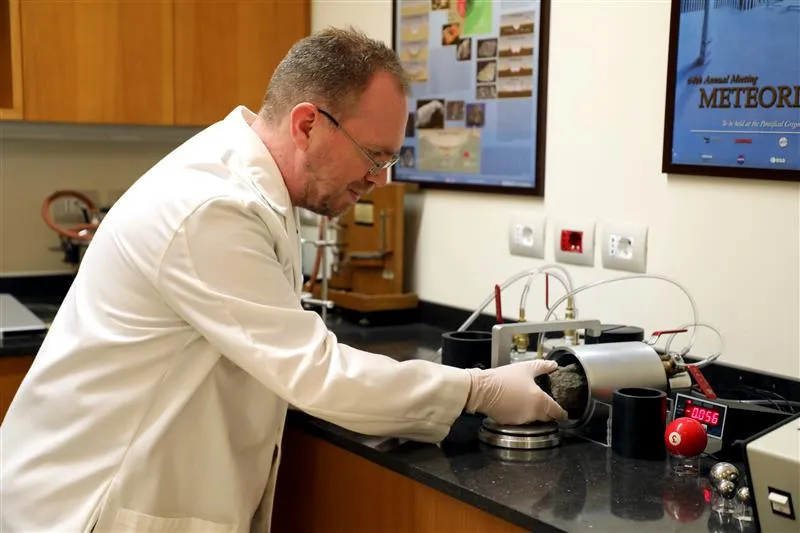
<p>Brother Robert Macke, known to many of his colleagues as “Brother Bob,” is a Jesuit astronomer at the Vatican Observatory and one of the world’s foremost experts in the study of meteorites. So, when Dr. Andy Ryan, one of the leads for NASA’s OSIRIS-REx mission, needed help constructing a device to study some of the oldest asteroid material in the solar system, he naturally turned to Macke.</p>
<p>The NASA mission required a custom-built “pycnometer” to measure the density and porosity of asteroid material taken from deep space. The device had to fit very specific restrictions to avoid contaminating the samples. Companies selling off-the-shelf pycnometers didn’t fit NASA’s specifications — only Macke was able to make the exact device the OSIRIS-REx mission needed.</p>
<p>Now, Brother Macke’s device will be used to closely study the asteroid material and hopefully answer some of NASA’s biggest questions about the origins of the solar system.</p>
<p>NASA&#8217;s OSIRIS-REx asteroid sample return mission will deliver its payload to Earth on Sunday!<a href="https://t.co/Wvp17rbcQM">https://t.co/Wvp17rbcQM</a></p>
<p>— Vatican Observatory (@VaticanObserv) <a href="https://twitter.com/VaticanObserv/status/1704592515813253202?ref_src=twsrc%5Etfw">September 20, 2023</a> What is the OSIRIS-REx mission?</p>
<p>OSIRIS-REx, which is short for the “Origins, Spectral Interpretation, Resource Identification, Security-Regolith Explorer,” is the first U.S. mission in history to deliver asteroid samples to Earth.</p>
<p>After seven years in space and collecting 8.8 ounces of surface material from the asteroid “Bennu” 200 million miles away, the OSIRIS-REx spacecraft landed back on Earth on Sunday, Sept. 24.</p>
<p>The samples, which NASA says date back to the earliest days of the solar system, were taken to NASA’s Johnson Space Center in Houston, where they will be permanently housed and studied.</p>
<p>The sample is now in Houston! The <a href="https://twitter.com/Astromaterials?ref_src=twsrc%5Etfw">@Astromaterials</a> curation team at <a href="https://twitter.com/NASA_Johnson?ref_src=twsrc%5Etfw">@NASA_Johnson</a> will carefully collect the sample from the capsule and prepare it for distribution and storage. 70% of the sample will be preserved for future generations to study. <a href="https://t.co/Li41TbcOLc">https://t.co/Li41TbcOLc</a> <a href="https://t.co/28GOrLVokx">pic.twitter.com/28GOrLVokx</a></p>
<p>— NASA Solar System (@NASASolarSystem) <a href="https://twitter.com/NASASolarSystem/status/1706442833899450566?ref_src=twsrc%5Etfw">September 25, 2023</a></p>
<p>NASA believes the sample taken by OSIRIS-REx will help answer questions about both the nature of asteroids and the origins of life in the solar system.</p>
<p>According to the NASA project’s website, the Bennu asteroid “is a remnant from the tumultuous formation of the solar system” and unlike any rocks found on Earth, “Bennu’s rocks offer us insight into our own history — a time about 4.5 billion years ago when Earth was first forming.” </p>
<p>How a Religious Brother Helped NASA</p>
<p>According to Brother Macke, Ryan wasn’t originally intending to ask him to join the mission, but after they began to talk, he realized Brother Macke was the perfect candidate to lead the construction of the pycnometer.</p>
<p>“He contacted me because I have extensive experience with the measurement techniques involved, having applied them to a few thousand meteorites and other specimens from collections in several cities in the USA and elsewhere,” Brother Macke told CNA. “At first he was just looking for advice, but as we talked more about it, eventually he asked me to join the team and to direct the construction of the device.” </p>
<div class="embed-block"><img alt="Brother Robert Macke, a Jesuit and astronomer at the Vatican Observatory, works in his office at the Vatican Observatory. Credit: Photo courtesy of Brother Robert Macke" class="img-fluid" src="https://admin.catholicnewsagency.com/storage/image/robertmack9.28.23-2.jpg"/></p>
<p class="embed-block__description">Brother Robert Macke, a Jesuit and astronomer at the Vatican Observatory, works in his office at the Vatican Observatory. Credit: Photo courtesy of Brother Robert Macke</p>
</div>
<p>According to Brother Macke, the process of constructing the device took over two years. His team’s efforts were complicated by the fact that the pycnometer had to be completely free of anything that might contaminate the specimens.</p>
<p>Now that the asteroid sample has returned to Earth, Brother Macke’s pycnometer will be a crucial tool to unlock the secrets being held by Bennu hundreds of millions of miles away. </p>
<p>“We have successfully built the device, but my task is not finished,” Brother Macke said. “The next step is to use the device to measure the densities of these specimens. This process will be spread over several weeks, and perhaps months. I cannot declare complete success for my part of the project until it is finished.” </p>
<div class="embed-block"><img alt="Artist's concept of NASA’s OSIRIS-REx spacecraft collecting a sample from the asteroid Bennu. Credit: NASA/Goddard/University of Arizona" class="img-fluid" src="https://admin.catholicnewsagency.com/storage/image/osiris-rexspacecraft9.28.23-3.jpg"/></p>
<p class="embed-block__description">Artist&#8217;s concept of NASA’s OSIRIS-REx spacecraft collecting a sample from the asteroid Bennu. Credit: NASA/Goddard/University of Arizona</p>
</div>
<p>The Study Begins</p>
<p>Brother Macke will be helping study the samples in Houston when it comes time to use his device.</p>
<p>“The OSIRIS-REx mission is a massive collaboration of scientists and engineers spanning numerous institutions and several countries,” Brother Macke told CNA. “It is a real honor to be included among their number.”</p>
<p>Brother Macke noted that he is “particularly excited” to be “helping to contribute to the wealth of knowledge that we will develop from the specimens brought back to the Earth from the asteroid Bennu.”</p>
<div class="embed-block"><img alt="The OSIRIS-REx spacecraft launches aboard a ULA Atlas V rocket, Sept. 8, 2016. Credit: United Launch Alliance" class="img-fluid" src="https://admin.catholicnewsagency.com/storage/image/osiris-rexspacecraft9.28.23-2.jpg"/></p>
<p class="embed-block__description">The OSIRIS-REx spacecraft launches aboard a ULA Atlas V rocket, Sept. 8, 2016. Credit: United Launch Alliance</p>
</div>
<p>Though Brother Macke said that he is honored to be on the NASA team studying Bennu, Brother Guy Consolmagno, director of the Vatican Observatory, told CNA that Macke is the perfect man for the job. </p>
<p>[Brother Macke] “Bob is the best in the world at making these measurements, having traveled across the U.S. and Europe to measure meteorite collections — and lunar samples — in this way,” Brother Consolmagno said. </p>
<p>“I am delighted that a member of the Vatican Observatory is a member of the science team studying the samples from asteroid Bennu,” Brother Consolmagno went on, “but it’s not surprising.” </p>
<div class="embed-block"><img alt="The OSIRIS-REx spacecraft is towed at NASA’s Kennedy Space Center before launch on Aug. 29, 2016. Credit: NASA/Dimitri Gerondidakis" class="img-fluid" src="https://admin.catholicnewsagency.com/storage/image/osiris-rexspacecraft9.28.23-1.jpg"/></p>
<p class="embed-block__description">The OSIRIS-REx spacecraft is towed at NASA’s Kennedy Space Center before launch on Aug. 29, 2016. Credit: NASA/Dimitri Gerondidakis</p>
</div>
<p>What is the Vatican Observatory?</p>
<p>The Vatican Observatory, which has locations in Rome’s Castel Gandolfo and Arizona, is the official astronomical and scientific research arm of the Vatican. </p>
<p>Though the modern observatory was founded in 1891, it has roots going back to 1582. Today, the Vatican Observatory is run by a community of Jesuit priests and brothers and is dedicated to advancing the scientific understanding of the universe. </p>
<p>According to Brother Macke, the Vatican Observatory has been involved in “countless collaborations with institutions around the world” and occasionally, as in this case, it is involved in NASA missions as well. </p>
<p>“I think it is safe to say that opportunities will arise to continue building useful collaborations with the whole scientific community,” Brother Macke said. </p>
<p>“The motto of the Vatican Observatory, given to us by Pope Pius XI in the 1930s,” Brother Macke said, “is ‘Deum Creatorem Venite Adoremus,’ or ‘Come Let Us Adore God the Creator.’”</p>
<p>Many believe that faith and science contradict each other. Catholic scientists at the Vatican Observatory disagree. </p>
<p>“By studying and learning about this great universe that is part of God’s creation, we can grow in appreciation of the Creator himself,” Brother Macke said. “In short, for us, doing science is a form of worship. We do the same science as everybody else and work right alongside the others contributing to the sum total of human knowledge, but what motivates our work is fundamentally adoration of God the Creator.”</p>
</p></div>
<p><script async src="https://platform.twitter.com/widgets.js" charset="utf-8"></script><br />
<br /><br />
<br /><a href="https://www.ncregister.com/cna/meet-the-vatican-scientist-helping-nasa-on-a-historic-space-mission">Source link </a></p>
<p><!-- END THEIA POST SLIDER --></p>

Meet the Vatican Scientist Helping NASA on a Historic Space Mission| National Catholic Register