<p><!-- BEGIN THEIA POST SLIDER --></p>
<p> <br />
</p>
<div>
<p><i>Editor&#8217;s Note: As we enter into Holy Week and prepare our hearts and minds for the Passion of Christ, here is Cardinal John Henry&#8217;s meditations on the Mental Sufferings of our Lord for reflection. </i></p>
<p>EVERY passage in the history of our Lord and Saviour is of unfathomable depth, and affords inexhaustible matter of contemplation. All that concerns Him is infinite, and what we first discern is but the surface of that which begins and ends in eternity. It would be presumptuous for any one short of saints and doctors to attempt to comment on His words and deeds, except in the way of meditation; but meditation and mental prayer are so much a duty in all who wish to cherish true faith and love towards Him, that it may be allowed us, my brethren, under the guidance of holy men who have gone before us, to dwell and enlarge upon what otherwise would more fitly be adored than scrutinised. And certain times of the year, this especially, call upon us to consider, as closely and minutely as we can, even the more sacred portions of the Gospel history. I would rather be thought feeble or officious in my treatment of them, than wanting to the Season; and so I now proceed because the religious usage of the Church requires it, {324} and though any individual preacher may well shrink from it, to direct your thoughts to a subject, especially suitable now, and about which many of us perhaps think very little, the sufferings which our Lord endured in His innocent and sinless soul.</p>
<p>You know, my brethren, that our Lord and Saviour, though He was God, was also perfect man; and hence He had not only a body, but a soul likewise, such as ours, though pure from all stain of evil. He did not take a body without a soul, God forbid! for that would not have been to become man. How would He have sanctified our nature by taking a nature which was not ours? Man without a soul is on a level with the beasts of the field; but our Lord came to save a race capable of praising and obeying Him, possessed of immortality, though that immortality had lost its promised blessedness. Man was created in the image of God, and that image is in his soul; when then his Maker, by an unspeakable condescension, came in his nature, He took on Himself a soul in order to take on Him a body; He took on Him a soul as the means of His union with a body; He took on Him in the first place the soul, then the body of man, both at once, but in this order, the soul and the body; He Himself created the soul which He took on Himself, while He took His body from the flesh of the Blessed Virgin, His Mother. Thus He became perfect man with body and soul; and as He took on Him a body of flesh and nerves, which admitted of wounds and death, and was capable of suffering, so did He take a soul, too, which was susceptible of that suffering, and {325} moreover was susceptible of the pain and sorrow which are proper to a human soul; and, as His atoning passion was undergone in the body, so it was undergone in the soul also.</p>
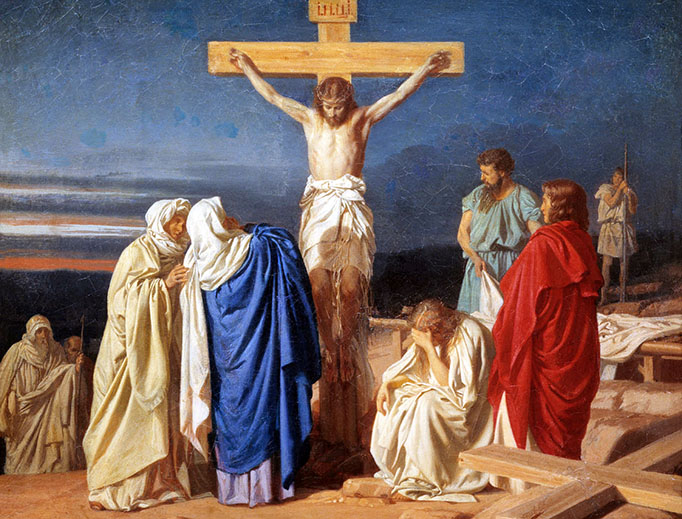
<p>As the solemn days proceed, we shall be especially called on, my brethren, to consider His sufferings in the body, His seizure, His forced journeyings to and fro, His blows and wounds, His scourging, the crown of thorns, the nails, the Cross. They are all summed up in the Crucifix itself, as it meets our eyes; they are represented all at once on His sacred flesh, as it hangs up before us—and meditation is made easy by the spectacle. It is otherwise with the sufferings of His soul; they cannot be painted for us, nor can they even be duly investigated: they are beyond both sense and thought; and yet they anticipated His bodily sufferings. The agony, a pain of the soul, not of the body, was the first act of His tremendous sacrifice; &#8220;My soul is sorrowful even unto death,&#8221; He said; nay; if He suffered in the body, it really was in the soul, for the body did but convey the infliction on to that which was the true recipient and seat of the suffering.</p>
<p>This it is very much to the purpose to insist upon; I say, it was not the body that suffered, but the soul in the body; it was the soul and not the body which was the seat of the suffering of the Eternal Word. Consider, then, there is no real pain, though there may be apparent suffering, when there is no kind of inward sensibility or spirit to be the seat of it. A tree, for instance, has life, organs, growth, and decay; it {326} may be wounded and injured; it droops, and is killed; but it does not suffer, because it has no mind or sensible principle within it. But wherever this gift of an immaterial principle is found, there pain is possible, and greater pain according to the quality of the gift. Had we no spirit of any kind, we should feel as little as a tree feels; had we no soul, we should not feel pain more acutely than a brute feels it; but, being men, we feel pain in a way in which none but those who have souls can feel it.</p>
<p>Living beings, I say, feel more or less according to the spirit which is in them; brutes feel far less than man, because they cannot reflect on what they feel; they have no advertence or direct consciousness of their sufferings. This it is that makes pain so trying, viz., that we cannot help thinking of it, while we suffer it. It is before us, it possesses the mind, it keeps our thoughts fixed upon it. Whatever draws the mind off the thought of it lessens it; hence friends try to amuse us when we are in pain, for amusement is a diversion. If the pain is slight, they sometimes succeed with us; and then we are, so to say, without pain, even while we suffer. And hence it continually happens that in violent exercise or labour, men meet with blows or cuts, so considerable and so durable in their effect, as to bear witness to the suffering which must have attended their infliction, of which nevertheless they recollect nothing. And in quarrels and in battles wounds are received which, from the excitement of the moment, are brought home to the consciousness of the combatant, not by the pain at the {327} time of receiving them, but by the loss of blood that follows.</p>
<p>I will show you presently, my brethren, how I mean to apply what I have said to the consideration of our Lord&#8217;s sufferings; first I will make another remark. Consider, then, that hardly any one stroke of pain is intolerable; it is intolerable when it continues. You cry out perhaps that you cannot bear more; patients feel as if they could stop the surgeon&#8217;s hand, simply because he continues to pain them. Their feeling is that they have borne <i>as much</i> as they can bear; as if the continuance and not the intenseness was what made it too much for them. What does this mean, but that the memory of the foregoing moments of pain acts upon and (as it were) edges the pain that succeeds? If the third or fourth or twentieth moment of pain could be taken by itself, if the succession of the moments that preceded it could be forgotten, it would be no more than the first moment, as bearable as the first (taking away the shock which accompanies the first); but what makes it unbearable is, that it <i>is</i> the twentieth; that the first, the second, the third, on to the nineteenth moment of pain, are all concentrated in the twentieth; so that every additional moment of pain has all the force, the ever-increasing force, of all that has preceded it. Hence, I repeat, it is that brute animals would seem to feel so little pain, because, that is, they have not the power of reflection or of consciousness. They do not know they exist; they do not contemplate themselves; they do not look backwards or forwards; every moment as {328} it succeeds is their all; they wander over the face of the earth, and see this thing and that, and feel pleasure and pain, but still they take everything as it comes, and then let it go again, as men do in dreams. They have memory, but not the memory of an intellectual being; they put together nothing, they make nothing properly one and individual to themselves out of the particular sensations which they receive; nothing is to them a reality, or has a substance, beyond those sensations; they are but sensible of a number of successive impressions. And hence, as their other feelings, so their feeling of pain is but faint and dull, in spite of their outward manifestations of it. It is the intellectual comprehension of pain, as a whole diffused through successive moments, which gives it its special power and keenness, and it is the soul only, which a brute has not, which is capable of that comprehension.</p>
<p>Now apply this to the sufferings of our Lord;—do you recollect their offering Him wine mingled with myrrh, when He was on the point of being crucified? He would not drink of it; why? because such a portion would have stupefied His mind, and He was bent on bearing the pain in all its bitterness. You see from this, my brethren, the character of His sufferings; He would have fain escaped them, had that been His Father&#8217;s will; &#8220;If it be possible,&#8221; He said, &#8220;let this chalice pass from Me;&#8221; but since it was not possible, He says calmly and decidedly to the Apostle, who would have rescued Him from suffering, &#8220;The chalice which My Father hath given Me, shall I not drink it?&#8221; If He was to suffer, He gave Himself {329} to suffering; He did not come to suffer as little as He could; He did not turn away His face from the suffering; He confronted it, or, as I may say, He breasted it, that every particular portion of it might make its due impression on Him. And as men are superior to brute animals, and are affected by pain more than they, by reason of the mind within them, which gives a substance to pain, such as it cannot have in the instance of brutes; so, in like manner, our Lord felt pain of the body, with an advertence and a consciousness, and therefore with a keenness and intensity, and with a unity of perception, which none of us can possibly fathom or compass, because His soul was so absolutely in His power, so simply free from the influence of distractions, so fully directed upon the pain, so utterly surrendered, so simply subjected to the suffering. And thus He may truly be said to have suffered the whole of His passion in every moment of it.</p>
<p>Recollect that our Blessed Lord was in this respect different from us, that, though He was perfect man, yet there was a power in Him greater than His soul, which ruled His soul, for He was God. The soul of other men is subjected to its own wishes, feelings, impulses, passions, perturbations; His soul was subjected simply to His Eternal and Divine Personality. Nothing happened to His soul by chance, or on a sudden; He never was taken by surprise; nothing affected Him without His willing beforehand that it should affect Him. Never did He sorrow, or fear, or desire, or rejoice in spirit, but He first willed to be {330} sorrowful, or afraid, or desirous, or joyful. When we suffer, it is because outward agents and the uncontrollable emotions of our minds bring suffering upon us. We are brought under the discipline of pain involuntarily, we suffer from it more or less acutely according to accidental circumstances, we find our patience more or less tried by it according to our state of mind, and we do our best to provide alleviations or remedies of it. We cannot anticipate beforehand how much of it will come upon us, or how far we shall be able to sustain it; nor can we say afterwards why we have felt just what we have felt, or why we did not bear the suffering better. It was otherwise with our Lord. His Divine Person was not subject, could not be exposed, to the influence of His own human affections and feelings, except so far as He chose. I repeat, when He chose to fear, He feared; when He chose to be angry, He was angry; when He chose to grieve, He was grieved. He was not open to emotion, but He opened upon Himself voluntarily the impulse by which He was moved. Consequently, when He determined to suffer the pain of His vicarious passion, whatever He did, He did, as the Wise Man says, <i>instanter</i>, &#8220;earnestly,&#8221; with His might; He did not do it by halves; He did not turn away His mind from the suffering as we do—(how should He, who came to suffer, who could not have suffered but of His own act?) no, He did not say and unsay, do and undo; He said and He did; He said, &#8220;Lo, I come to do Thy will, O God; sacrifice and offering Thou wouldest not, but a body hast Thou fitted to Me&#8221;. He took a {331} body in order that He might suffer; He became man, that He might suffer as man; and when His hour was come, that hour of Satan and of darkness, the hour when sin was to pour its full malignity upon Him, it followed that He offered Himself wholly, a holocaust, a whole burnt-offering;—as the whole of His body, stretched out upon the Cross, so the whole of His soul, His whole advertence, His whole consciousness, a mind awake, a sense acute, a living cooperation, a present, absolute intention, not a virtual permission, not a heartless submission, this did He present to His tormentors. His passion was an action; He lived most energetically, while He lay languishing, fainting, and dying. Nor did He die, except by an act of the will; for He bowed His head, in command as well as in resignation, and said, &#8220;Father, into Thy hands I commend My Spirit;&#8221; He gave the word, He surrendered His soul, He did not lose it.</p>
<p>Thus you see, my brethren, had our Lord only suffered in the body, and in it not so much as other men, still as regards the pain, He would have really suffered indefinitely more, because pain is to be measured by the power of realising it. God was the sufferer; God suffered in His human nature; the sufferings belonged to God, and were drunk up, were drained out to the bottom of the chalice, because God drank them; not tasted or sipped, not flavoured, disguised by human medicaments, as man disposes of the cup of anguish. And what I have been saying will further serve to answer an objection, which I shall proceed to notice, and which perhaps exists latently {332} in the minds of many, and leads them to overlook the part which our Lord&#8217;s soul had in His gracious satisfaction for sin.</p>
<p>Our Lord said, when His agony was commencing, &#8220;My soul is sorrowful unto death&#8221;; now you may ask, my brethren, whether He had not certain consolations peculiar to Himself, impossible in any other, which diminished or impeded the distress of His soul, and caused Him to feel, not more, but less than an ordinary man. For instance, He had a sense of innocence which no other sufferer could have; even His persecutors, even the false apostle who betrayed Him, the judge who sentenced Him, and the soldiers who conducted the execution, testified His innocence. &#8220;I have condemned the innocent blood,&#8221; said Judas; &#8220;I am clear from the blood of this just Person,&#8221; said Pilate; &#8220;Truly this was a just Man,&#8221; cried the centurion. And if even they, sinners, bore witness to His sinlessness, how much more did His own soul! And we know well that even in our own case, sinners as we are, on the consciousness of innocence or of guilt mainly turns our power of enduring opposition and calumny; how much more, you will say, in the case of our Lord, did the sense of inward sanctity compensate for the suffering and annihilate the shame! Again, you may say that He knew that His sufferings would be short, and that their issue would be joyful, whereas uncertainty of the future is the keenest element of human distress; but He could not have anxiety, for He was not in suspense; nor despondency or despair, for He never was deserted. {333} And in confirmation you may refer to St. Paul, who expressly tells us that, &#8220;for the joy set before Him,&#8221; our Lord &#8220;despised the shame&#8221;. And certainly there is a marvellous calm and self-possession in all He does: consider His warning to the Apostles, &#8220;Watch and pray, lest ye enter into temptation; the spirit indeed is willing, but the flesh is weak&#8221;; or His words to Judas, &#8220;Friend, wherefore art thou come?&#8221; and, &#8220;Judas, betrayest thou the Son of Man with a kiss?&#8221; or to Peter, &#8220;All that take the sword shall perish with the sword&#8221;; or to the man who struck Him, &#8220;If I have spoken evil, bear witness of the evil; but if well, why smitest thou Me?&#8221; or to His Mother, &#8220;Woman, behold thy Son&#8221;.</p>
<p>All this is true and much to be insisted on; but it quite agrees with, or rather illustrates, what I have been observing. My brethren, you have only said (to use a human phrase) that He was always Himself. His mind was its own centre, and was never in the slightest degree thrown off its heavenly and most perfect balance. What He suffered, He suffered because He put Himself under suffering, and that deliberately and calmly. As He said to the leper, &#8220;I will, be thou clean&#8221;; and to the paralytic, &#8220;Thy sins be forgiven thee&#8221;; and to the centurion, &#8220;I will come and heal him&#8221;; and of Lazarus, &#8220;I go to wake him out of sleep&#8221;; so He said, &#8220;Now I will begin to suffer,&#8221; and He did begin. His composure is but the proof how entirely He governed His own mind. He drew back, at the proper moment, the bolts and fastenings, and opened the gates, and the floods fell right {334} upon His soul in all their fulness. That is what St. Mark tells us of Him; and he is said to have written his Gospels from the very mouth of St. Peter, who was one of three witnesses present at the time. &#8220;They came,&#8221; he says, &#8220;to the place which is called Gethsemani; and He saith to His disciples, Sit you here while I pray. And He taketh with Him Peter and James and John, and He <i>began to be</i> frightened and to be very heavy.&#8221; You see how deliberately He acts; He comes to a certain spot; and then, giving the word of command, and withdrawing the support of the God-head from His soul, distress, terror, and dejection at once rush in upon it. Thus He walks forth into a mental agony with as definite an action as if it were some bodily torture, the fire or the wheel.</p>
<p>This being the case, you will see at once, my brethren, that it is nothing to the purpose to say that He would be supported under His trial by the consciousness of innocence and the anticipation of triumph; for His trial consisted in the withdrawal, as of other causes of consolation, so of that very consciousness and anticipation. The same act of the will which admitted the influence upon His soul of any distress at all, admitted all distresses at once. It was not the contest between antagonist impulses and views, coming from without, but the operation of an inward resolution. As men of self-command can turn from one thought to another at their will, so much more did He deliberately deny Himself the comfort, and satiate Himself with the woe. In that moment His soul thought not of the future, He thought only of the {335} present burden which was upon Him, and which He had come upon earth to sustain.</p>
<p>And now, my brethren, what was it He had to bear, when He thus opened upon His soul the torrent of this predestinated pain? Alas! He had to bear what is well known to us, what is familiar to us, but what to Him was woe unutterable. He had to bear that which is so easy a thing to us, so natural, so welcome, that we cannot conceive of it as of a great endurance, but which to Him had the scent and the poison of death—He had, my dear brethren, to bear the weight of sin; He had to bear your sins; He had to bear the sins of the whole world. Sin is an easy thing to us; we think little of it; we do not understand how the Creator can think much of it; we cannot bring our imagination to believe that it deserves retribution, and, when even in this world punishments follow upon it, we explain them away or turn our minds from them. But consider what sin is in itself; it is rebellion against God; it is a traitor&#8217;s act who aims at the overthrow and death of His sovereign; it is that, if I may use a strong expression, which, could the Divine Governor of the world cease to be, would be sufficient to bring it about. Sin is the mortal enemy of the All-holy, so that He and it cannot be together; and as the All-holy drives it from His presence into the outer darkness, so, if God could be less than God, it is sin that would have power to make Him less. And here observe, my brethren, that when once Almighty Love, by taking flesh, entered this created system, and submitted Himself to its laws, then forthwith this {336} antagonist of good and truth, taking advantage of the opportunity, flew at that flesh which He had taken, and fixed on it, and was its death. The envy of the Pharisees, the treachery of Judas, and the madness of the people, were but the instrument or the expression of the enmity which sin felt towards Eternal Purity as soon as, in infinite mercy towards men, He put Himself within its reach. Sin could not touch His Divine Majesty; but it could assail Him in that way in which He allowed Himself to be assailed, that is, through the medium of His humanity. And in the issue, in the death of God incarnate, you are but taught, my brethren, what sin is in itself, and what it was which then was falling, in its hour and in its strength, upon His human nature, when He allowed that nature to be so filled with horror and dismay at the very anticipation.</p>
<p>There, then, in that most awful hour, knelt the Saviour of the world, putting off the defences of His divinity, dismissing His reluctant Angels, who in myriads were ready at His call, and opening His arms, baring His breast, sinless as He was, to the assault of His foe,—of a foe whose breath was a pestilence, and whose embrace was an agony. There He knelt, motionless and still, while the vile and horrible fiend clad His spirit in a robe steeped in all that is hateful and heinous in human crime, which clung close round His heart, and filled His conscience, and found its way into every sense and pore of His mind, and spread over Him a moral leprosy, till He almost felt Himself to be that which He never could {337} be, and which His foe would fain have made Him. Oh, the horror, when He looked, and did not know Himself, and felt as a foul and loathsome sinner, from His vivid perception of that mass of corruption which poured over His head and ran down even to the skirts of His garments! Oh, the distraction, when He found His eyes, and hands, and feet, and lips, and heart, as if the members of the Evil One, and not of God! Are these the hands of the Immaculate Lamb of God, once innocent, but now red with ten thousand barbarous deeds of blood? are these His lips, not uttering prayer, and praise, and holy blessings, but as if defiled with oaths, and blasphemies, and doctrines of devils? or His eyes, profaned as they are by all the evil visions and idolatrous fascinations for which men have abandoned their adorable Creator? And His ears, they ring with sounds of revelry and of strife; and His heart is frozen with avarice, and cruelty, and unbelief; and His very memory is laden with every sin which has been committed since the fall, in all regions of the earth, with the pride of the old giants, and the lusts of the five cities, and the obduracy of Egypt, and the ambition of Babel, and the unthankfulness and scorn of Israel. Oh, who does not know the misery of a haunting thought which comes again and again, in spite of rejection, to annoy, if it cannot seduce? or of some odious and sickening imagination, in no sense one&#8217;s own, but forced upon the mind from without? or of evil knowledge, gained with or without a man&#8217;s fault, but which he would give a great price to be rid of at once and for ever? And adversaries such as {338} these gather around Thee, Blessed Lord, in millions now; they come in troops more numerous than the locust or the palmer-worm, or the plagues of hail, and flies, and frogs, which were sent against Pharaoh. Of the living and of the dead and of the as yet unborn, of the lost and of the saved, of Thy people and of strangers, of sinners and of saints, all sins are there. Thy dearest are there, Thy saints and Thy chosen are upon Thee; Thy three Apostles, Peter, James, and John; but not as comforters, but as accusers, like the friends of Job, &#8220;sprinkling dust towards heaven,&#8221; and heaping curses on Thy head. All are there but one; one only is not there, one only; for she who had no part in sin, she only could console Thee, and therefore she is not nigh. She will be near Thee on the Cross, she is separated from Thee in the garden. She has been Thy companion and Thy confidant through Thy life, she interchanged with Thee the pure thoughts and holy meditations of thirty years; but her virgin ear may not take in, nor may her immaculate heart conceive, what now is in vision before Thee. None was equal to the weight but God; sometimes before Thy saints Thou hast brought the image of a single sin, as it appears in the light of Thy countenance, or of venial sins, not mortal; and they have told us that the sight did all but kill them, nay, would have killed them, had it not been instantly withdrawn. The Mother of God, for all her sanctity, nay by reason of it, could not have borne even one brood of that innumerable progeny of Satan which now compasses Thee about. It is the long history of a world, and God {339} alone can bear the load of it. Hopes blighted, vows broken, lights quenched, warnings scorned, opportunities lost; the innocent betrayed, the young hardened, the penitent relapsing, the just overcome, the aged failing; the sophistry of misbelief, the wilfulness of passion, the obduracy of pride, the tyranny of habit, the canker of remorse, the wasting fever of care, the anguish of shame, the pining of disappointment, the sickness of despair; such cruel, such pitiable spectacles, such heartrending, revolting, detestable, maddening scenes; nay, the haggard faces, the convulsed lips, the flushed cheek, the dark brow of the willing slaves of evil, they are all before Him now; they are upon Him and in Him. They are with Him instead of that ineffable peace which has inhabited His soul since the moment of His conception. They are upon Him, they are all but His own; He cries to His Father as if He were the criminal, not the victim; His agony takes the form of guilt and compunction. He is doing penance, He is making confession, He is exercising contrition, with a reality and a virtue infinitely greater than that of all saints and penitents together; for He is the One Victim for us all, the sole Satisfaction, the real Penitent, all but the real sinner.</p>
<p>He rises languidly from the earth, and turns around to meet the traitor and his band, now quickly nearing the deep shade. He turns, and lo there is blood upon His garment and in His footprints. Whence come these first-fruits of the passion of the Lamb? no soldier&#8217;s scourge has touched His shoulders, nor {340} the hangman&#8217;s nails His hands and feet. My brethren, He has bled before His time; He has shed blood; yes, and it is His agonising soul which has broken up His framework of flesh and poured it forth. His passion has begun from within. That tormented Heart, the seat of tenderness and love, began at length to labour and to beat with vehemence beyond its nature; &#8220;the foundations of the great deep were broken up;&#8221; the red streams rushed forth so copious and fierce as to overflow the veins, and bursting through the pores, they stood in a thick dew over His whole skin; then forming into drops, they rolled down full and heavy, and drenched the ground.</p>
<p>&#8220;My soul is sorrowful even unto death,&#8221; He said. It has been said of that dreadful pestilence which now is upon us, that it begins with death; by which is meant that it has no stage or crisis, that hope is over when it comes, and that what looks like its course is but the death agony and the process of dissolution; and thus our Atoning Sacrifice, in a much higher sense, began with this passion of woe, and only did not die, because at His Omnipotent will His Heart did not break, nor Soul separate from Body, till He had suffered on the Cross.</p>
<p>No; He has not yet exhausted that full chalice, from which at first His natural infirmity shrank. The seizure and the arraignment, and the buffeting, and the prison, and the trial, and the mocking, and the passing to and fro, and the scourging, and the crown of thorns, and the slow march to Calvary, and the crucifixion, these are all to come. A night and a {341} day, hour after hour, is slowly to run out before the end comes, and the satisfaction is completed.</p>
<p>And then, when the appointed moment arrived, and He gave the word, as His passion had begun with His soul, with the soul did it end. He did not die of bodily exhaustion, or of bodily pain; at His will His tormented Heart broke, and He commended His Spirit to the Father.</p>
<p>&#8220;O Heart of Jesus, all Love, I offer Thee these humble prayers for myself, and for all those who unite themselves with me in Spirit to adore Thee. O holiest Heart of Jesus most lovely, I intend to renew and to offer to Thee these acts of adoration and these prayers, for myself a wretched sinner, and for all those who are associated with me in Thy adoration, through all moments while I breathe, even to the end of my life. I recommend to Thee, O my Jesus, Holy Church, Thy dear spouse and our true Mother, all just souls and all poor sinners, the afflicted, the dying, and all mankind. Let not Thy Blood be shed for them in vain. Finally, deign to apply it in relief of the souls in Purgatory, of those in particular who have practised in the course of their life this holy devotion of adoring Thee.&#8221;</p>
</p></div>
<p><br />
<br /><a href="https://www.ncregister.com/commentaries/cardinal-newman-mental-sufferings-of-our-lord-in-his-passion">Source link </a></p>
<p><!-- END THEIA POST SLIDER --></p>

Mental Sufferings of Our Lord in His Passion| National Catholic Register