


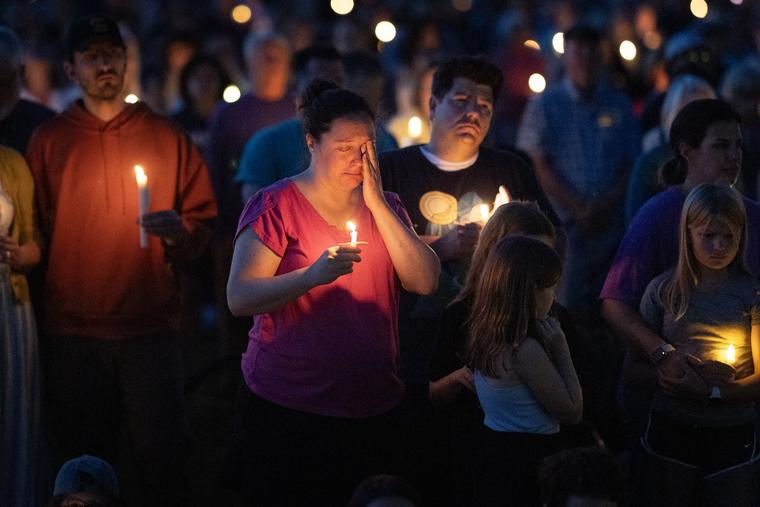
COMMENTARY: Our Catholic faith unites us with the incarnate God who knows grief and suffering.
Grief is not one feeling. Grief is not a linear, sequential progression through stages. No, grief is a profound collection of many feelings, thoughts and behaviors.
After a loss, it is common for people to feel sad, angry, numb, anxious, withdrawn, busy and guilty — all at once. Recognizing, articulating and expressing those feelings is difficult. At the same time, grief may prompt odd thoughts and strange behaviors. That is why, when people are grieving, they do not act like their normal selves, and we often struggle with how to react. What do we say? What do we do?
Right now, after yesterday’s tragic school shooting at Annunciation Catholic School and another shooting Tuesday next to Cristo Rey High School in Minneapolis, the Catholic community in Minnesota is grieving. First and foremost, please respond to Archbishop Bernard A. Hebda’s call for prayers. Praying has immeasurable and supernatural power, especially during times of heartbreak and suffering.
In my many years as a psychologist, I have found that healing from grief, untethered from faith, is almost untenable. Our Catholic faith offers so much — community, prayers, sacraments, rituals, teachings — and most importantly, a direct connection to the incarnate God who has known grief and suffering.
This summer, I started working at Saint Mary’s University of Minnesota. The university community has been welcoming and supportive of me and my family. My oldest daughter was recently accepted into the nursing program, with plans to start next year. Saint Mary’s has a Minneapolis campus a few miles from the sites of both shootings.
Father James Burns, president of Saint Mary’s University, touched upon the close connections within the local Catholic community.
“These heartbreaking acts of violence have struck communities closely tied to our own,” he said. “Our alumni serve on the staff at these schools, and many of their graduates have found their way to Saint Mary’s, enriching our university family with their faith, spirit, and gifts.”
In my brief time at Saint Mary’s, I have come to know many in the local Catholic community. There is a clear sense of collaboration, service and resilience that is certainly needed during this time of grieving.
In my years of counseling individuals experiencing grief, I have learned that the typical techniques do not work. In a profession that relies on the power of words to heal, it is paradoxically challenging that words do not have the same impact with grief. No, grief requires a radical willingness to be present and to sit with grief — often, without saying any words — and to feel the grief with the person.
Very early in my psychological studies, I was drawn to the writings of St. Edith Stein. She was no stranger to human suffering. She lived through the early deaths of siblings and her father. She was sent to Auschwitz and died as “a martyr of love” during the Holocaust. Thus, it seems providential that her seminal piece of scholarship was about empathy.
All of these years later, I still draw upon her scholarship in my clinical practice. She described the phenomenon of “fellow feeling,” which occurs when two or more people have the same feeling over the same event. Fellow feeling is a core part of empathy. Part of healing from grief is having another person willing to feel the grief. Empathy between people brings healing.
I am a father of four daughters who attend Catholic schools. Yesterday morning, my 10-year-old daughter went to her Catholic school and celebrated morning Mass with her teachers and classmates. How do I make sense of such divergent experiences? The hard answer is that there is no making sense of it.
There are no words to explain the tragedy in one school and a normal day in another school. Yet, I have recalled the wisdom passed on to me from Catholic clergy. Deacon Stephen Byers of the Diocese of Pittsburgh spoke of the simple yet powerful beauty of what he called “presence ministry.” Presence ministry is just that — being there, with and for another person.
We can be present for each other. We can grieve with each other. And we can pray.