<p><!-- BEGIN THEIA POST SLIDER --></p>
<p> <br />
</p>
<div>
<p><a href="https://www.ncregister.com/blog/old-testament-and-art-moses-youth">Botticelli’s painting</a> gave us a preview of Moses’ encounter with God at the burning bush, but that event is so important to Jewish and Christian theology that it deserves its own treatment and not be attached as an afterthought to Moses’ early biography.</p>
<p>Scripture tells us that Moses was tending his father-in-law’s sheep at Horeb. Mount Horeb is somewhat unclear but is traditionally identified with Mount Sinai, where Moses would in the future receive the Ten Commandments. If that is so, it’s on the Sinai Peninsula side of the region where Moses was now living.</p>
<p>Moses is probably spending a quiet day outdoors with the flock when he sees an unusual phenomenon: a bush that is burning yet unconsumed. That a bush should catch fire is not unusual; under dry conditions, it can become tinder.</p>
<p>What <i>is </i>unusual is that the bush is burning but unconsumed. A dry bush ought to burn up quickly and then extinguish: there’s no more fuel for the fire. That’s not what Moses sees. So, he decides to investigate. “I must turn aside to look at this remarkable sight. Why does the bush not burn up?” (Exodus 3:3).</p>
<p>In the course of his investigation, he discovers something deeper: his calling.</p>
<p>As he approaches, God calls to him: “Moses!” God <i>always </i>encounters us personally. He who knew our names before we existed (Jeremiah 1:5) does not deal with us as “no-name” generics. </p>
<p>Moses answers: “Here I am.”</p>
<p>God tells him to stop where he is and remove his sandals “for the place where you stand is holy ground,” holy because God is present there. It is also why Moses hides his face: while he is “here” for the Lord, he recognizes the profound dissonance between the Eternal and Holy One and sinful man.</p>
<p>God then goes on, identifying himself as “the God of Abraham, the God of Isaac and the God of Jacob.” Exodus now links up with Genesis: God’s salvific plan, begun with Abraham, is continuing.</p>
<p>And God reveals the next installment of that plan. It is not to leave the people Joseph and his brothers brought to Egypt as permanent residents, no, permanent slaves there. God is a <i>just and merciful </i>God who remains faithful to those he has made covenant with (even if they don’t). He promises them deliverance and a “land flowing with milk and honey,” the land previously promised to and held by Abraham, Isaac and Jacob.</p>
<p>Good news — even feel-good news — for the rescued: after all, one reason I’m here is for standing up for a Hebrew abused by an Egyptian. But why has the God of my ancestors troubled to speak to me of his plans?</p>
<p>“Now go! I am sending you to Pharaoh to bring my people, the Israelites, out of Egypt!” (Exodus 3:10)</p>
<p>God has a plan. You are part of it.</p>
<p>Moses demurs, out of humility and fear, without explicitly articulating the latter. Humility: “Who am I to do a reverse Joseph? Fear: Pharaoh already tried to kill me (Exodus 2:15). God reassures — “I am with you” (3:12). Not only that, God offers him a proof, but a proof he must take on faith: “When you have brought the people out of Egypt, you will serve God on this mountain.” In other words, when you fulfill your vocation, you will come right back here.</p>
<p>“Is God with me or not?” is the constant human question. We saw it in <a href="https://www.ncregister.com/blog/old-testament-and-art-jacobs-wrestling-match">Jacob’s tortured path to the Promise</a>. But God wants our faith. Abraham, do you believe you will have a child you humanly expect to be impossible? It’s an act of faith: because if God <i>isn’t</i> with him, Moses would <i>not</i> be back on this mountain. He’d be impaled in Egypt. The ball’s in Moses’ court.</p>
<p>This is where it gets even more interesting. Moses dares to throw a hypothetical at God: “<i>If </i>I go to the Israelites and say, ‘God … has sent me,’ and they ask, ‘What is his name?’ what do I tell them?” (Exodus 3:13)</p>
<p>This is <i>not </i>a purely informational inquiry. Moses defers to God. He doesn’t first ask about how he is to legitimate himself before Pharaoh because, by commissioning him, God has already done that (though Moses will later dissemble about his lack of eloquence: Exodus 4:10-12). Moses is trying to trap God. </p>
<p>In the Bible, to know or give a name is <i>not </i>mere information. It’s not a parental fling of whimsy: “We’ll name him Abercromby if he’s a boy and Zarabeth if she’s a girl.” To know or give a name is truly to know something about that person, to penetrate his identity, to have some measure of control or authority over him. That’s why in the Bible it is God who changes names when he gives people new missions. (And why, viscerally, parents rebel when teachers “change” their child’s name in school behind their backs). </p>
<p>Moses wants to have <i>some </i>hook, some claim on God more than faith that he’ll be back at Horeb. God does not oblige. </p>
<p>“I AM (×Ö¶Ö½×Ö°×Ö¶Ö×) has sent me to you” (Exodus 3:14).</p>
<p>“I AM.”</p>
<p>In a very real sense, if a “name” is expressive of who someone is, there is <i>no </i>more accurate name for God. God “IS.” God is the only being who can truly say, “I AM” — without beginning, without end, without change, without dependency, without contingency.</p>
<p>In one sense, God’s answer to Moses is something of a backhanded rebuke. While Moses is fishing for something to put a claim on God, God pushes back: you, man, who exist (like everything else) only because of me, would have me account to you? I AM. You aren’t.</p>
<p>Throughout their history, Jews have recognized the unique meaning of the “Name” pronounced at the Burning Bush. It is why the whole Gospel of John is built around a series of “I AMs” — “I am the bread come down from heaven,” “I am the living water,” “I am the way, the truth and the life.” All because—as Jesus baldly tells the Pharisees: “Before Abraham was, I AM” (John 8:58). It is Jesus’ clear claim to divinity and the Pharisees’ reaction — trying to stone him for blasphemy — is a clear rejection. It brings us back to the central question of the Gospels: “Who do you say I AM?” (Mark 8:29).</p>
<p>God’s response at the burning bush was deeper than anything Moses could ever have imagined, an answer that echoes eternally. God then backs up for Moses’ sake, legitimating him before the Hebrews as “the God of Abraham, of Isaac, and of Jacob.” (Exodus 3:15).</p>
<p>Initially, God wants Moses to ask for a respite for the Hebrews so they can go and worship. God is aware that Pharaoh will refuse and even harden his heart. God foretells that Moses’ mission will encounter resistance: Pharaoh “will not allow you to go unless his hand is forced” (v. 19), except this time “to go” means freedom from Egypt. To that end, God promises to work through Moses “signs and wonders” (v. 20).</p>
<p>God does <i>not </i>say Moses will be his agent for inflicting “plagues” on Egypt, but that the events that break Pharaoh’s stony heart are “signs.” God is not looking to punish Egyptians, but will not countenance resistance to his plans, either. These “signs” invite Egypt to yield. But, if man prefers to oppose God, God cannot be blamed for the consequences befalling man: man is not God’s bargaining partner.</p>
<p>(Indeed, aware that Pharaoh would resist, God predicts that not only will Egypt eventually free the Hebrews, but they’ll even bribe them to get out. The departure of the Hebrews with Egyptian wealth — the “despoiling of Egypt” (vv. 21-22) — is presented as part of God’s plan, as provision for the Hebrews’ journey, and even as compensation for the slave labor the Hebrews rendered.</p>
<p>God continues talking to Moses, giving him signs as proof of his commission and assuring him that his natural limits notwithstanding, God will provide. Moses continues to hem and haw until, having run out of excuses, bluntly asks God: “Please send someone else” (Exodus 4:13). At that point, “the Lord’s anger burned against Moses” (v. 14). He reveals that his brother, Aaron, will accompany him but that, with God’s assurances in hand, he expects Moses to take up his vocation (and cross). Moses is sufficiently pious to recognize that God should not be refused. He returns to Jethro to announce his intention to go back to Egypt and, with Aaron, departed.</p>
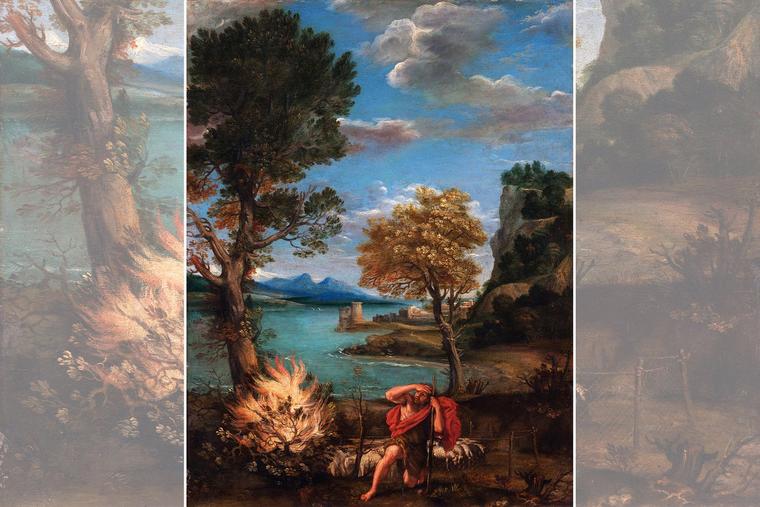
<p><b>Moses’ encounter with God at the burning bush</b> has often been depicted in art. My choice is the 17th-century artist, Domenichino. I chose it in some ways more for what the painting is not than for what it is.</p>
<p>Horeb clearly isn’t an environment as one might find on a nice northern Italian lake, which is more of what Domenichino’s painting suggests. But it does represent the very personal relationship Moses experienced with God at the burning bush. The flock is small. Moses shields his eyes. But the clear linkage is between him and the burning bush, with which everything we see here suggests is more than just a desert brush fire. The darkness of the overall painting stands in sharp contrast to the focal point of the light of God’s presence in the bush. Overall, what I find appealing here is the personal encounter of God with Moses without additional embellishment.</p>
<p>There are other depictions of this scene I also think are well-balanced, but they are often copyrighted (and so cannot be reproduced): see <a href="https://www.art.com/products/p56091120962-sa-i5578426/mcconnell-moses-and-the-burning-bush.htm">here</a>, <a href="https://fineartamerica.com/featured/god-and-moses-at-the-burning-bush-earl-mott.html">here</a> and <a href="https://www.mfab.hu/artworks/10092/">here</a>. Sometimes, a sacred name is superimposed on the bush, as in this <a href="https://garystockbridge617.getarchive.net/media/jhwh-skepplanda-5ee33a?zoom=true">Swedish painting</a>, though it seems not the name in Exodus 3:14. Some depictions actually attempt to show God appearing amid the flames of the bush, e.g., 17th-century Frenchman Sébastien Bourdon’s, <a href="https://upload.wikimedia.org/wikipedia/commons/4/49/Bourdon%2C_S%C3%A9bastien_-_Burning_bush.jpg">here</a>.</p>
</p></div>
<p><br />
<br /><a href="https://www.ncregister.com/commentaries/grondelski-ot-and-art-22-o9i92uef">Source link </a></p>
<p><!-- END THEIA POST SLIDER --></p>

Moses’ Vocation Begins| National Catholic Register