<p><!-- BEGIN THEIA POST SLIDER --></p>
<p> <br />
</p>
<div>
<p>Three major events are converging on Feb. 11 this year: the feast of Our Lady of Lourdes, the World Day of the Sick, and the 40th anniversary of St. John Paul II’s apostolic letter <a href="https://www.vatican.va/content/john-paul-ii/en/apost_letters/1984/documents/hf_jp-ii_apl_11021984_salvifici-doloris.html"><i>Salvifici Doloris</i></a> (The Christian Meaning of Human Suffering). The timing could not be better for Father Christopher Mahar’s recently released book, <i>Finding God in Suffering</i>.</p>
<p>Register contributor Father Roger Landry recommends the book, writing, “Finding an answer to the question of suffering is one of the most crucial discoveries in life. Father Mahar masterfully and gracefully guides us into this difficult subject, helps us find God in suffering, and in him discover its meaning and value. This work is an answer to the prayers and cries of so many,” calling it “a source of light and hope to all those who compassionately strive to love and care for them.”</p>
<p>Cardinal Robert Sarah also endorsed it.</p>
<p><i>Finding God in Suffering</i> is highly readable, easy to understand and uplifting. Many insights serve as comfort, hope and guidance.</p>
<p>Before Father Mahar returned to Providence, Rhode Island, in 2023, where he is now pastor of St. Augustine Church, he served at the Dicastery for Promoting Integral Human Development in Rome, working with Cardinals Peter Turkson and Michael Czerny. In January, he discussed with the Register how and why he came to write this book.</p>
<p><i>What prompted you to write </i>Finding God in Suffering<i>?</i></p>
<p>One of the reasons I wrote the book is because it&#8217;s such a beautiful teaching that the Church possesses, but it&#8217;s not widely known and understood. It’s not that it’s hidden. It’s very accessible. But it’s just not talked about enough. The Church has such a rich, beautiful teaching about God’s closeness to those who suffer. I wanted to make sure that people would understand that.</p>
<p><i>Did John Paul II’s letter on suffering play into your decision?</i></p>
<p>I was a seminarian during the last years of his pontificate. I remember going as frequently as I could to the papal Masses and witnessing his suffering in person. I read everything that he wrote, and reading <i>Salvifici Doloris</i> really struck me as somebody who lives out the message that he was trying to explain. That was convincing to me — the witness of his life, the suffering he went through — being through the darkness of the Second World War, being a witness to hope during that period when his home country was being attacked, suffering so many trials, his own family dying early and being an orphan at such a young age, and then the attempted assassination and the Parkinson’s disease.</p>
<p>So many different parts of his life were really immersed in suffering. But he always was positive; he always witnessed in a joyful way to the presence of God through the difficult moments of life. I think that’s something that certainly speaks to our hearts.</p>
<p><i>Then did you plan on your book coming out ahead of the 40th anniversary of his letter on suffering?</i></p>
<p>I happened to be inspired to write the book a number of years ago, and it just happened to be finishing up [ahead of the] 40th anniversary. I thought that it was a wonderful coincidence, or God-incidence.</p>
<p><i>Does the Lourdes anniversary at this time have any connection that you intended with your book?</i></p>
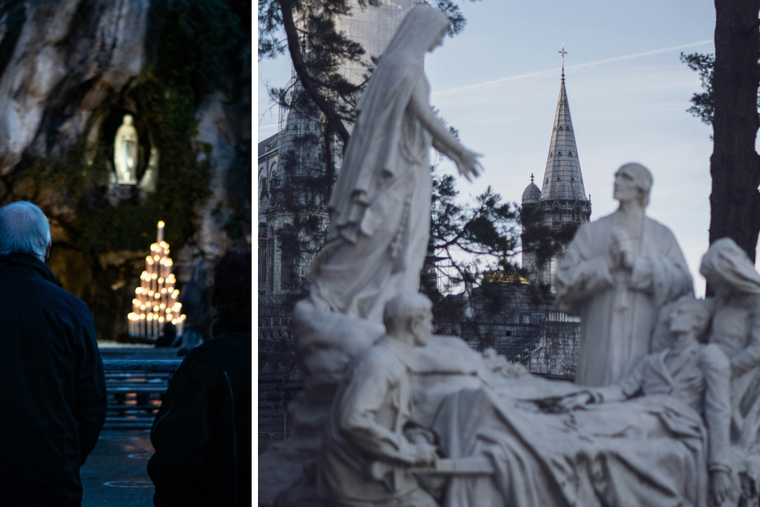
<p>One of the things that’s compelling for me is having gone to Lourdes so many times. So many people are suffering in that place, and they’re all happy. Then you go to other places where people are well off and have everything they could ever want, and they’re unhappy. I thought, ‘This is a great feast day to remember the joy that can come with those who understand that God is with them in their suffering.’ I think that the World Day of the Sick falling on that feast day is always a reminder to me of redemptive suffering. And it’s very hard.</p>
<p>No, I don’t see any specific connection to the feast of Our Lady of Lourdes. But I definitely see the connection to those who suffer, who have a capacity to experience the joy of God. I think that’s one of the things that comes out clearly, in the book, on many different levels. And that’s something you find in Lourdes. Those who have been there can tell you; certainly, there’s a presence of joy in so many souls who are in wheelchairs, or were burdened by sickness, and they’re still somehow able to find that joy of living in the presence of God, and they’re praying the Rosary. They’re holding lamps that are lit and have that flame of hope going forward. I tried to carry that message through the book — that we can be in the midst of suffering and still encounter the joy of God, and he can be present in our lives. I try to communicate that often.</p>
<p><i>How does your book serve as a personal guide to helping people deal with struggles in their lives, whether that be physical or psychological or moral sufferings?</i></p>
<p>The avenue I tried to use to reach people on that personal level was the use of stories. Every chapter begins with a story. I think it’s tough to reach somebody with a deep theological teaching, like redemptive suffering, on a head level or intellectual level alone. It’s just not going to work because people are too deeply personally involved in something like the cross and suffering. But when you reach somebody with a story and tell them about a family or individual who has been able to get over something that&#8217;s overwhelming, and to find hope and to find God in the midst of it, it opens up that personal level for each individual to say, “If that could happen in their lives, it could happen in mine too.” I tried to use these personal stories throughout the book that can be so convincing because of the way God has worked in the lives of many.</p>
<p><i>Please highlight an example.</i></p>
<p>One that is sort of a fictional story that is also true, is about the young woman who was a nurse during the COVID crisis in a hospital. She’s overwhelmed by what she sees and driven to the point of almost doubting that God is real because how could God allow such suffering to happen? But then she witnesses the presence of a priest who is anointing somebody, and she remembers her own Catholic faith. It brings her back to the hope that God is real and that God is in the midst of the struggle. That story in particular reaches me and a lot of people who have read the book. They find a lot of hope in that kind of story.</p>
<p><i>Many of the stories are true. What is one or two you highlight? </i></p>
<p>The story of Viktor Frankl is also a personal vignette that is rather convincing. Here’s a man in the midst of the Holocaust who was in a living hell on every level, and, suddenly, through a sunrise, he’s reminded of his spouse and reminded of love and realizes that he has transcended this horrible experience.</p>
<p>He thought, “There’s something beyond what I’m experiencing that can bring hope,” and he writes about that in <i>Man’s Search for Meaning</i>. That moment for him was the love that she had for him and his love for her. That moment of love could not be taken away. And that, for him, was a turning point, to find the level of transcendence that goes beyond the suffering that we experience. That story in particular, when he found that transcendent moment, was convincing for me about hope and suffering.</p>
<p>Pretty compelling as well is the witness of Venerable Cardinal Francis Xavier Nguyen van Thuan, who had every reason to say, “I did everything I could to serve God and this is what I get for it. I’m in prison. I’m being mistreated. I can hear the bells in my cathedral in the distance. I’m just a bitter, angry person.” But he never got there. He was so in love with God. He listened to the voice of God in the midst of his suffering and became a force of transformation for even the guards who kept him prisoner. So that’s compelling.</p>
<p><i>You mentioned these stories communicate a profound truth — there’s a meaning in suffering and even suffering we can find love. Please explain.</i></p>
<p>When we look at the cross, when we look at the Passion, when we look at the presence of Christ, he has chosen what we have not. So we experience the cross almost in a passive sense. We don’t look for it; we don’t seek it. It happens to us, whereas the Lord literally came from perfect beatitude to encounter the cross to save us.</p>
<p>John Paul II talks about the descending meaning of suffering. In other words, I don’t find meaning in suffering by studying it and arriving at something. I find it when I recognize that God has descended into my suffering. Then I find meaning and hope. We have found love because we found God.</p>
<p>God has made himself known to us to say two things. In the first place, “You are not alone. I am with you in your suffering.” Then, second, he also says, “I’ve redeemed suffering. You can unite yourself to my cross and be a participant in the work of redeeming the world.” The remarkable insight of <i>Salvifici Doloris</i> is that, through the cross, suffering itself has been redeemed.</p>
<p><i>What are your hopes for the book?</i></p>
<p>My ultimate hope is that it will reach a lot of people who are suffering. The world that we live in is immersed in human suffering. So I pray that thousands, maybe millions, would be touched by the message that is not mine, and not even distinctively John Paul II’s, but belongs to the treasury of the Church, about redemptive suffering, and that many people who suffer would be touched by the message and increase their faith and their trust and their hope in God.</p>
<p>And how can we get more people to understand that they can participate in the work of redeeming the world? This is the great message of <i>Salvifici Doloris</i> and the meaning of redemptive suffering. I try to communicate that, especially in the final chapter of the book. The question people who are suffering could ask would be, “How am I asked to participate in God’s work of redeeming the world?” If we could have more people answering that question, it would change the face of the civilization of love that John Paul II spoke about so often.</p>
<p><b>READ</b></p>
<p><a href="https://paulinestore.com/finding-god-in-suffering-qs1010623-202953.html"><i>PaulineStore.com</i></a></p>
</p></div>
<p><br />
<br /><a href="https://www.ncregister.com/features/finding-god-in-suffering">Source link </a></p>
<p><!-- END THEIA POST SLIDER --></p>

New Book Focuses on Divine Accompaniment Amid Sickness and Trial| National Catholic Register