


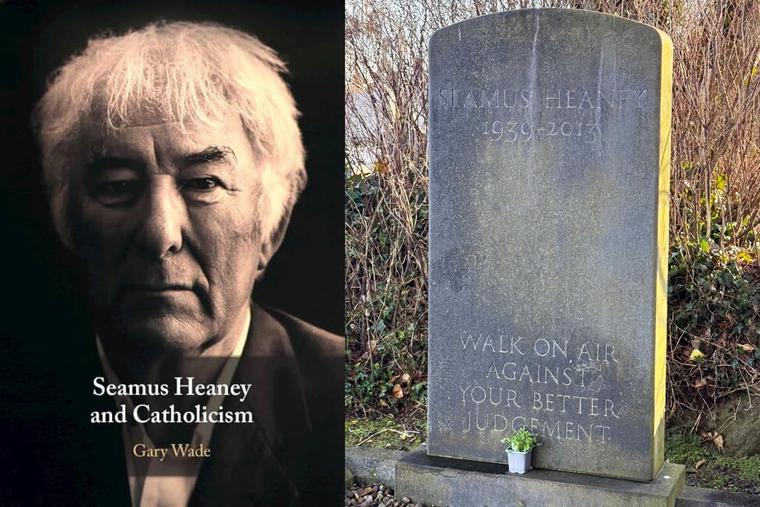
On the 40th anniversary of Irish poet Seamus Heaney’s Nobel prize, Cambridge University Press has published Seamus Heaney and Catholicism, an in-depth study by Irish writer Gary Wade examining the Catholic faith in Heaney’s poetry.
Forty years ago, Heaney was awarded the prize “for works of lyrical beauty and ethical depth, which exalt everyday miracles and the living past.” Heaney is known for his evocations of Irish rural life and the influence of the verse of Jesuit poet Gerard Manley Hopkins, Patrick Kavanagh, and the Old English epics. This new book follows a route less traveled and examines Heaney’s profound Catholic sensibility and the sacramental and religious language that permeates his poetry.
Heaney died in 2012. At his requiem Mass, his son Michael told mourners that his father’s final message to his wife Marie, sent moments before his death, read simply noli timere, meaning “Be not afraid.” Readers of Heaney will know he chose his words carefully.
Author Gary Wade visited archives in Dublin and Atlanta examining the Catholic faith in Heaney’s poetry. Wade explained to the Register that Heaney’s relationship with Catholicism is inextricably linked to his childhood in a Catholic family home, the idea of parish, household imagery of saints and the 1932 Eucharistic Congress, recollections of the family Rosary and the rituals around Irish wakes and funerals.
Heaney attended St Columb’s College in Derry, the diocesan grammar school where the current archbishop of Ireland was previously headmaster. Other St. Columb’s alumni include Heaney’s fellow Nobel laureate John Hume, as well as playwright Brian Friel, author of Dancing at Lughnasa, singer-songwriter Paul Brady, and former Glasgow Celtic and Ireland soccer coach Martin O’Neill.
Wade explained, “On the surface, it may not have been overly explicit, but what came out was a deeply sacramental sensibility. The sacramental instinct in Heaney is deeply rooted and informs, to some extent, his understanding of the material world.”
“His Catholic faith is also inextricably linked to his relationship with his mother and what he most admired in her. His relationship with Catholicism is far from straightforward and its most intense scrutiny [is found] in the self-excoriating poems of Station Island.”
The place called Station Island to which Wade refers is St. Patrick’s Purgatory at Lough Derg, the ancient Irish pilgrimage site that is reputed to have influenced Dante’s Inferno. Heaney uses the pilgrimage site as a figurative landscape where he encounters characters as pilgrims would. These characters explore criticisms of his poetry and his Catholic faith. Among those imagined conversations in his three-day poetic pilgrimage are Colum McCartney, a relative shot dead in the Troubles; Francis Hughes, an IRA hunger striker from Heaney’s parish; and William Strathearn, a Catholic murdered by loyalist terrorists. All are used as poetic devices to examine his own poetic conscience.
Wade says, “Station Island really is the fundamental book about his belief. In an interview at the time in the Tribune, he said, ‘I set out to find out, you know, to kind of decide whether I believe it or not and I ended up with neither unbelief nor belief,’ which I think is a very honest position for Heaney. He couldn’t let it go, even though the voice of James Joyce says at the end of Station Island, ‘Let others wear the sackcloth and the ashes. Let go, let fly, forget. You’ve listened long enough. Now strike your note.’”
“It frees him up, because he’s gone through this cathartic thing of examination, conscience and so on. For example, he has the ghost of Colum McCartney chastise him for a poem he wrote in 1979 turning his death into an artistic thing. It’s actually Heaney chastising himself, of course; it’s not the ghost of Joyce or Colum McCartney. There’s a line where he says, ‘they pronounced me a feeder of battlefields.’ Wade points to Heaney’s guilt and anger as a Catholic in the face of criticisms of the way he treated violence or failed to criticize one side or another in the Northern Ireland Troubles.
However, for Wade, “He never quite is able to let Catholicism go in his poems. That’s my argument; it just operates at different levels. There are numerous recurring themes and a deeply sacramental perspective.”
Interestingly, Wade offers several examples where a very explicit Catholic dimension is reduced, if not entirely suppressed, but still evident.
“In the sonnet Clearances III, Heaney talks about the death of his mother; he’s at the bedside of his mother, and as the priest is saying the prayers, he’s lost in a kind of reverent memory of himself and his mother peeling potatoes.”
“When I read that poem, there’s something about the intimacy between him and his mother. He talks about ‘her breath and mine.’ I thought about the priest’s breath in the chrism Mass when they blow over the chrism oils. That seemed to be pushing it too far to make that connection. Still, when I went to the archives, I discovered that in the earliest version of that poem, he had originally said that when the potatoes fell into the bucket of clean water, it was like a ‘brimming ciborium.’”
“That suggested to me … that Heaney’s first instincts in thinking about the relationship with his mother is deeply sacramental, in terms of the Eucharist.”
Heaney ultimately redacted that, as with other Catholic references in that collection, but these are among the sense of the sacramental that Wade highlights.
“The sacramentality comes from the idea that, you know, the incarnation of God, that God is present in material things.”
Wade points out that his sensibility changes after the self-flagellation and examination of conscience in Station Island. “There is a marked shift in Heaney’s poetry after Station Island; and Catholicism figures less explicitly. It continues to operate at other levels, as an impulse towards transcendence and in poetry of praise.”
“Heaney is a poet of praise. There’s an early poem that hasn’t been studied much, called St. Francis and the Birds. And I think it’s a beautiful poem. It’s a story from one of Francis’ legends, where he speaks to the birds, and they’re full of joy, and they kind of dance around them and so on. And he gives voice to a sort of praise through the voice of St. Francis.”
“He talks of his poetry in the language of Church language, but often it’s not picked up. By the time we get to District and Circle in 2006, it’s a book heavily influenced by Czesław Miłosz, the Polish poet and Catholic intellectual.”
Wade pointed out that Heaney would have seen clear parallels in Nobel laureate Miłosz’s emphasis on family, Catholicism, parochial attachments and loyalties. He may have been influenced by Miłosz speaking of inherited items, like clothing and furniture, possessing a kind of afterlife, as his verse becomes poetry of praise. He would have read the poem Blacksmith Shop, where Miłosz concludes, ‘I stare and stare/It seems I was called for this/To glorify things just because they are.’”
“So there’s a level of praise for what we call inanimate objects. Relics. So a sledgehammer, a harrow pin. District and Circle is an excellent volume of praise. But it’s not voiced through the saints like earlier works. In his earlier volume, The Spirit Level, he mentions a proliferation of saints, St. Caedmon, St. Brigid, St. Kevin and Adomnán.
On his motivation for researching and writing this book, Wade said, “I thought there was scope for talking about how Catholicism operates in his work. And my conclusion was that it operated largely as what I call a ‘felt sense’ — that even when he gave up the practice of his faith, it still had this deep emotional pull. I think that’s everywhere in the poetry at different levels.”
Seamus Heaney died on Aug. 30, 2013. Following his requiem Mass in the Church of the Sacred Heart in Donnybrook, Dublin, he was buried in his native Bellaghy in County Derry. His grave is in the cemetery of St. Mary’s Catholic Church, and his gravestone inscription reads “Walk on air, against your better judgment,” a line taken from his 1995 Nobel lecture.
During his homily at Heaney’s funeral Mass, Msgr. Brendan Devlin remembered that Heaney had “the early stirrings of a poetic imagination as he recited as an altar boy the words of the litany.” Msgr. Devlin spoke of “the prayers that had been said before us for generations, generations whose hard-won loyalties were so authentically embodied in the man and in his work.”
Wade’s work demonstrates that Heaney’s Catholicism is present throughout his poetry to the end and suggests that his Catholic faith is displaced rather than having become lost. It directs the reader back to the poetry to fully recognize the Catholic sensibility that is never too far from the obvious.