


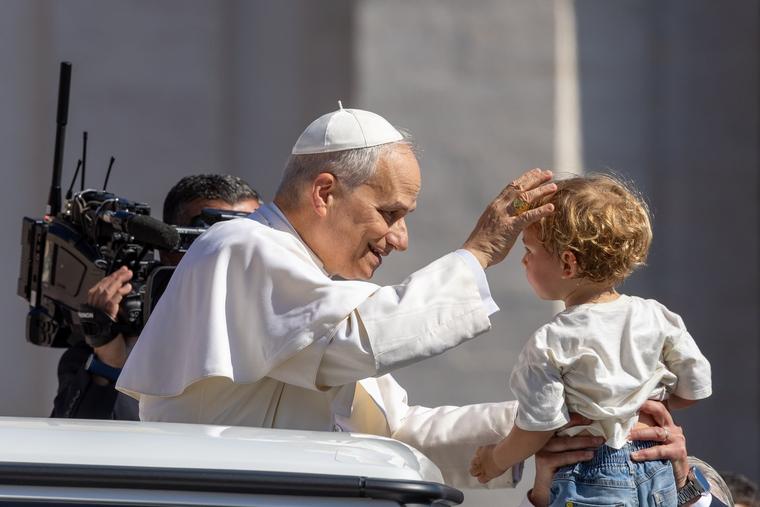
There is “a time for every matter under heaven,” Ecclesiastes counsels us. “Timing is everything,” to paraphrase Shakespeare in one of his plays. With that advice, the excitement surrounding the election of the first U.S.-born pope, Leo XIV, makes for the perfect time to follow this truism and invite someone to Mass.
“It has been almost impossible to avoid conversations or news clips about our faith over the last few weeks,” observed Kris Frank, vice president of mission advancement for the National Eucharistic Congress. “There is a general excitement and curiosity surrounding the faith. It isn’t every day that our faith is in the public eye, so I believe we should make the most of it. The election of an U.S.-born Pope is something that I think intrigues all Americans, not just American Catholics. So we can leverage the moment to share our own excitement about the selection of Pope Leo and, further, our enthusiasm for our faith.”
Frank called it “an amazing time to be a Catholic,” given the excitement about our new American-born Pope. “Now that we have an American-born Pope, Catholicism — and maybe even holiness — seem much more tangible. … Now that a kid born on the South Side of Chicago is the Vicar of Christ, it feels like holiness can happen here in our own neighborhoods.”
Lauren Lagassie, leader of the Greater Hartford Chapter of Crossroads for Christ for young adults in Connecticut, told the Register that she has “been able to identify with the Pope” in a way that she was not able to before with previous popes. “They are wonderful and holy, and I trust them and their leadership,” she said. “But there’s just something about having an American Pope that I know myself and probably so many others can identify with him, his experience as an American, knowing personally and deeply and intimately the American culture. It opens up a greater opportunity as people are identifying with the Pope to also identify with the Church in which he is now the head of.”
Invitation Tips
With Catholics and non-Catholics alike showing high interest in all things Catholic, the question is, how can we help people to take the next step, extending an invite to Mass or adoration or church events?
Father John LoCoco, judicial vicar for the Archdiocese of Milwaukee and administrator of St. John Vianney Catholic Parish in Brookfield, Wisconsin, told the Register that Sts. Cyril and Methodius gave us a good model — “You have to speak to people in the language that they understand.”
His first piece of advice: “It’s all according to the individual person.” A Catholic who has fallen away is different than somebody who grew up Baptist “and has not ever stepped in a Catholic church for a whole slew of different reasons. Be it the non-practicing Catholic or the Christian or the unbaptized person, they all need to be evangelized according to their own condition, their history.”
“One of the best things that we can do is really get to know the person first,” Father LoCoco added, a strategy that he utilizes with couples for marriage formation. He tries to meet with them over a meal first — to put them at ease, as often, “it’s this very ominous prospect of: ‘I have to come to the church and be formed. Maybe I haven’t been to church in a long time, but my mother is Catholic, and I really love it.’”
Especially among millennials and Gen Z youth, he has found increased anxiety and concerns. Sometimes the best intentioned invitation such as, “Come to Mass with me [for] great community, great music, great opportunity to hear Scripture and worship the Lord,” he said, “might be an overwhelming prospect for somebody.”
The answer for some might be “to take them to a very quiet and humble daily Mass. For someone else, it might be the experience of a Sunday liturgy where you see more of the community.”
When discerning, pray to the Holy Spirit to give you the wisdom to understand, “Lord, how are you calling me to invite this person? How are you calling me to walk with them in this way?” he suggested.
Father LoCoco explained that sometimes an invite like, “‘Come on, it’s Sunday Mass. I’ll pick you up, and then we’ll got for a little bit of brunch’ … might be very effective for some people.” He added that “for some people it might be a very overwhelming thing. So the main piece of advice that I convey is try to understand the person. And you can do that first over a meal. … I love that line from the Acts of the Apostles, ‘Tell the people about this life’ (5:20). That can be a beautiful principle in terms of evangelization. Share your own experience of your parish, the Mass, the Church, Jesus. And those things can be, in many ways, a very effective way of laying a foundation then for them to engage with the question of worship and praise of the Lord.”
Frank also makes attending Mass part of a larger invitation. “I often invite people to join me and my family for Mass and brunch,” he emphasized. “By doing that, it shows that I’m interested in connecting with the person and not just trying to fill the pews at my church. Furthermore, having a meal together naturally creates a setting where we can reflect on the experience we shared at Mass, and I can answer any questions the guest(s) may have about the liturgy.”
When Lagassie invites people to Mass, the results vary — from “Nope, not interested” and “No thank you” to “Oh, I can’t today, but maybe some other time” and “Sure. I’ll come and check it out.”
She agrees that the context of relationship is key to extending invitations. “Ask, ‘Do you want to go to Mass and then grab coffee?’ or ‘Do you want to go to Mass and then do something else?’ It seems a little less intimidating and also has the opportunity, especially if we do something after, to give that space to ask questions or to process the experience.”
Brock Martin, son of FOCUS founder Curtis Martin who has served with FOCUS for 13 years and now is vice president of parish outreach, told the Register, “There’s a famous saying that we often use in FOCUS: People don’t care what you know until they know that you care.” So any invitation, he explained, is “going to be most powerful when the person that you are making the invitation to knows that you care.”
Making these invitations reminds him of John 1, where the first disciples, inquiring about Jesus, asked, “Teacher, where are you staying?” And Jesus’ answer is, “Come and see.”
“We’re seeing these people, very similar to these first disciples,” Martin observed for modern seekers, pointing out that with the unwinding of moral and objective truth, many people — wrestling with questions the modern world doesn’t have answers to — are looking for a teacher. “When we encounter people who are asking those questions, this is an unbelievable opportunity for us to say the same: ‘Come and see. Let me show you.’”
Planting Spiritual Seeds
Lagassie said it’s common for there to be hesitation to invite those closest to us, “because if they say ‘No,’ then you probably feel a personal sense of rejection.” Yet she also thinks “those people are also more apt to say ‘Yes,’ even if they’re saying ‘Yes’ because they see it’s important to us.”
Frank stressed, “There is no one-size-fits-all strategy when it comes to evangelization, so we need to craft the strategy for the individual. Or to say it another way, the invitation should be tailored for the invitee. For example, if the person is a fallen-away Catholic and you know they have experience with the liturgy, the invitation can be a warm and friendly offer to attend Mass with you. However, if the person is a non-Catholic and has minimal or no experience with the Catholic liturgy, a warm invitation can still be extended. However, some preparation may be necessary to ensure the person is aware of what they are being asked to participate in.”
Similarly, Martin believes accompaniment is paramount — including sitting next to them in the pew, unless being states away makes that impractical. He underscored, “This invitation is going to be most powerful and most efficacious if it’s coming from an existing friendship, an existing relationship.”
Lagassie added this recommendation: “Be persistent, but … not in a pestering way. Maybe that first invitation is not one that they’re ready or willing to accept. But if it’s something that is done with prudence, but also persistence in making that invitation, maybe the fifth or sixth or seventh time that you ask, they might be ready to say ‘Yes.’ And those prior invitations may be planting and watering that seed.”
Frank encourages people “not to overthink this opportunity.” He explains, “Inviting another to join you at Mass, or the adoration chapel, or a Bible study is inviting someone into something meaningful to you, and I hope they are receptive to that. But the worst-case scenario is that they say ‘No,’ and I wouldn’t take that personally. Perhaps your invitation is a seed that will bear fruit later on.” (Find free resources with information and guidance for sharing the faith with others.)
Hopeful Hearts
Extending invitations to Mass also builds on the Eucharistic moment in America.
“It feels like Providence to see this moment in the Church over the last few years leading up to the Eucharistic Revival and to see the Revival itself,” Father LoCoco said. “Between the Eucharistic Revival and this papacy, things seem particularly primed for an outpouring of the Holy Spirit and for the softening of hearts to the Gospel. I’m very hopeful in this Year of Hope.”
Kris Frank, too, is hopeful about the impact of inviting others to Mass. “I do know that God can accomplish a great deal through a simple invitation, and, ultimately, it is God who changes hearts,” he said. “I don’t think we have a lot to lose. But we do have many souls to gain.”