<p><!-- BEGIN THEIA POST SLIDER --></p>
<p> <br />
</p>
<div>
<p>COMMENTARY: Miss O’Connor’s embrace of the challenging vocation of writing was shaped by the vocation of suffering.</p>
</p></div>
<div>
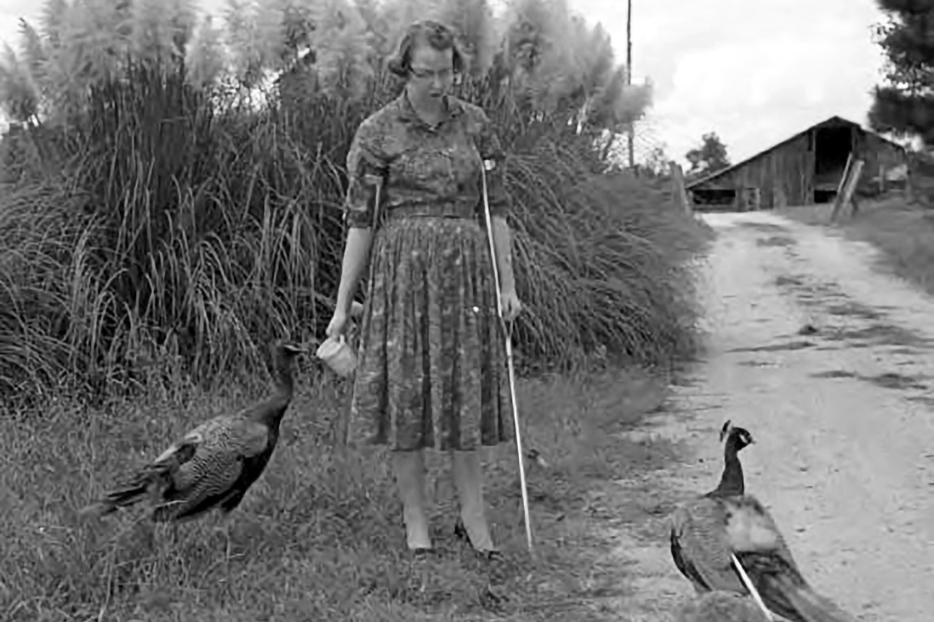
<p>How appropriate that Flannery O’Connor should have been born on the Solemnity of the Annunciation: the liturgical feast celebrating the willing acceptance of a God-given vocation. As we marked Miss O’Connor’s centenary three months ago — and yes, boys and girls, it was <i>Miss</i> O’Connor, as no one would have been more repelled by the neologism <i>Ms.</i> — that’s the dimension of her life that struck me most powerfully: her embrace of the challenging vocation of writing, shaped in her case by the vocation of suffering. </p>
<p>Some years back, shortly after the Polish edition of my <a href="https://www.georgeweigel.com/books/letters-to-a-young-catholic/" target="_blank"><i>Letters to a Young Catholic</i></a> (which includes a section on Miss O’Connor) was published, I got a sulfuric e-mail from a Polish priest. How dare I, the biographer of John Paul II, recommend such a vile author to impressionable young Catholics? Turns out that the good father had found a Polish translation of that quintessential O’Connor short story, “A Good Man Is Hard to Find,” and had been <a href="https://www.youtube.com/watch?v=vxnpY0owPkA" target="_blank">shocked, shocked</a>, by that quintessential O’Connor character, the homicidal Misfit. </p>
<p>In a return email, I explained that Flannery O’Connor’s unique aesthetic (Catholic + gothic + American Southern) was exceptionally difficult to translate, and suggested he might give Miss O’Connor a second try by reading her letters in <a href="https://www.goodreads.com/book/show/48466.The_Habit_of_Being" target="_blank"><i>The Habit of Being</i></a><i>. </i> </p>
<p>I hope he did. Because I agree with <a href="https://modernagejournal.com/flannery-at-100-and-forever/249450/" target="_blank">Chilton Williamson Jr.</a> that the posthumously published <i>Habit of Being</i> was Flannery O’Connor’s best book: an agreement I record with some trepidation, given critic Bruce Bawer’s recent assertion in <a href="https://newcriterion.com/article/there-at-the-new-yorker/" target="_blank"><i>The New Criterion</i></a><i> </i>that Miss O’Connor was the best American short story writer of the 20th century (take <i>that</i>, Papa Hemingway!) </p>
<p>In <i>Habit</i>, and in her own voice, she traces the arc of her often-difficult life as a lupus-afflicted author of fiction while revealing herself as one of the most gifted Catholic apologists of her time. And by “apologist,” I don’t mean someone who bludgeoned others into the act of faith by the ahistorical, logical rigor of irrefutable syllogisms. Rather, Flannery O’Connor’s apologetics were grounded in a profoundly humanistic grasp of the deep theological truths of the Creed, coupled with a penetrating insight into the cultural obstacles that modern life posed to a Christian apprehension of those truths. </p>
<p>The first and perhaps most obvious of those obstacles was modernity’s loss of a grip on good and evil. Writing to her friend Betty Hester about a “moronic” <i>New Yorker</i> review of “A Good Man Is Hard to Find,” Flannery suggested that “the moral sense has been bred out of certain sections of the population, like the wings have been bred off certain chickens to produce more white meat on them. This is a generation of wingless chickens, which I suppose is what Nietzsche meant when he said God was dead.” </p>
<p>Or, as she also wrote, “When I see [my] stories described as horror stories, I am always amused because the reviewer always has got hold of the wrong horror.” Why? Because the reviewer, like so many of our contemporaries, had grown up in a culture in which “evil” had been psychologized, the confessional had been exchanged for the analyst’s couch, and the biblical personification of evil, Satan, had been turned into a cartoon character. </p>
<p>As that reference to Nietzsche suggests, the Flannery O’Connor on display in <i>The Habit of Being</i> also understood, as early as the 1950s, that at the root of modernity’s confusions over good and evil was the nihilism that was tacit then but quite explicit today: the notion that there are no givens in the human condition, such that everything about us is plastic, malleable, and subject to change by assertions of the will. Miss O’Connor would not have been surprised, therefore, by some recent legal madness in what FDR’s political fixer Jim Farley used to describe as the “<a href="https://depts.washington.edu/labhist/cpproject/" target="_blank">Soviet of Washington</a>:” a statute (recently upheld by the Ninth Circuit Court of Appeals) that allows a fully, er, equipped man who “identifies” as a woman complete access to a women’s spa, including the “right” to bathing with 13-year old girls. </p>
<p>Flannery O’Connor, who died in 1964, did not live to read the Second Vatican Council’s declaration that “Christ the Lord, Christ the new Adam, in the very revelation of the mystery of the Father and of his love, fully reveals man to himself and brings to light his most high calling” (<a href="https://www.vatican.va/archive/hist_councils/ii_vatican_council/documents/vat-ii_const_19651207_gaudium-et-spes_en.html" target="_blank"><i>Gaudium et Spes</i></a><i>, </i>22). But then she didn’t have to. For as her epistolary apologetics demonstrate, she fully understood that the answer to the nihilism underwriting today’s real horrors is the Incarnation, by which Christ reveals the truth about us to us. </p>
</p></div>
<p><br />
<br /><a href="https://www.ncregister.com/commentaries/weigel-flannery-oconnor-100-years">Source link </a></p>
<p><!-- END THEIA POST SLIDER --></p>

On Flannery O’Connor’s Centenary| National Catholic Register