<p><!-- BEGIN THEIA POST SLIDER --></p>
<p> <br />
</p>
<div>
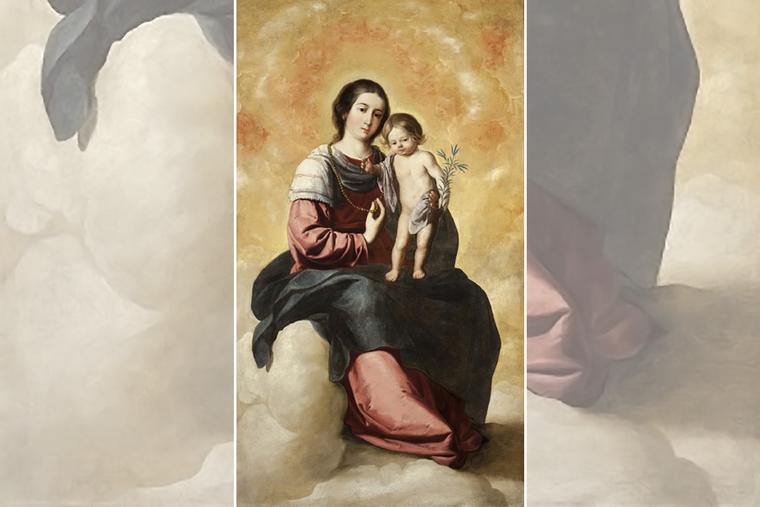
<p>ROSARY &; ART: Today’s depiction of Our Lady and the Rosary comes from the Spanish artist Francisco de Zurbarán</p>
</p></div>
<div>
<p>Among the best-known Marian apparitions of recent centuries were the appearances of Our Lady to a French peasant girl, Bernadette Soubirous, in Lourdes in southwestern France, near the Spanish border. She would later become a nun and die in 1879, at age 35. She was canonized Dec. 8, 1933, the Solemnity of the Immaculate Conception. </p>
<p>Our Lady appeared to the 14-year-old in a cave when the young girl went out in search of firewood. She said she heard a gust of wind and, investigating what apparently concerned her, she saw a woman in white. She prayed the Rosary with the woman. Our Lady had a Rosary hanging from her arm.</p>
<p>Later, asked to identify herself, the woman answered, “I am the Immaculate Conception,” a title the Church had always honored in her tradition but was first infallibly declared part of the faith four years earlier by Pope Pius IX. One could say Lourdes was heavenly affirmation of the papal decision.</p>
<p>Like Fatima almost 60 years in the future and so many other Marian apparitions, there are two constants to these messages: a call for repentance, of turning from sin, and prayer of the Rosary. The Rosary is a powerful weapon for conversion: as many saints observed, it forces a decision — one either clings to the Rosary or to one’s sins, not both. </p>
<p>Our Lady <a href="https://www.lourdes-france.com/en/the-apparitions/">appeared to Bernadette 18 times</a>, during which the young girl performed a number of symbolic actions, including digging in the ground that resulted in the emergence of the famous spring of Lourdes, in whose waters the first sick person was cured in less than a month after the first apparition. Our Lady asked for a chapel, which has become the Shrine of Lourdes.</p>
<p>The Rosary is again showcased as a preferred prayer, to be accompanied by the performance of penitential acts in reparation for sin. “Penance, penance, penance!” calls Our Lady at Lourdes. It is not an obsession. It is not even just God’s justice. It’s the justice we owe God. God gave man a beautiful nature, which man warped by sin. God has restored us in baptism, but our nature still suffers the wounds of sin. God has a right to receive us back as he intended us to be. Sin warps our nature. It alienates us from God, our fellow man, the world, and even ourselves. It introduces disorder into us: our conscience, our spirit, our bodily appetites, our desires, our emotions. Because of sin, we learn to flip values upside down: we start calling evil good and good evil.</p>
<p>These are not just decisions that we repent of and that’s the end of them. Repentance is, of course, the first step, not the last. Restoring what we have damaged ordinarily takes time and normally involves opposing the evil habits or dispositions to which we have grown accustomed. That will hurt. That is penance. But God has a right to us in the image in which he made us, not in the deformed image we made ourselves. We can do that in this life or in Purgatory, but either way, tearing down the false selves we have built up — sometimes over very long times — is going to hurt. Cures sometimes hurt, but we want to get better.</p>
<p>Lourdes is associated with cures, i.e., with healing miracles. Jesus’s healing miracles were not about his first-century public health campaign in Israel. Jesus healed to show that God wants to cure the whole man, body and soul, to be what St. Irenaeus of Lyons said he should be — “the glory of God is man fully alive.”</p>
<p>This is a good time to commit to prayer and conversion, including the sacrament of Penance.</p>
<p><b>Today’s depiction of Our Lady and the Rosary</b> comes from the Spanish artist Francisco de Zurbarán (1598-1664) and appears to be held in Seville.</p>
<p>Compare it with the image of the Virgin Mary with Child and the rosary painted by Murillo, which we examined last Saturday. This painting is slightly earlier.</p>
<p>Although dark colors are typical of Zurbarán and the Spanish Baroque, that’s not the case here, at least not in the usual sense. Typically, the figures in these paintings would be set against a dark background, as we saw with Murillo. But Zurbarán’s depiction of Virgin and Child with Rosary is set in heaven, where “the night will be no more” (Revelation 22:5) and all is illuminated by the Lord God himself. So, Our Lady and the Christ Child are set against a lighter background which, on closer examination, is populated by a semi-circle of cherubs.</p>
<p>In contrast to Murillo’s bench, Our Lady sits on a cloud, and clouds are typically heavenly shields of God’s glory. Zurbarán respects the conventions of Baroque color contrast instead by dressing Our Lady in a dark blue robe — blue, of course, as a Marian color, but in this case, dark blue. Her red dress also leads us to the angels in the clouds of glory behind her.</p>
<p>Our Lady wears a rosary around her neck, which she touches with her right hand. Jesus, standing on her lap with a palm cross, is physically close to the rosary. As in Murillo’s painting, both look toward us, the Christ Child even pointing to us, to draw us to themselves by the Rosary. </p>
<p>Will we allow ourselves to be?</p>
</p></div>
<p><br />
<br /><a href="https://www.ncregister.com/blog/rosary-and-art-our-lady-of-lourdes">Source link </a></p>
<p><!-- END THEIA POST SLIDER --></p>

Our Lady of Lourdes and the Rosary| National Catholic Register