<p><!-- BEGIN THEIA POST SLIDER --></p>
<p> <br />
</p>
<div>
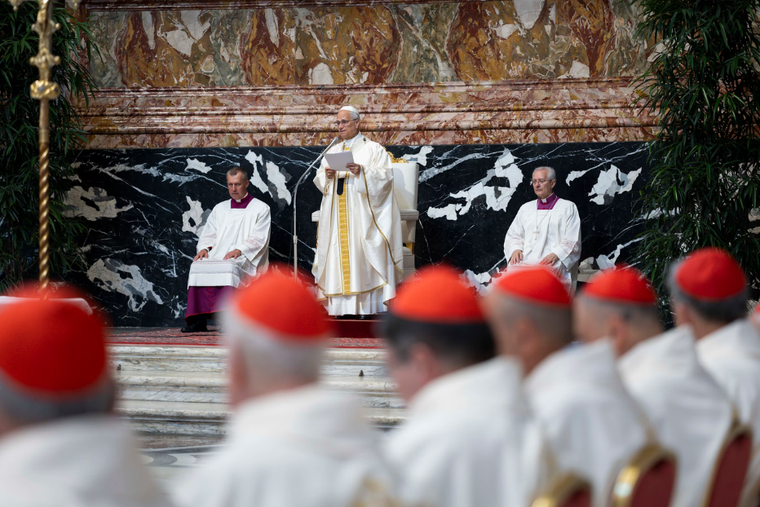
<p>Pope Leo XIV on June 27 thanked the College of Cardinals for their work during their two-day extraordinary consistory, highlighting their reflections on war, poverty, and social fragmentation as well as deeper wounds such as loneliness and loss of meaning.</p>
<p>The Pope said in his closing address that he was “particularly struck by the way [the cardinals] spoke about young people,” especially in their suffering that can at times lead “to the extreme despair of taking their own lives.”</p>
<p>“You have recognized one of the deepest wounds of our time,” he said, “yet you have also been able to recognize the work of the Holy Spirit [in their] search for authenticity, for genuine relationships, and for meaning.”</p>
<p>Addressing another of the world’s wounds — war — Leo XIV reiterated themes from his encyclical <i>Magnifica Humanitas</i> , warning that war stems from a broader “culture of power” affecting politics, economics, and even religion.</p>
<p>“War is born within us,” he said, but it is “precisely in the heart that peace is also decided.” It is in that same heart, he said, where Christ “continues to meet us, speak to us, and to convert us,” and he called for renewed commitment to dialogue, multilateral cooperation, and nonviolent responses rooted in the Gospel.</p>
<p>Although the cardinals discussed “just war,” the Pope did not specifically mention the tradition in his address, noting instead the theme of self-defense in light of “profound transformations” in contemporary conflicts.</p>
<p>Reflection on this topic needs to be “further developed,” he said, “with necessary theological and pastoral rigor.”</p>
<p>Issuing a global appeal, Leo XIV declared: “God desires peace for every nation and every people,” urging the Church to help the world reject violence and rediscover the Lord’s paths of reconciliation.</p>
<p>Pope Leo also underscored the importance of the family, the Church’s social doctrine, and the formation of consciences, while reaffirming the role of ecumenical and inter-religious dialogue in promoting peace.</p>
<p>He urged the cardinals to deepen the Church’s synodal path as a “spiritual style” rooted in listening, discernment, and fidelity to the Gospel. Synodality, he said, is not primarily about structures or decision-making, but about safeguarding the Church’s mission through shared discernment.</p>
<p>“The question is not ‘who decides,’” he said, “but how we together safeguard the gift entrusted to the Church.”</p>
<p>Leo XIV encouraged the cardinals to promote active participation across local Churches, saying that authentic synodality arises from encounter and openness to the Holy Spirit.</p>
<p>He likened this two-day gathering — which had a distinctly synodal format of working group discussions — to the Gospel account of the disciples on the road to Emmaus in which Christ renews hope and clarifies mission.</p>
<p>Referring to a <a href="https://www.vaticannews.va/en/pope/news/2026-03/pope-leo-xiv-amoris-laetitia-anniversary-summit-family-love.html#:~:text=Ten%20years%20after%20its%20publication,the%20Gospel%20to%20families%20today." target="_blank">meeting of bishops in October</a> to mark the 10th anniversary of <i>Amoris Laetitia,</i> the Pope said the gathering<i> </i>will be part of the implementation of the Synod on Synodality — a chance to “foster spaces where the People of God can listen to one another, pray, discern and walk together.”</p>
<p>The Pope closed by entrusting the fruits of the consistory to the intercession of Our Lady. “May she teach us to preserve unity in diversity and to serve the Gospel of peace with humility, courage, and hope,” he said.</p>
<p>He reiterated that these extraordinary consistories will take place annually, and said he will be announcing next year’s meeting at the end of the year.</p>
<h3>Vatican Synthesis</h3>
<p>As the consistory took place behind closed doors, it was not possible to know exactly what the cardinals discussed during the two-day meeting.</p>
<p>Instead, media had to rely on syntheses provided by the Holy See Press Office which omitted some key interventions such as Cardinal Gerhard Müller’s call on the Vatican to issue a formal response to the Society of St. Pius X’s latest challenge to Rome, <a href="https://www.ilgiornale.it/news/vaticano/scisma-agita-concistoro-dobbiamo-rispondere-ai-lefebvriani-2685197.html" target="_blank">as reported on Saturday by <i>Il Giornale’s</i> Nico Spuntoni.</a></p>
<p>The syntheses also did not cover any topics raised in the free discussion at the end of the consistory. The Vatican did, however, provide full texts of four cardinals’ reflections.</p>
<p>Opening Friday afternoon’s session on “The Culture of Power and the Civilization of Love” was Cardinal Victor Fernández, prefect of the Dicastery for the Doctrine of the Faith, who reflected on the theme and Chapter V ofâ¯<i>Magnifica Humanitas.</i></p>
<p>Drawing on the social encyclical, he argued that a deep cultural shift had been enabling the outbreak and normalization of new wars, often sustained by AI-driven media and political manipulation.</p>
<p><i>Magnifica Humanitas</i>, he said, marked a significant development by declaring “just war” theory outdated in practice. It insisted instead on a far stricter understanding of legitimate defense and condemning pre-emptive and disproportionate warfare as incompatible with Catholic teaching and the Second Vatican Council’s <i>Gaudium et Spes</i> and its rejection of indiscriminate destruction.</p>
<p>As examples, he highlighted military interventions in Gaza and southern Lebanon.</p>
<p>Relativism, cynicism, “spiteful verbal attacks by political leaders,” and geopolitical inconsistency favored violent powers, the cardinal said, adding that the Church’s social doctrine was the answer.</p>
<p>Alluding to a consistent life ethic, he said the teaching is coherent in its defense of life, migrants, peace, and the vulnerable, and that it is capable of resisting the culture of power and fostering a culture of fraternity and the common good.</p>
<p>The Vatican reported that in their working groups during the session, presided over by <a href="https://collegeofcardinalsreport.com/cardinals/cardinal-pablo-virgilio-siongco-david/" target="_blank">Filipino Cardinal Siongco David</a>, the cardinals similarly voiced concern about a pervasive “culture of power” marked by polarization, normalization of war, and diminished sensitivity to violence.</p>
<p>In response, they stressed the Church’s urgent duty to witness credibly to peace through a transformed language of encounter, rooted in listening, forgiveness, and reconciliation, and through visible Christian unity.</p>
<p>They also urged dialogue with other religions, especially Islam, and engagement with international institutions. The Vatican said “numerous groups” called for moving beyond classical “just war” frameworks toward proportionate self-defense, while reaffirming the Gospel as the true source of peace.</p>
<p>The Vatican said strong support was expressed for Pope Leo XIV’s encyclical and his moral leadership, alongside renewed reflection on the Petrine ministry as a safeguard of the Church’s independence and a sign of unity.</p>
<h3>Building the Common Good</h3>
<p>Saturday morning’s session shifted focus to “Building for the Common Good,” examining the deep fractures affecting societies, families, and individuals.</p>
<p>Cardinal Stephen Brislin of Johannesburg presentedâ¯<i>Magnifica Humanitas</i>â¯as a theologically coherent vision of human “building” in an age of technological power, reading the whole encyclical through the opening contrast between Babel’s self-enclosed self-sufficiency and Jerusalem’s God-oriented rebuilding.</p>
<p>He noted that the introduction offered a “grammar of building” structured around desire, limitation, shared responsibility, and discernment, asking whether technological expansion, including AI, actually produced more just relationships and institutions attentive to the person.</p>
<p>In his reading, the conclusion showed how this grammar found its fulfilment in the theological virtues: faith reading history in the light of God’s merciful plan, charity rooted in the Eucharist grounding synodal communion, and hope directing concrete responsibility toward a “civilization of love,” all sustained by prayer exemplified in Mary’s contemplative gaze.</p>
<p>In the Vatican-summarized discussions that followed, presided by Tanzanian <a href="https://collegeofcardinalsreport.com/cardinals/protase-rugambwa/" target="_blank">Cardinal Protase Rugambwa</a>, the cardinals highlighted the anthropological crisis underlying these divisions, including loss of meaning, identity, and relationships, exacerbated by extreme individualism and emerging challenges such as artificial intelligence.</p>
<p>AI was discussed not only technologically but as a force reshaping human self-understanding, raising concerns about dignity, limitation, and the reduction of persons to data. The common good was presented as both elusive and essential, requiring a rediscovery of solidarity grounded in faith and expressed through concrete care for the poor.</p>
<p>The Vatican said the Church’s social doctrine and the formation of responsible political leaders were seen as vital responses to systemic inequality and fragmentation. Across interventions, the Gospel emerged as the antidote to division, calling the Church to embody a “Samaritan” presence, foster belonging, and promote synodality as a lived practice of listening and shared responsibility.</p>
<h3>Final Session</h3>
<p>The final session of the consistory turned to the practical implementation of synodality, emphasizing spiritual elements and institutional challenges.</p>
<p>In his reflection, Cardinal Mario Grech, secretary general of the Synod Secretariat, described the Synod on Synodality as a profound experience “in the Spirit” and declared that it had already awakened in the Church a broad desire for participation, mutual listening, and shared discernment among bishops, clergy, religious, and laity.</p>
<p>He asserted that the current implementation phase was not a matter of mechanically applying decisions but of receiving, testing, and integrating synodal insights into the ordinary life of local Churches, culminating in the 2028 ecclesial assembly.</p>
<p>That phase, he said, depended on bishops as primary stewards of the synodal journey, adding that they needed to hold together synodality and collegiality as complementary expressions of one communion ordered to mission in a world marked by war, inequality, migration, and technological upheaval.</p>
<p>In their discussions that followed, presided by <a href="https://collegeofcardinalsreport.com/cardinals/joseph-william-tobin/" target="_blank">Cardinal Joseph Tobin of Newark</a>, the Vatican said the cardinals agreed on the need to integrate the “ascetical and historical” dimensions of synodality while ensuring that its processes do not become overly burdensome or distract from the Church’s evangelical mission.</p>
<p>Particular attention was given to priestly formation, with calls for a vision of the priesthood that is dynamic, attractive, and authentically evangelical without reinforcing clericalism.</p>
<p>Discussion also clarified the complementary roles of hierarchy and laity in discerning the voice of “the Spirit,” highlighting synodality as a shared but differentiated responsibility within the People of God. The contribution of Eastern Catholic Churches, with their longstanding synodal traditions, was said to be especially valuable.</p>
<p>The Vatican synthesis noted that cardinals discussed “the risk that the complexity of the consultation process might weigh down the Church at a time when she is called to bear witness.”</p>
</p></div>
<p><br />
<br /><a href="https://www.ncregister.com/news/pentin-june-consistory-pope-leo">Source link </a></p>
<p><!-- END THEIA POST SLIDER --></p>

Pope Leo XIV Closes Consistory With Appeal to Help World Find God’s Paths to Peace| National Catholic Register