<p><!-- BEGIN THEIA POST SLIDER --></p>
<p> <br />
</p>
<div>
<p>What the New Pope Wears on the Balcony May Say Something About His Papacy.</p>
</p></div>
<div>
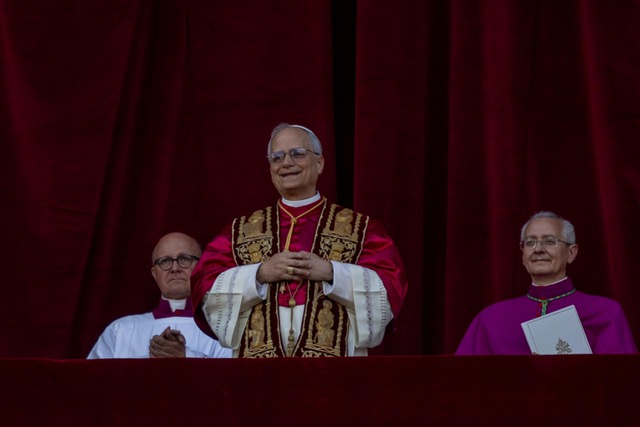
<p>Pope Leo XIV came out wearing the traditional garb for a new pope Thursday – a red mozzetta and a stole over a white rochet and his new white cassock – restoring a tradition that Pope Francis dispensed with in 2013.</p>
<p>While many think of the pope wearing all white, that’s not typically how a newly elected pontiff presents himself on the balcony overlooking St. Peter’s Square.</p>
<p>In fact, for that unrepeatable moment, most new popes wear mostly red.</p>
<p>They wear the white cassock reserved for the Roman pontiff. But over the white cassock they also typically wear a white rochet (which is similar to a surplice) and over that a red mozzetta – a short cape with a hood that is also known as a choir robe, said Father James Garneau, a Church historian and a priest for the Diocese of Raleigh, North Carolina.</p>
<p>That red mozzetta dominates the front-view television camera angle, which focuses on the head and torso of the new pope.</p>
<p>Why do popes typically wear it?</p>
<p>It’s because the white cassock, while an essential part of the pope’s uniform, isn’t associated with a liturgical function.</p>
<p>“A cassock is simply a house garment. It’s not a liturgical garment, properly speaking,” Father Garneau told the Register by telephone.</p>
<p>What the new pope wears is, of course, up to him. But most follow a pattern.</p>
<p>Videos from first appearances of new popes during the 20th century show them wearing the red mozzetta, as Pope John Paul I and Pope John Paul II did in 1978, for instance.</p>
<p>Pope Benedict XVI in 2005 had a twist. He wore a black cassock underneath the white cassock and white rochet and red mozzetta, giving him a red-and-white-and-black look when he raised his arms — apparently because he forgot to take off the black cassock he had worn into the conclave.</p>
<p>“I don’t think he was trying to bump the papal tradition. He was the exact opposite,” Father Garneau said.</p>
<p>But Pope Francis in 2013 made immediate wardrobe choices that diverged from his predecessors. Even before he said a word to the crowd in St. Peter’s Square, he was perceived to be sending a message by what he was wearing: a white cassock, with nothing over it.</p>
<p>“He was not wearing the traditional complete choir dress. Perhaps as a Jesuit he would rarely have been in choir dress,” Father Garneau said.</p>
<p>The unadorned white cassock helped set a media image that solidified when he spoke informally to the crowd in St. Peter’s Square, asked for the crowd’s blessing before he gave his own, and later decided to eschew the papal apartments to live in the Casa Santa Marta guesthouse.</p>
<p>Francis said he made his lodging choice to live among other people at the Vatican guesthouse and not be isolated in the Apostolic Palace. But that decision and others were widely reported as following a simpler and humbler papacy — an image the plain white cassock helped establish immediately.</p>
<p>“He didn’t seem to mind that reporting,” Father Garneau said.</p>
<p>At the other end of the clothing spectrum is the regal robes popes once wore.</p>
<p>Starting perhaps in the ninth century and through 1963, popes were crowned sometime after being elected, a symbol in part of their temporal authority, which still exists today in tiny Vatican City State but once included much of central Italy (the so-called “Papal States”). Crowning a new pope ended in August 1978, when Pope John Paul I decided to have an inauguration instead of a coronation, something his three successors opted for, as well.</p>
<p>During the more than 1,000 years when popes were crowned, however, what they wore was highly regimented.</p>
<p>“There used to be, for sure, detailed protocols about what the new pope should wear and especially complicated ones about the clothing for the papal coronation,” said Toby Osborne, professor of history at Durham University in England.</p>
<p>In contrast, Pope Francis’ coming out onto the balcony in a simple white cassock in March 2013 sent a message.</p>
<p>“In Francis’ case, it seems a clear point was being made about humility,” Osborne told the Register by email. “So yes, changes from protocols and norms can indeed send out powerful signals.”</p>
</p></div>
<p><br />
<br /><a href="https://www.ncregister.com/news/what-did-pope-leo-xiv-wear-traditional-red-mozzetta">Source link </a></p>
<p><!-- END THEIA POST SLIDER --></p>

Pope Leo XIV Dons Traditional Red Mozzetta, Echoing Past Pontiffs| National Catholic Register