


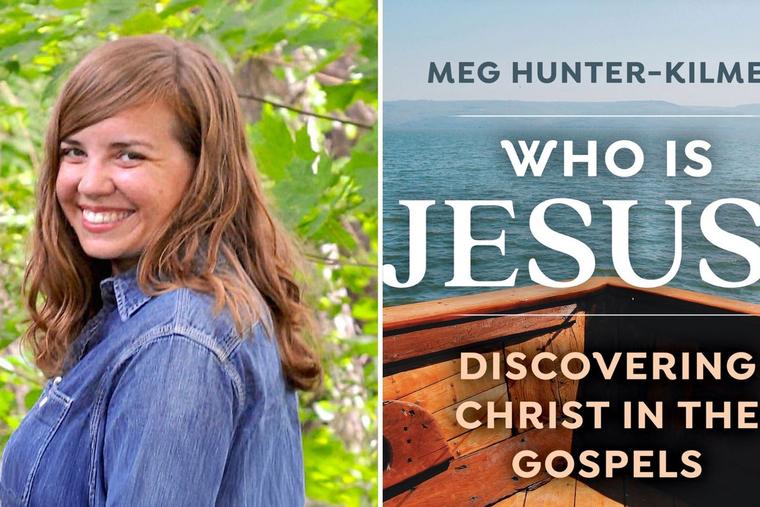
Veteran speaker and Notre Dame campus minister writes ‘Who Is Jesus?’ 12-week primer.
If you found yourself diving into Scripture with renewed zeal this Lent and are now inspired to organize a Bible study group in Eastertide, Catholic evangelist and speaker Meg Hunter-Kilmer has written the perfect book for you.
Her new release, Who Is Jesus?: Discovering Christ in the Gospels: A 12-Week Catholic Bible Study, published by Ave Maria Press — which follows Christ from his birth to his passion and resurrection — is aimed at both the first-time reader of the Bible as well has those who have read through the Bible more than once.
Hunter-Kilmer is a popular retreat leader, speaker and campus minister at the University of Notre Dame, where she earned her bachelor’s and master’s degrees in theology. She has also traveled around the country to share the Gospel while living out of her car, as a self-titled “Hobo for Christ.” Hunter-Kilmer is the author of five books, including Pray for Us: 75 Saints Who Sinned, Suffered, and Struggled on Their Way to Holiness; Saints Around the World; and Eyes Fixed on Jesus: A Journey Into the Gospels: Volume One.
Her new Bible study makes it easy to dive right in, with a weekly reading plan, helpful notes providing historical and biblical context, suggested questions and prompts for reflection.
The Register interviewed Kilmer by email March 31 about her new book and her thoughts on why it’s important to read sacred Scripture.
What inspired you to create a Bible study focused on encountering Jesus through the Gospels?
In my work as coordinator of small groups at the University of Notre Dame, I’m always looking for ways to invite our students into a deeper relationship with Jesus, especially through engaging with Scripture. I’ve found over the years that even as American Catholicism has started to emphasize reading the Bible more, many Catholics are much more comfortable reading a book about the Bible or listening to a podcast about the Bible. I wanted something to give my students that would require them to open their actual Bibles and wrestle with the text, so I created this study as a first step. Most of the texts featured here will be familiar to people who go to Mass with any regularity, so they’re able to start with something that doesn’t seem impenetrable. Still, the word of God is limitlessly fruitful, so even the stories they think they know so well will offer an invitation to learn more about who God is.
Is this book something readers who don’t have much experience reading the Bible can use? Do you have any tips so they don’t get discouraged?
My hope in creating this resource was to offer something that could be a first Bible study for those who don’t know where to start but that would also be helpful for those who may have studied Scripture for years. This book highlights foundational texts that you need to read in order to get the outline of the story of Jesus, but in many ways, those who are new to Scripture study are at an advantage, even in a group with mixed levels of experience. Often, we become hemmed in to a particular way of reading a familiar text and don’t easily see things we may have missed in the past; those who are reading with fresh eyes have so much to offer the veterans because the things that stand out to you might be exactly what we need to hear but won’t notice ourselves. If you’re in a group and feeling self-conscious, please know: Many of the questions you worry about asking are questions we should all be asking but have forgotten to!
And for those who have been in Bible study groups before, what can they expect to find in this book?
Like any good Bible study, this book is sending you back to the word of God. The point here isn’t earth-shattering revelations from a commentator, but intimacy for the reader, a return to the stories that speak to us of the unceasing love of God and his gift of his life for us. As an individual study, it’s a great fit for beginners through intermediate students of Scripture; I think that even experts will appreciate it in a group setting, as your companions’ insights will help you to see the texts with fresh eyes.
How can reflecting on Scripture lead to a personal encounter with Jesus, and how important is it to continually read the Bible to progress in one’s spiritual life?
Other than the sacraments, there’s nothing in my life that’s been more significant than the decision to read the Bible daily. Even now (on my 25th time through), I’m learning more and more — not just about the text, but about the way God loves me and refuses to give up on me. For many people, Scripture can seem dull or impenetrable, which is one reason why reading in a group (or at least guided by a text) can be so helpful. But even when you feel like you’re not getting anything out of it, the word of God is living and effective (Hebrews 4:12), and you can trust that the more time you give to God by reading Scripture, the more fruit that time will bear (even if it may be a ways down the road).
What is one thing that you hope readers take away from this 12-week Bible study?
Primarily, my hope is that people will feel more confident in the love of God and his desire for a relationship with them. More concretely, I hope that readers will feel more comfortable opening their Bibles and seeking God there. Having finished this study, I hope that they’ll feel empowered to keep studying Scripture, whether with or without Bible study aids.
In your travels and work with students, have you noticed a shift in attitudes among young people towards the Catholic faith in recent years? What does the Church need to do to welcome and sustain these converts?
It’s beautiful to see how many people feel drawn to the Church, especially young people. For many, this may be prompted by an experience of suffering or loneliness that leads them to look for community. It’s absolutely essential that the Church community — while being loving and welcoming — not point to itself as the ultimate end, but to Jesus. We need to help recent converts and reverts come to a lived relationship with Jesus by helping them to build a personal prayer life — not merely a system of devotions or pious practices, but a constant call to invite the Lord into the dark places of our hearts and let him love us. Helping people learn how to pray in silence, encounter God in Scripture, and meet him in the poor and the marginalized will strengthen them to follow him even when the Christian community may disappoint them or their suffering may make it difficult to believe in God’s goodness.