<p><!-- BEGIN THEIA POST SLIDER --></p>
<p> <br />
</p>
<div>
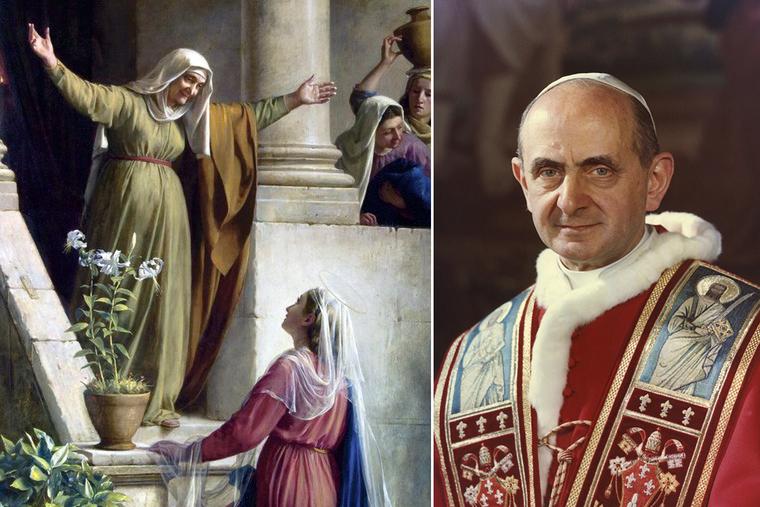
<p>On Gaudete Sunday, we have another reason to rejoice this year: 2025 marks the 50th anniversary of St. Paul VI’s apostolic exhortation on Christian joy, <a href="https://www.vatican.va/content/paul-vi/en/apost_exhortations/documents/hf_p-vi_exh_19750509_gaudete-in-domino.html"><i>Gaudete in Domino</i></a><i> </i>(“Rejoice in the Lord always”) from Philippians 4:4, the same expression from which the Third Sunday of Advent gets its nickname. </p>
<p>While we sing of joy throughout the Advent season — “Rejoice! Rejoice! Emmanuel shall come to thee, O Israel!” — this Sunday’s Mass begins with a special imperative taken from St. Paul’s charge to the first Christians in Philippi: <i>Gaudete semper in Domino. Iterum dico: Gaudete!</i> (“Rejoice in the Lord always. Again I say: Rejoice!”). The fundamental reason for our special joy is because, as St. Paul mentions in the next verse, “the Lord is near” (Philippians 4:5). Gaudete Sunday invites us to taste already the joy that comes from knowing our Savior is coming for us out of love. </p>
<p>That Savior who was born amid the angels’ singing “good news of great joy that will be for all the people” said that he had come so that “my joy may be in you and your joy might be complete” (Luke 2:10; John 15:11). In his 1975 exhortation, St. Paul VI focuses on Jesus’ joy and joys, so that we might recognize the true natural and supernatural sources of our joy, and have Jesus’ contagious joy brought in us to perfection. </p>
<p>Pope Paul VI’s exhortation is the most beautiful expression of Christian joy in the history of the magisterium. Reading — or re-reading — it for Gaudete Sunday will certainly nourish the type of joy we’re commanded to show not only on this special day in Advent but always. Since I first discovered it as a baby priest during its 25th anniversary, I have read it often, preached on it more often, and encouraged many others to read it, too. </p>
<p>On this Sunday of joy, we can profit anew, or perhaps for the very first time, from the wisdom of this document that seeks to teach us how to rejoice in a world often marked by sadness, anxiety, anger, tribulations and even despair. </p>
<p>St. Paul VI begins not with heaven, but earth. He insists that before we can appreciate the supernatural joys of the Kingdom, we must relearn how to savor the natural joys God places in our path. That’s what the Pope underlines Jesus himself did.</p>
<p>Christ did not float above ordinary human experience. He marveled at the lilies of the field, the birds of the air, wedding feasts, the delight of finding what was lost, children returning home and women who have embraced their newborn children. He relished friendship, shared meals, the wonder and simplicity of children, and the generosity of the poor. These real, embodied joys became the raw material for his parables and preaching, as signs and starting points of heavenly joys.</p>
<p>“Christian joy,” writes Paul VI, “presupposes a person capable of natural joy.” To rejoice in God, we must first recognize the Creator’s fingerprints in the simple gifts around us: the beauty of nature, the satisfaction of work well done, the warmth of family and community, the peace of a quiet moment, the affection we give and receive.</p>
<p>On Gaudete Sunday, the Church invites us to pause and notice these joys anew, not as distractions from holiness, but as its seeds. Every genuine human joy is an invitation to see God’s goodness and to recognize how he has made and declared the world good, and our fellow human beings very good. </p>
<p>The liturgy of Gaudete Sunday and the message of <i>Gaudete in Domino</i>, nevertheless,<i> </i>call us higher. Natural joys prepare us for the deeper joy Jesus came to give, what Paul VI calls the “unfathomable joy” dwelling within Christ himself born of his perfect loving communion with the Father.</p>
<p>Supernatural joy is not a mood, escape, or fleeting feeling. It is participation in the very life of God. Through Jesus’ incarnation, passion, death and resurrection, entered into by baptism and intensified in the sacraments, prayer and the Christian life, we are made sharers in this divine joy. This is the joy of those who know they are loved and forgiven by God, who live in grace, who walk in the light even when darkness seems to surround them. This demanding Christian joy has roots in the form of the Cross and fruits flowing from Jesus’ drawing good even out of suffering, persecution and death. </p>
<p>Paul VI reminds us that Christian joy unfolds along a steep royal way of the Cross, the path of the corporal and spiritual works of mercy, and the road of the Beatitudes. The world says joy comes from abundance, praise and ease; Jesus reveals that it flows from poverty of spirit, meekness, mercy, purity, and perseverance in suffering. </p>
<p>This is the joy of John the Baptist, who could step aside when the Bridegroom arrived and say with serenity, “This joy of mine is now complete” (John 3:29). It is the joy that sustained Mary in her Magnificat as she proclaimed God’s greatness even though her heart would be pierced (Luke 1:47, 2:35). It is the joy Isaiah foretold when he exulted, “In my God is the joy of my soul” (Isaiah 61:10). It is the joy that the apostles experienced the night of the resurrection. </p>
<p>“In a mysterious way,” St. Paul VI writes, “Christ Himself accepts death at the hands of the wicked and death on the cross, … but the Father has not allowed death to keep Him in its power. … This is why the disciples were confirmed in an ineradicable joy when they saw the Lord on Easter evening.” </p>
<p>And so Paul VI draws a conclusion:</p>
<blockquote><p>The joy of the kingdom brought to realization can only spring from the simultaneous celebration of the death and resurrection of the Lord. … Neither trials nor sufferings have been eliminated from this world, but they take on a new meaning in the certainty of sharing in the redemption wrought by the Lord and of sharing in His glory. … Here below this joy will always include to a certain extent the painful trial of a woman in labor and a certain apparent abandonment, like that of the orphan… but the disciples’ sadness … will be promptly changed into a spiritual joy that no one will be able to take away from them.</p></blockquote>
<p>This is the joy Christ desires to place within us, which the world can’t give or rob. “In essence,” states Paul VI, “Christian joy is the spiritual sharing in the unfathomable joy, both divine and human, which is in the heart of Jesus Christ glorified.” </p>
<p>The Pope recognized two great threats to Christian joy that are still with us five decades later.</p>
<p>The first is the illusion that joy can be obtained through pleasure, comfort, or material accumulation. Our technological world offers endless distractions and momentary pleasures yet is incapable of generating genuine and lasting joy. Pleasure always has an expiration date. Joy endures. </p>
<p>The second threat is the rise of secularism, which is a practical atheism, living as if God does not exist. When we sever the bond between ourselves and God, we lose the very foundation of joy. Meaning collapses, hope dims, and life becomes flat and directionless.</p>
<p>Gaudete Sunday stands as the antidote to both threats. The Church reminds us that joy is not found in what we control or consume, but in the One who comes to meet us. Every Advent sharpens this awareness as we prepare for Emmanuel, God who is with us, comes to save us, and desires to fill our hearts with his own inextinguishable gladness.</p>
<p>As we celebrate Gaudete Sunday and the semicentenary of St. Paul VI’s exhortation, we are invited anew to grasp that Christian joy is both a gift and a calling. It’s an opportunity to savor the natural joys Jesus shared and to receive the supernatural joy he was born, died and rose to give us. It’s also a summons, a fruit of the Holy Spirit, that Christians have the duty to proclaim to the world.</p>
</p></div>
<p><br />
<br /><a href="https://www.ncregister.com/commentaries/landry-gaudete-sunday-rejoice-in-the-lord-always">Source link </a></p>
<p><!-- END THEIA POST SLIDER --></p>

Rejoice in the Lord Always| National Catholic Register