


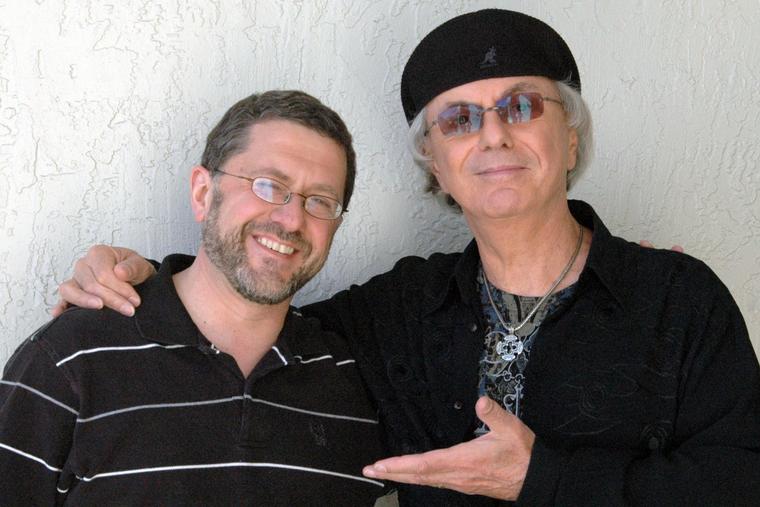
The year was 2005. Mike Aquilina, already a renowned Catholic writer and authority on Church history, was on a St. Paul Center summer pilgrimage to Rome. This was not Aquilina’s first pilgrimage, either as a participant or lecturer. But it would prove to be perhaps his most memorable.
Joining Aquilina as a presenter was Dion DiMucci, better known in America and around the world simply as Dion. An iconic singer and performer who began his career in the 1950s during the height of the doo-wop era, Dion’s memorable hits include his signature song, The Wanderer, as well as I Wonder Why, A Teenager in Love, Runaround Sue and his 1968 classic, Abraham, Martin and John. Dion’s music was by then in its sixth decade and still going strong across multiple genres.
But it wasn’t just Dion’s music career that brought him to Rome that trip; rather, it was his commitment to his Catholic faith — as well as an invitation from Scott Hahn, another well-known and well-respected Catholic author, lecturer and leader.
“Dion and I both spoke to the pilgrim group,” recalled Aquilina who, then age 41, had already written nine books, mostly on the Fathers of the Church. “Dion gave his testimony and it was even a little bit of a concert. He would tell his story and intersperse songs.”
The Wanderer Meets the Thunderer
As Dion remembers, he met Aquilina during that Rome trip while standing under a statue of St. Jerome.
“All I knew about St. Jerome is that in my church growing up was a plaque in the back that said, ‘Ignorance of Scripture is ignorance of Christ,’” Dion said. “So I look at this guy, Mike Aquilina, he’s sitting right there. I didn’t know him yet, but I said to him, ‘Ignorance of Scripture is ignorance of Christ: St. Jerome.’”
Aquilina, perhaps trying to preserve his energy during what he recalled as a “beastly, hot and humid summer” in the Eternal City, responded with two words. “The Thunderer.”
Dion’s reaction was one of surprise: “The Thunderer? What’s the Thunderer?” he asked Aquilina. “I knew the Wanderer, but I didn’t know the Thunderer.”
Aquilina offered a quick overview of St. Jerome: How he was an ordinary guy who didn’t get along well with others, often cursing at them and showing no tolerance.
“So how did he become a saint?” Dion asked. “I thought you had to be humble to be a saint. And Mike said, ‘It takes all kinds to make a heaven.”
Aquilina explained that St. Jerome was a bright student living during the fourth century who moved to Rome from what is now Croatia. Pope Damasus I named St. Jerome his personal secretary and directed him to translate the Bible from Greek to Latin. But he also got on everyone’s nerves, so he later left Rome for Israel, learned Hebrew and translated the Bible from that language as well.
“I told Mike this guy (St. Jerome) deserves a song,” Dion said. “I got the guitar out and we started fooling around. I googled St. Jerome and found Phyllis McGinley’s poem, where she calls him ‘God’s Angry Man.’”
The Thunderer would be the first song Aquilina and Dion wrote together. It was, to paraphrase a line from Casablanca, the beginning of a beautiful friendship.
Different Paths, Same Destination
To some, it might seem an unlikely pairing.
Aquilina, now 61, grew up in Pittston, a small town in northeast Pennsylvania in the heart of anthracite coal country where, he said, “Everyone there was Catholic and all ethnic groups worked in the mines.”
Bespeckled and bearded, with a scholarly look right out of central casting (one can almost picture the elbow patches on his tweed jacket), Aquilina graduated from Penn State University, where he studied writing with a poetry emphasis. He worked in the technology field as well as publishing and advertising for 10 years before joining the Diocese of Pittsburgh in 1993 as editor of the Pittsburgh Catholic newspaper. At the same time, he also wrote for other Catholic media, including First Things and Our Sunday Visitor. It was through his connection with the latter publication and its president, the late Bob Lockwood, that Aquilina was asked to write his book The Fathers of the Church.
“It was a book that Bob wanted, but he didn’t think it would sell,” Aquilina recalled. “But he said it had to be written. It became a bestseller for them. Every book I’ve written since then has been a follow-up to that.”
Dion DiMucci, 86, grew up in the rough Belmont section of the Bronx, a borough of New York City.
While learning to survive the mean streets of his neighborhood, Dion said he was touched by the music coming from his radio, which would be, in his words, his “first taste of transcendence and a hint of salvation.”
“I cut my teeth on Hank Williams, Jimmy Reeves and Carl Perkins,” he said. “When I was very young and first heard Hank Williams on the radio, it threw me into another world. I’ve never been the same.”
He formed the legendary group Dion and the Belmonts, whose claim to fame would be Dion’s voice — that incomparable voice — and how they helped elevate doo-wop, a subgenre of rhythm and blues often featuring a wide range of vocal parts, into a musical phenomenon.
Often sporting a beret, with a guitar slung over his shoulder and a New York City swagger, Dion played to full houses over the years with such legends as Buddy Holly, Ritchie Valens, JP “The Big Bopper” Richardson, Chubby Checker, Bruce Springsteen, Van Morrison, Paul Simon and Carole King.
One of two Americans (the other being Bob Dylan) featured on the cover of the Beatles’ Sgt. Pepper’s Lonely Hearts Club Band album, Dion eventually expanded beyond doo-wop to branch out to other genres, including classic rock and roll, gospel, folk and the blues. He produced more than 40 albums and sold 28 million records worldwide. He received numerous Grammy nominations and was inducted into the Rock and Roll Hall of Fame in 1989 by Lou Reed.
At first glance, Dion and Aquilina might appear to be an unlikely pair to collaborate on music. It’s not that Aquilina was bereft of interest in music or even some experience as a performer or songwriter. He grew up listening to rock and roll as well as blues. In grade school and high school, he and his friends formed garage bands and played local gigs, including one at the zoo, where Aquilina recalled the llamas spitting on them as they played.
“We wrote some songs about teachers we didn’t like,” he said. “But I can’t say I had anything aspirational about being a songwriter. I studied writing at Penn State with an emphasis on poetry.”
Yet it wasn’t music that resonated first between the two men.
“The first night in Rome, I had dinner with Dion and we connected on a lot of things,” said Aquilina. “We’re both Italian-American and we both grew up eating the same foods in similar ethnic neighborhoods. We’re also both avid readers.”
Coming Home
Perhaps, ultimately, the most important similarity they shared was their sleep habits.
“We stayed in touch after we returned home,” Aquilina said. “Back then, I was an early riser, getting up before my kids to start writing. Dion was also an early riser who would take morning walks. That’s when he did his thinking, so he’d call me and we’d talk a lot, maybe several times a week. We got to know each other very well.
Dion agreed that the familiarity and respect — both personal and professional — grew as the phone conversations continued.
“Mike’s a friend I run by a lot of theological questions because he’s very knowledgeable on Scripture, the teachings of the Church and theology,” Dion said. “He’s also a very unassuming guy. He’s kind of in a way like an outside reference to my life, a mentor.”
While Dion and Aquilina are strong in their faith, they both took a circuitous route to get where they are today.
Aquilina, who is quick to acknowledge that faith is a gift from God, also credits his parents for raising their children to be strong Catholics.
“Both of my parents were saints,” he said, while also admitting he didn’t practice his faith much during high school or college. He did read authors like C.S. Lewis and Thomas Merton and inherited a library of Catholic philosophy and theology from a friend at Penn State with whom he discussed the books through letters. Eventually, he started attending Mass again shortly after his marriage in 1985.
Dion’s return to his Catholic faith was, in a word, dramatic.
A self-admitted alcohol and drug addict during most of the 1960s, Dion said he would do heroin with Frankie Lymon, whose group, Frankie Lymon and the Teenagers, had several hits, including Why Do Fools Fall in Love?
Lymon died of an overdose at age 25 in February 1968.
“That scared me and made me start thinking, so I went home that night and said a prayer,” Dion said. “I got on my knees and said, ‘God, help me.’ I became aware of his power before I became aware of his reality..”
Dion began a 12-step recovery program and became clean and sober. He has remained so ever since.
“The obsession to drink and drug was taken out of me on April 1, 1968,” he said.
(The irony of that date, April Fool’s Day, is not lost on Dion. “I always looked at drugs and booze as the biggest foolers in my life,” he said.)
Yet something was still missing: a relationship with God.
“I believed in God but I didn’t know the Lord, Jesus Christ, from a hole in the wall,” he said. “There were neighbors witnessing to me, telling me about Jesus. I was listening to everyone else, but I wanted to hear from the Person who created the universe and the stars.”
While jogging one day, Dion said simply, “Lord, it would be nice to be closer to you.” The answer came in dramatic fashion.
“I had this ‘white light’ experience,” he said. “It was very profound, brilliant, sudden. Just like that, Jesus appeared to me. I ran right into his arms, his body. I felt his forgiveness, his grace and his mercy. The world turned technicolor.
“I felt at home. And I’ve never been the same.”
Dion’s experience with Christ happened Dec. 14, 1979.
A Creative Collaboration is Born
His relationship with Aquilina took a big step around 2008, when Dion was approached about writing a memoir. He agreed, with one condition: that Aquilina work with him on it. Dion: The Wanderer Talks Truth was published in 2011. (It is the second of three Dion memoirs. The third, Dion, the Rock n’ Roll Philosopher, written with Adam Jablin, was published in 2025.)
From that first collaboration, a partnership was formed, built on shared faith, talent, creativity, respect and, most critically, a genuine and growing friendship.
Once the book was published, Aquilina would get phone calls or tape-recorded messages from Dion with ideas for songs, often just a single word or phrase. The first such message, for example, was, “I read it in The Rolling Stone, I read it in The Rolling Stone. I want to sing that line in a song and you’re going to write that song.”
“I saw what he was doing,” Aquilina said. “Kind of Italian machismo. He was daring me to write a song. So I wrote it that night and probably faxed it to him. The next morning, he says, ‘I love this. I love this. I’m gonna record it.’”
If it was a test, Aquilina passed. The writing partnership was off and running.
Since then, Aquilina has collaborated with Dion on both singles and albums across different genres. To date, the duo has written about 100 songs, with 67 registered with ASCAP, most of them appearing on six albums. Aquilina also noted they have been nominated for a Blues Music Award, the most prestigious honor in the genre. (It should be noted that during this frenzy of activity, the prolific Aquilina also pushed his number of published books to over 70.)
For Aquilina, providing Dion with lyrics has been at times surreal.
“You can’t underestimate what Dion meant to Italian-Americans in the ‘50s and ‘60s,” Aquilina said. “We felt we were treated like outsiders for the first 50 years. People considered us a criminal element in society.
“Then along came people like Frank Sinatra, Joe DiMaggio, Frankie Valli, Frankie Avalon, Fabian and Dion. All of these made us feel proud to be Italian-American.”
On a more personal level, Aquilina said hearing his songs being sung with Dion and others felt almost unreal.
“The album we wrote, Blues with Friends, featured a lot of my heroes from when I was a kid,” he said. “It made my head explode to hear people like Jeff Beck, who I listened to all the time, and Paul Simon, singing New York Is My Home. It was just amazing.”
To describe the association between Dion and Aquilina as a collaboration is to understate their relationship. Rather, it is a deep connection forged by respect and admiration for each other. Their friendship works on many levels, including the creative process, personal values and shared faith.
“Mike is a great guy,” Dion said. “He’s like Clark Kent. He opens up his shirt and he’s like Superman. He’s a great lyricist and poet. There’s no end to his creativity.
“It’s amazing. Through voicemail and through phone calls or FaceTime, I grab the guitar and it’s like he’s there with me. Like a quarterback and receiver, we just connect.”
From Aquilina’s perspective, writing with Dion is like an ongoing master class.
“He (Dion) is constantly drawing from conversations he has had, and work he has done, with giants from Roy Orbison to Frank Zappa,” Aquilina said. “I hardly realize he’s teaching me because he’s dazzling and entertaining me at the same time.
“I don’t think of myself as a songwriter. I think of the songwriting I’ve done as an expression of my friendship with Dion. What it comes down to is that I’m having a blast.”
More Than Just Music
Dion and Aquilina’s friendship extends far beyond creating music. Both devoted family men, each speaks of the other with admiration and affection. Aquilina points to the trove of advice Dion has shared with him over the years, everything from relationships and parenting to professional decisions.
“He’s got a lot of wisdom and he’s been through some wars that I haven’t had to fight,” Aquilina said. “He’s like a brother. We’re also interested in the same things, like questions of philosophy, theology and, of course, music.”
Aquilina said he and Dion talk frequently, often several times a week, and the conversations sometimes go in unexpected directions. He recounted a phone call he once received in the middle of the afternoon. It was Dion, on a bus headed for a performance in Lancaster, Pennsylvania, with a question.
“He wanted me to explain mimetic desire to him,” Aquilina said. “So here’s Dion, engaging with the thoughts of French philosopher René Girard, as he moves from New York to Lancaster to do a show. That’s Dion. He had a discussion about Girard and he wanted to understand it better. He’s so hungry for knowledge and understanding.”
Two men travel all the way from America for a retreat during a hot summer in Rome. One a famous singer whose music spans genres and has reached multiple generations. The other, a writer whose books, articles and lectures have inspired innumerable individuals to rekindle their Catholic faith. A chance meeting under a statue of St. Jerome and a lifelong friendship is born.
“Our friendship is built on trust and faith, goodwill and brotherhood,” Dion said. “But it’s built on Christ. That’s the center of both our lives: Christ.”
And somewhere the Thunderer roars his approval.
Ron Cichowicz writes from Pittsburgh.