


Leading theologians and cardinals examine Marian doctrine, devotion and history nearly a year after the Vatican controversially called the title inopportune in official usage.
Two cardinals, leading theologians and other scholars defended the title of “Co-Redemptrix” for the Blessed Virgin Mary at an international conference in Rome, stressing her unique cooperation in the redemption of mankind while also underscoring that her task is subordinate to Christ’s salvific role.
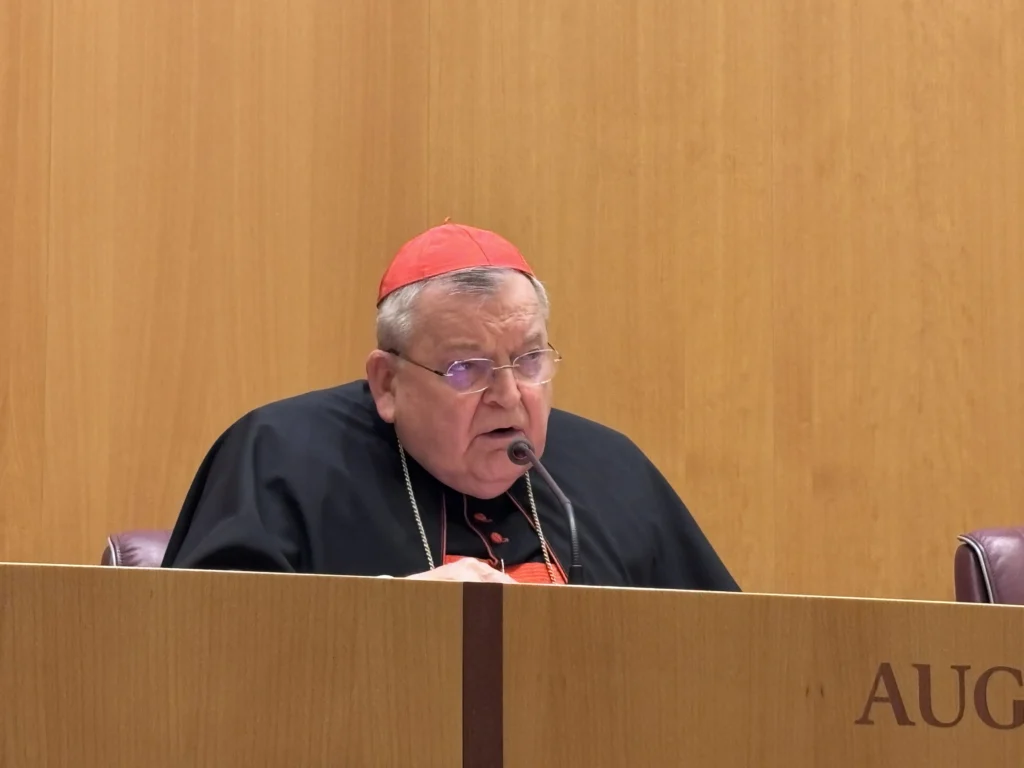
Cardinal Raymond Burke and Cardinal Gerhard Müller affirmed the Marian title during the Oct. 7-8 conference entitled De Maria numquam satis (“Of Mary one can never say enough”). The gathering brought together more than 400 scholars, religious and laypeople from all over the world to discuss major dogmatic issues underpinning the veneration of the Mother of God and Mary’s role in worship, devotion and history.


The cardinals’ defense of the Marian title of devotion came almost a year after the Vatican published Mater Populi Fidelis. The 23-page doctrinal note was widely criticized for saying that the title “Co-Redemptrix” for the Blessed Virgin Mary is “always inappropriate” (or “inopportune”) in official Church language and the liturgy, as it “risks obscuring Christ’s unique salvific mediation and can therefore create confusion.”
In his talk that opened the conference, which was held at the Patristic Institute Augustinianum in Rome, Cardinal Burke said the title, when properly understood, does not place Mary on Christ’s level. Christ alone is Redeemer, he said, while Mary’s role is wholly dependent on and subordinate to him. Drawing on Scripture, the Church Fathers, Lumen Gentium, St. John Paul II and Mariologists, he underlined Mary’s singular participation in the accomplishment of redemption.
He maintained that Vatican II affirmed the substance of this teaching, even though it avoided the term “Co-Redemptrix” because of possible misunderstanding. Cardinal Burke added that the Guadalupe apparitions of 1531 are a vivid expression of this theology. Mary’s words to Juan Diego, he said, identify her as the Virgin Mother of the true God and reveal her maternal mission to bring Christ’s mercy, healing and salvation to all peoples.
He concluded that devotion to Our Lady of Guadalupe should strengthen fidelity to Christ, encourage consecration to Mary as a path to Him, and inspire the baptized to unite suffering, service and witness with Christ for the salvation of the world.
In his talk on Oct. 8, Cardinal Gerhard Müller described the title “Co-Redemptrix” for the Blessed Virgin Mary as a legitimate expression of Catholic faith and not a misleading exaggeration or a challenge to Christ’s unique place as sole Redeemer and Mediator.
The prefect emeritus of the Congregation for the Doctrine of the Faith said the title recognizes Mary’s singular, subordinate cooperation in salvation, willed “in the freedom wrought by grace.” Her cooperation, he said, was “constitutive” of the Incarnation and inseparably connected to Christ’s redemptive work. “Had she refused her ‘Fiat,’” he noted, “we would all have remained lost for ever.”
The German cardinal rejected the argument that the title should be abandoned to avoid Protestant objections, maintaining that such concerns reflect a theology that does not adequately recognize humanity’s free cooperation with grace.
He stressed that the title “Co-Redemptrix” must be understood analogically, saying that Christ alone redeems humanity in the primary and perfect sense, while Mary’s role is entirely dependent on and derived from his grace. He also argued that the title’s later emergence as a theological formulation does not undermine the truth it expresses, since the Church often gives precise language to realities it has long believed.
The two-day conference featured a range of talks by Catholic scholars delving into various aspects of Marian theology.
One of the featured speakers, Father Manfred Hauke, a professor of dogmatic theology at the Theological Faculty of Lugano, Switzerland, spoke on the “Divine Motherhood” of Mary and refuted 19th-century historical theories that reduced the dogma to a syncretism with the pagan cults of Artemis or Isis. He demonstrated the solid biblical and patristic foundation of the Theotokos, recalling that the Incarnation requires the active cooperation of the creature and that Mary expressed her consent at the Annunciation on behalf of the whole of human nature.
The papal theologian Dominican Father Wojciech Giertych gave a paper on “The Primacy of Virginal Love within Mary’s Maternal Love” in which he outlined a profound emotional and spiritual distinction between virginal love — characterized by awe, veneration and a total absence of possessiveness — and maternal love. The latter, if left unpurified, risks degenerating into selfish attachment, whereas in Mary the two dimensions merge perfectly, offering the Church the perfect model of spiritual fruitfulness that springs from grace and charity.

In his presentation, Church historian and professor Roberto de Mattei said the perspective of the theology of the history of Fatima revolves around two cornerstones: “Russia will spread her errors throughout the world” and “In the end, my Immaculate Heart will triumph.”
He explained that the triumph of the Immaculate Heart of Mary will show the maternal sovereignty of Mary who was immaculate from the very first moment. As Co-Redemptrix and universal Mediatrix of all graces, he said she prepares — through the conversion of mankind and the defeat of all errors — the recognition of her queenship and the kingship of Jesus Christ over the whole of humanity.
The reason for our hope, de Mattei concluded, “is the certainty that God is faithful to his promises, for, as St. Augustine always teaches, ‘He who has led us to hope will not deceive us; he will grant us the fulfillment of what we hope for.’ This hope does not rest on our own strength, but is placed in Her whom God has established Mother of divine hope and victor in all battles. She is the very source of our trust and the root of our theology of history.”
The conference ended with a roundtable discussion on the theme “Mary Today: Faith, Doctrine and Devotion in the Contemporary World,” featuring Dominican Father Lawrence Lew, Régis de Lassus, founder of Salve Corda, the International Alliance for the First Saturdays of Fatima; and Timothy Tindal Robertson, former national president of the World Apostolate of Fatima in England and Wales.
Closing remarks were given by Virginia Coda Nunziante, who recalled that the conference is but one stage on a journey that the organizers intend to continue “with our meager strength and with immense trust in the promise that lights our way: ‘In the end, my Immaculate Heart will triumph.’”
In an interview ahead of the gathering, Nunziante told the Register that the intention of the conference was not “to fuel controversy, but to restore theological clarity.”
The conference, which included adoration and a daily Rosary in the Basilica di San Giovanni Battista dei Fiorentini, received various messages of support from curial officials, including from Cardinal Víctor Fernández, prefect of the Dicastery for the Doctrine of the Faith who oversaw the writing of the doctrinal note Mater Populi Fidelis. He said he regretted not being able to attend the event, but conveyed his “warmest and most sincere best wishes” and joined the gathering in prayer.