<p><!-- BEGIN THEIA POST SLIDER --></p>
<p> <br />
</p>
<div>
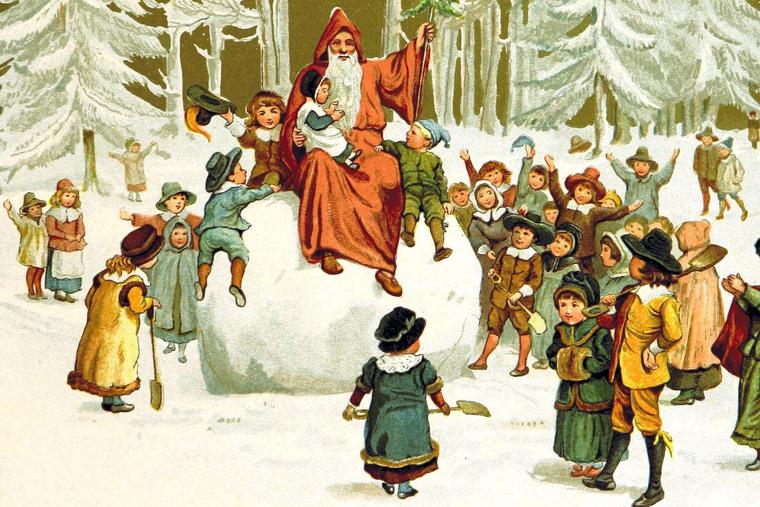
<p>What is Santa Claus if not just a small piece of heaven, for the wondrous period of childhood?</p>
</p></div>
<div>
<p>Since when have heartwarming fairy tales been considered “lies?” I think this business of anti-Santa Claus is a remarkably imagination-challenged mentality. Children can’t yet fully distinguish between fantasy and reality. Since many fantasies and stories and fairy tales are wonderfully instructive and cultivate the imagination, I don’t see how anyone can say they entail “lying.” They’re examples of fiction.</p>
<p>Young children are in a place where they are between fantasy and reality. Things like Santa Claus and the Easter Bunny are simply means to make them feel that some of the wonderful fantasies <i>actually come true</i>. If the parents control these things so that only good stories of benevolence and caring and love are allowed, then I see no problem with this whatsoever.</p>
<p>What is Santa Claus if not (in one sense) just a small piece of heaven, for the wondrous period of childhood? After all, in heaven many of our deepest longings come true and we are totally fulfilled; so what is wrong about bringing that “world” to a child in a more tangible way? I think to be against that is to have a mind that is “imaginatively stunted” (for lack of a better term). We don’t need to <i>stifle </i>imagination and fantasy; we need to <i>cultivate </i>a healthy Christian sense of them. This is what brought C.S. Lewis to Christianity. He loved fantasy and mythology; then he discovered (with a nudge from Tolkien) that <i>Christianity was the true myth</i>.</p>
<p>Now, with Santa Claus, of course it isn’t ultimately true in a factual, literal sense, but the truths conveyed are “true” in the sense that great mythology is “true.” It strikes a chord deep within the soul, of a world where such things can take place. Children are still capable of believing that it is possible. I see this as a little slice of heaven. Children are closer to heaven in a sense because they haven’t been in this world long enough to become jaded or to lose faith. In my opinion, to call this sort of thing a “lie” entirely misses the point. I think one either intuitively “gets it” or they do not, and discussion about it is fairly futile, in terms of persuading anyone.</p>
<p>It’s not a “lie” to encourage children’s imagination (though I think the “con” position makes some good points). It’s known that young children blur reality and fantasy to a great extent, anyway. For them, most of what they see is quite real. Therefore, it’s up to parents to choose to teach positive or negative things. Myths (even something like <i>Aesop’s Fables</i>) often teach the deepest truths about life and right and wrong, but they do it in a way that’s different from historical narrative: by using symbols and fictional characters. What lies behind all that is profound truth and wisdom.</p>
<p>The Bible itself does this to some extent. <i>Aspects</i> of the Adam and Eve story are likely allegorical. There may not have been an actual tree, or forbidden fruit, etc. It was illustrating the principles of obedience to God and its converse: rebellion. But they were real people, the first human beings, and they did indeed fall (original sin). This is what the story is showing, whether every last detail was “historical fact” or not. The Book of Revelation has symbols and allegories, which have made it historically difficult to interpret in many ways.</p>
<p>Our own practice as parents was sort of a “middle ground” (as so often). We “did” Santa Claus thing, but at the same time we taught our children about the <i>real </i>St. Nicholas, to ground it in historical fact.</p>
<p>I would note that Santa Claus (as we know him) was largely a Protestant phenomenon, because of the antipathy to veneration of the saints; his portrayal became secularized (for better or ill) to what we see today.</p>
<p>But in the Catholic and Orthodox traditions (and to a lesser extent, Anglican) there was no problem with venerating (honoring) real persons in history, including St. Nicholas. The Catholic Encyclopedia provides a helpful summary of what we know about <a href="https://www.newadvent.org/cathen/11063b.htm">St. Nicholas of Myra</a>, a bishop (d. Dec. 6, 345 or 352), and the evolving legend:</p>
<blockquote><p>The numerous miracles St. Nicholas is said to have wrought, both before and after his death, are outgrowths of a long tradition. &#8230; His cult in the Greek Church is old and especially popular in Russia. As early as the sixth century Emperor Justinian I built a church in his honour at Constantinople, and his name occurs in the liturgy ascribed to St. Chrysostom. In Italy his cult seems to have begun with the translation of his relics to Bari, but in Germany it began already under Otto II [d. 983]. &#8230; Bishop Reginald of Eichstaedt (d. 991) is known to have written a metric, &#8220;Vita S. Nicholai.&#8221; The course of centuries has not lessened his popularity. The following places honour him as patron: Greece, Russia, the Kingdom of Naples, Sicily, Lorraine, the Diocese of Liège; many cities in Italy, Germany, Austria, and Belgium; Campen in the Netherlands; Corfu in Greece; Freiburg in Switzerland; and Moscow in Russia. He is patron of mariners, merchants, bakers, travellers, children, etc. His representations in art are as various as his alleged miracles. In Germany, Switzerland, and the Netherlands, they have the custom of making him the secret purveyor of gifts to children on 6 December, the day on which the Church celebrates his feast; in the United States and some other countries St. Nicholas has become identified with Santa Claus who distributes gifts to children on Christmas eve. His relics are still preserved in the church of San Nicola in Bari; up to the present day an oily substance, known as Manna di S. Nicola, which is highly valued for its medicinal powers, is said to flow from them.</p></blockquote>
<p>My poem, <a href="https://www.ncregister.com/blog/darmstrong/st.-nicholas-speaks-loves-pure-light-shepherds-carol"><i>St. Nicholas Speaks</i></a>, was published in this venue on Dec. 13, 2018.</p>
</p></div>
<p><br />
<br /><a href="https://www.ncregister.com/blog/dave-armstrong-santa-and-st-nicholas">Source link </a></p>
<p><!-- END THEIA POST SLIDER --></p>

Santa Claus, St. Nicholas, Myths, Fairy Tales and ‘Lies’| National Catholic Register