


COMMENTARY: Far from arbitrary punishments, the plagues of Egypt are presented in Exodus as divine signs meant to call Pharaoh to repentance and reveal the danger of hardening one’s heart against God.
Reading: Exodus 7:14-10:29
As noted before, Pharaoh’s continued hardness of heart inaugurates a cycle of events often called “the ten plagues on Egypt.” Exodus does use the word “plague” but it also calls them “signs and wonders.” They are “plagues” on those who refuse God’s command, but they are “signs and wonders” that ought to move the hardened heart not to refuse.
The first plague occurs shortly after the decisive meeting between Moses, Aaron and Pharaoh discussed last week. God commands his prophets to appear before Pharaoh in the morning, when he goes to the Nile. Aaron is to touch the river with his staff, and the river will become “blood,” making it undrinkable and uninhabitable for marine creatures. But Pharaoh’s “magicians” perform a similar deed and Pharaoh remains obstinate — even though Aaron’s curse apparently is not removed quickly, forcing Egyptians to dig wells for drinkable water.
One should not forget the centrality of the river in that nation’s life: as the saying goes, “Egypt is the gift of the Nile.” In addition to a water source in a desert country, its annual flooding was essential to providing fertile topsoil for growth of food alongside the Nile. Without it, there is famine.
Subsequent plagues follow. Frogs invade the land. Pharaoh pleads for their removal which God, through Aaron and Moses, provides, but the divine relenting only allows Pharaoh to renege on his promise to let the Hebrews go to worship. Gnats, flies, livestock disease, boils, hail, locusts and darkness befall Egypt. And, with each plague, a similar cycle with local variants is played out: the plague descends; Pharaoh and his courtiers are frightened; they sometimes beg for relief, they sometimes bargain (you can worship God but here/your men only, not your women or children/leave your livestock behind). But, in the end, Pharaoh constantly “hardens his heart” and refuses to let the Hebrews go.
What are we to say of these plagues? Some people have sought natural explanations for at least some of them. Contamination of the Nile at its source or marine infestations could make it run red and render it undrinkable; stagnant water can attract frogs and other bugs; dying insects and amphibians can generate disease that spreads to other animals and people.
Seeking such “natural” explanations, however, is misdirected, even if they may be responsible for some of the plagues. The point is that these plagues are also “signs.” God uses them to prompt the Egyptians to let the Hebrews go and to punish them for not doing so. The theological point is that God used these events, not how he did them, whether purely supernaturally, largely naturally, or a combination of both. It is clear that the events and their proximate sequence are presented as God’s deliberate will to move Pharaoh, regardless of how God accomplished them.
It’s also clear that some of these events are less arguably “natural” occurrences. Sure, darkness can be an eclipse and hail a “freak” meteorological happening, but that they all occur in response to what these two men foretell as God’s will makes the “naturalistic” argument weak. And clearly the tenth, final, and ultimate plague — the death of the firstborn — is clearly a supernatural occurrence. (We will consider it separately.)
Likewise, neither should we imagine the biblical writers are not to be believed in their constant repetition of Pharaoh’s hardness of heart. A “sign” does not ensure that the one seeing it will react to it rightly. The perversity of human stubbornness can be amazing: there is such a thing as final obstinance (the “sin against the Holy Spirit”), i.e., resistance to God’s grace leading to final damnation. Obstinacy, especially in evil, is a human trait and anybody who also thought he was a god — like Pharaoh — no doubt had a double or triple dollop of it.
That is an important theological lesson of Exodus: the danger of “hardening one’s heart” (against which the Church prays every day in Psalm 95 in Morning Prayer). Resistance to God’s grace, even when it is increasingly manifest, is a human reality. If you’re surprised by Pharaoh, consider how Jesus’s signs elicit similar anti-reactions from the Pharisees. Indeed, the paradox of raising Lazarus from the dead is that it seals Jesus’ fate with them — he must die (John 11:45-54).
Finally, let’s also dispose of another possible objection: Who hardens Pharaoh’s heart? Reading through Exodus, we seem to find two answers. There are places that say Pharaoh hardened his heart (8:15, 32). There are places that say the Lord hardened Pharaoh’s heart (9:12; 10:20, 27). There is even a place that says his heart was hard, as God foretold, without attributing it to either side (9:35). So, which is it? Can Pharaoh be blamed for allegedly “divinely-induced” spiritual hardening of the arteries?
I’d answer from a Catholic theological perspective. God does not wish anyone to die spiritually. But whatever we do is a delicate minuet between divine grace and human freedom. To do good requires the prompting of God’s grace, which man can refuse. But when man constantly refuses God, he predisposes himself to resist God — and God has no obligation to overcome his resistance. In that sense, God “hardens” a man’s heart by leaving him to his own sinful wishes but he’s in those straits not because he wants to repent but can’t but because he didn’t want to. The fault is Pharaoh’s.
The plagues on Egypt have been depicted by many artists. A 13th-century French illustrated manuscript, for example, provides a composite collection of them all (save the death of the firstborn).
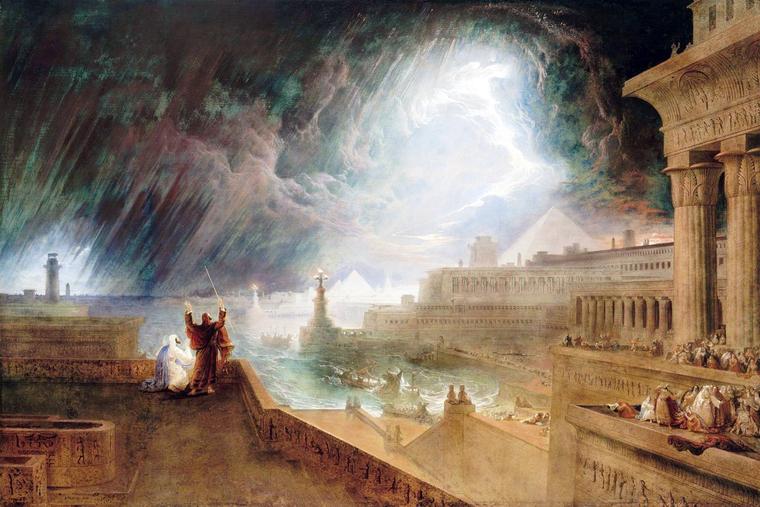
But our focus will be John Martin’s “Seventh Plague,” held by the Museum of Fine Arts in Boston. We’ve already met Martin through his depiction of the destruction of Sodom and Gomorrah. What can I say? If you want a grand depiction of an apocalyptic scene, this English Romanticist is your go-to man. Any wonder he was tapped to illustrate John Milton’s Paradise Lost?
And “Seventh Plague” is grand: it’s a huge oil painting, 5-1/2 by 7 feet. Dark and foreboding colors dominate the scene, e.g., the cloud formation. They provide stark contrast to the brightness of the storm whose pelting is apparent in the diagonal, right to left lines across the painting. The storm seems still at a distance, over the sea, but fast approaching the city. Moses and Aaron stand alone on the left, Moses (Exodus 9:22-23) stretching his staff to the sky. The Egyptians stand on the right, watching in horror what is approaching them. Exodus 9:24 describes the event as “the worst storm in all the land of Egypt since it had become a nation” (though not extending to the district of Goshen, “where the Israelites were”).
Some commentators claim that Martin knew of recent archaeological discoveries from Egypt (early 19th-century Europe was interested in Egypt, e.g., Napoleon) and incorporated them into his painting. It seems to me that the building complex appears more Greek than Egyptian. Incorporation of a Lighthouse of Alexandria lookalike (on the left in the clearing of the storm) reinforces the “Egyptian” feeling but is an anachronism: the real lighthouse would not be built far into the future (third century BC).